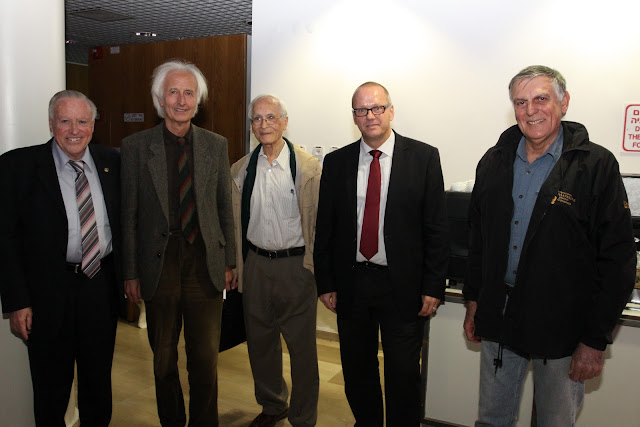
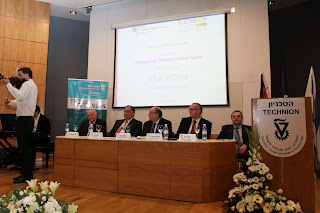
~Prof. Yitchak Apeloig (former Technion President)
~Technion President Prof. Peretz Lavie
Extracts from Prof. Apeloig’s Speech:
…It is a great honor for me to stand here today and to receive the Order of Merit of the Federal Republic of Germany. I am excited, proud and humbled to receive this honor in recognition of my activities to promote and advance the scientific cooperation between Israelis and Germans.
To be awarded the Order of Merit by the President of Germany has a multitude of meanings and involves complex emotions which I believe touch on the essence of this recognition and I want to share some of my thoughts and feelings with you.
Both Tzipi, my wife, and I come from families who are Holocaust survivors. I was born during the Second World War in Buchara, Uzbekistan in central Asia , at that time part of Soviet Russia, to where my parents fled from their homeland Poland. My grandparents who stayed in Poland and many members of mine and Tzipi’s families were murdered during the Holocaust. In 1947, after 2 years of difficult wondering through Europe during which my mother was twice hospitalized and was close to dying, we immigrated to Palestine which a year later became the State of Israel.
During my youth I grew up with harsh feelings towards Germany and Germans. The reparation agreement between Germany and Israel which was signed in 1952 was violently criticized in Israel, reflecting the strong emotions of many against any connection with Germany. The public atmosphere was such that it took another 7 years before the first visit of a small delegation of German scientists to Israel took place.
As you can imagine, this was not a promising beginning for my relations with Germans when I first visited Germany for a few months in 1974 as a postdoctoral fellow. Honestly, at that time I did not like the idea of spending several months in Germany, but was forced to do so as a result of my 7-month long reserve military service during the Yom Kippur war which prolonged my PhD beyond my original plan. When I was released from the army I found that my postdoctoral supervisor from Princeton University is already on a sabbatical leave in Munich and took his entire research group with him and I had no other choice but to join him.
And yet, with this difficult background, a tie between me and German scientists developed. It developed slowly, through scientific connections and through German chemists I met. These scientists showed me a different face of Germany. These scientists, mostly of my age group, showed a real desire to cope with the terrible events of the past, understood that there is no forgiveness to what happened, and were determined to do whatever is necessary to make sure that racism and anti-Semitism must be wiped from the face of the Earth. . The scientific and personal contacts with German scientists developed slowly but steadily. Over the years I visited German universities frequently, including for longer stays as a DAAD and Humboldt fellow and German colleagues visited me frequently at the Technion. With time the connections became stronger and many of these scientists became friends, some of them became close personal friends – friends for life. I am delighted that one of them, Prof. Helmut Schwarz from the Technische Universitat of Berlin, who played a major role in creating my strong scientific ties to Germany, is here with us this afternoon.
I strongly believe that science can serve as a bridge between cultures and nations, because science is truly international and multi-cultural. There is no German, American, Chinese, or “Jewish” science- an infamous term coined by the Nazi regime – there is only one type of science, science which searches for the scientific truth and tries to understand our universe. I therefore believe that science can mitigate conflicts and traumas between nations, even the devastating trauma of the Holocaust. Because I believed that it is important for Israel, politically, economically and scientifically, to begin the long and difficult process of building a new basis for German-Israeli relations, I used science, throughout my career, both as a scientist and as the President of the Technion, to help to create this bridge.
…Recently, one hears occasionally voices in Germany saying that maybe now, 66 years after the end of the Second World War, the relations between Germany and Israel have reached a stage where they are “normal” and they do not need any more special attention. I want to strongly reject this opinion. German-Israeli and German-Jewish relations are still fragile. They need attention, nurturing and support especially among the young people. These young people were fortunately born into a very different Germany and a different Europe than 70- 80 years ago and they must be taught the lessons of history and the responsibility which they carry to make sure that the dark times of the thirties and forties of the last century, never return!
Let me conclude with what Richard von Weizäcker, a former President of Germany, said: “It is not a case of coming to terms with the past. That is not possible. The past cannot be subsequently modified or made undone. However, anyone who closes his eyes to the past is blind to the present!” And, quoting on the same theme from the Jewish Talmud: “the secret of redemption lies in remembrance”.
http://www.technioniit.com/2011/12/israel-germany-transcript-of-technion.html

 PRESIDENT’S REPORT 2015