
 PRESIDENT’S REPORT 2015


Coming Soon: First Nanosatellite Cluster Flight
The SAMSON Project, led by the Technion’s Asher Space Research Institute, as presented to heads of the Israeli space industryThe Asher Space Research Institute held the PDR (preliminary design review) stage of their SAMSON satellite project last week. The meeting was attended by leading specialists in the field, including representatives of the Israeli Space Agency, Israel Aerospace Industries (MBT Space Division), ELTA Systems and RAFAEL.
Within several years, the first triple-nanosatellite cluster in the history of space will be launched as part of the SAMSON project. This will be the first autonomous cluster flight of three satellites. The term “autonomous” means that the satellites will function and communicate with each other and will be able to maintain a coordinated flight even without ground control. The project is headed by Prof. Pini Gurfil of the Distributed Space Systems Laboratory at the Asher Space Research Institute and the Faculty of Aerospace Engineering at the Technion.
The Samson project is generously supported by the Arlene and Arnold Goldstein Family Foundation from New York.
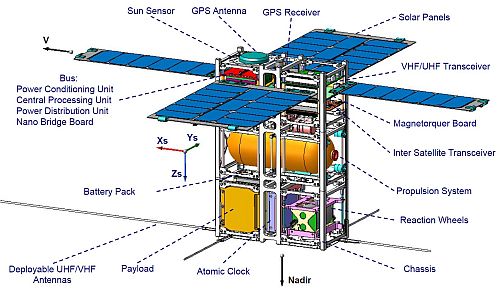
“Besides the challenges associated with the technology of cluster flight, the project also involves significant innovations on the individual satellite level as well. First, the satellites will be propelled by a propulsion system that is being developed specially for the project by RAFAEL and the Technion. In addition, each satellite will carry an atomic clock. We want the satellites to be light-weight, and so each of them will contain only 300 grams of fuel, a challenge that requires us to develop super-economical flight systems and trajectory management strategies. The project poses many challenges, including the large inter-satellite distance variation- excessive proximity might cause collision, whereas excessive distance might lead to loss of inter-satellite communication. It must be understood that these new aspects are breakthroughs in space engineering technology.”
The primary objective of the experiment is to prove the feasibility of an extended (one year at least) nanosatellite cluster flight. Another objective is to examine the possibility of determining the exact location of transmissions that originate on Earth by analyzing the information received simultaneously by the three satellites. One possible application of this technology is search and rescue missions.
The mechanical design of the satellites was done by Dr. Vladimir Balabanov of the Technion’s Asher Space Research Institute and it included the integration of all the mechanical subsystems of each satellite. The satellites will carry space computers with processors designed based on a development by Prof. Ran Ginosar of the Technion’s Faculty of Electrical Engineering. Ms. Margarita Shamis from the Asher Space Research Institute wrote a prototype of the satellites’ software under the guidance of Dr. Raz Tamir of Israel Aerospace Industries. Mr. Jacob Herscovitz of RAFAEL supervised the students’ project in the framework of which various analyses were conducted on behalf of the project, and he is also directing the development of the satellite’s propulsion system at RAFAEL. The design of the electronic systems and the communications systems was directed by Hovik Agalarian, Chief Electronics Systems Engineer from the Distributed Space System Laboratory, in collaboration with the Communications Laboratory at the Technion’s Faculty of Electrical Engineering.