
 PRESIDENT’S REPORT 2015


On June 14, 2011 during the Technion International Board of Governors meeting, guests were treated to an evening at the Haifa City Museum to view the exhibition, War of the Languages — The Founding of the Technion/Technikum. Among the guests present were important historical figures who played different roles in the founding of the Technion. Among them were Theodor Herzl, Ahad Ha’am, Kalonimus Wolf Wissotzky and Shmaryahu Levin.
All posts by admin
Mazor sells 2 robotic systems for $1.4m
The company sold 2 Renaissance systems to West Coast Spine & Ortho and the University of Mainz hospital.
2 October 11 16:44, Gali Weinreb
Mazor Robotics Ltd. (TASE:MZOR) has sold two of its new Renaissance robotic systems in the US and Germany at an average price of $700,000 each. California medical devices distributor West Coast Spine & Ortho Inc. bought one system, and the Clinical Center of the Johannes Gutenberg University of Mainz bought the other.
Mazor’s share price rose 21.9% today to NIS 3.53, giving a market cap of NIS 77 million.
The Renaissance enables highly accurate, state-of-the-art, robotic procedures on the spine, with less radiation, including for minimally invasive surgery, scoliosis, and other complex spinal deformities.
Mazor mentioned no sales of the Renaissance robotic system in its financial report for the second quarter, and total sales of the system disappointed investors, who had expected more on the basis of analysts’ forecasts. Mazor’s sales fell to NIS 1.9 million in the second quarter from NIS 4.2 million for the corresponding quarter of 2010, although first half 2011 sales rose to NIS 8.3 million from NIS 4.7 million in the first half of 2010.
Mazor CEO Ori Hadomi said, “We have not changed our full-year guidance. Our cash burn rate is also as planned.”
Mazor has NIS 20 million in cash. It is readying for a hearing with the US Food and Drug Administration (FDA) on registering its robotic systems for brain surgery. The company believes that the FDA will grant approval without the need to conduct new clinical trials for this indication, and that marketing of the systems will begin in 2012.
Published by Globes [online], Israel business news – www.globes-online.com – on October 2, 2011
A GTEP Year in Review ~ Shana Tova & Happy New Year
 A Happy New Year From the Nancy & Stephen Grand Technion Energy Program!
Dear Friends,
As we celebrate the entry of the New Year 5772, we are happy to update you on some exciting GTEP initiatives on the global horizon of scientific and technological research into energy solutions. Thanks to the generosity of the Grand family with their initial gift to establish GTEP as a focussed center of energy research, we have been able to expand with full power. As we enter the New Year, our activities are moving on many tracks thanks to the vision and support of a wonderful team of supporters. We are excited to have submitted the winning proposal to the Israel Science Foundation, through the framework of the Israeli Centers for Research Excellence (ICORE) . As proposal coordinator, GTEP will be coordinating top researchers to advance research into Solar fuels from Technion, the Weizmann Institute of Science and Ben-Gurion University of the Negev. The new center will include nine existing faculty members from each university and 3 new faculty members in each school (a total of 36 members).Also this year, GTEP has allied with the Russell Berrie Nanotechnology Institute (RBNI) to set up two new labs in the Zisapel Building, at the Technion Micro- and Nanofabrication Center. This new Solar to Electrical Energy Conversion Center aims to provide state-of-the-art equipment for fabricating solar (photovoltaic) cells and components, to measure their optical and electrical properties, and to test their performance in simulated solar radiation conditions. We have also began construction of facilities for the Battery Laboratory and Central X-ray Facility that are part of the Leona M. and Harry B. Helmsley Energy Storage Project led by Prof. Yair Ein-Eli of the Faculty of Materials Engineering. The renovation is expected to be complete by the beginning of 2012. The new Ed Satell Family Nitrogen-Hydrogen Alternative Fuels (NHAF) Reaction Research Laboratory was inaugurated and is operating with full power. The research team is pursuing safe, clean and practical alternatives to fossil fuels, based on nitrogen-hydrogen compounds. The New Year welcomes new faculty members, and students for advanced degrees in energy. These are the engaged, dynamic young minds of the next generation. They hold our global future in their hands. A very Happy New Year to you all! May it be one of renewed energy, progress and new discovery! Prof. Gideon Grader
Director of the Nancy and Stephen Grand Technion Energy Program.
|


A GTEP Year in Review ~ Shana Tova & Happy New Year
|
A Happy New Year From the Nancy & Stephen Grand Technion Energy Program!
Dear Friends,
As we celebrate the entry of the New Year 5772, we are happy to update you on some exciting GTEP initiatives on the global horizon of scientific and technological research into energy solutions. Thanks to the generosity of the Grand family with their initial gift to establish GTEP as a focussed center of energy research, we have been able to expand with full power. As we enter the New Year, our activities are moving on many tracks thanks to the vision and support of a wonderful team of supporters. We are excited to have submitted the winning proposal to the Israel Science Foundation, through the framework of the Israeli Centers for Research Excellence (ICORE) . As proposal coordinator, GTEP will be coordinating top researchers to advance research into Solar fuels from Technion, the Weizmann Institute of Science and Ben-Gurion University of the Negev. The new center will include nine existing faculty members from each university and 3 new faculty members in each school (a total of 36 members).Also this year, GTEP has allied with the Russell Berrie Nanotechnology Institute (RBNI) to set up two new labs in the Zisapel Building, at the Technion Micro- and Nanofabrication Center. This new Solar to Electrical Energy Conversion Center aims to provide state-of-the-art equipment for fabricating solar (photovoltaic) cells and components, to measure their optical and electrical properties, and to test their performance in simulated solar radiation conditions. We have also began construction of facilities for the Battery Laboratory and Central X-ray Facility that are part of the Leona M. and Harry B. Helmsley Energy Storage Project led by Prof. Yair Ein-Eli of the Faculty of Materials Engineering. The renovation is expected to be complete by the beginning of 2012. The new Ed Satell Family Nitrogen-Hydrogen Alternative Fuels (NHAF) Reaction Research Laboratory was inaugurated and is operating with full power. The research team is pursuing safe, clean and practical alternatives to fossil fuels, based on nitrogen-hydrogen compounds. The New Year welcomes new faculty members, and students for advanced degrees in energy. These are the engaged, dynamic young minds of the next generation. They hold our global future in their hands. A very Happy New Year to you all! May it be one of renewed energy, progress and new discovery! Prof. Gideon Grader
Director of the Nancy and Stephen Grand Technion Energy Program.
|
Technion experiment “Spring Spirit” shows covert policing more effective.
At the Road Safety Conference held at the Technion:
Covert law enforcement is a more effective means to ensure safety on the roads.
 |
| Technion research at the Transportation Research Institute is dedicated to making Israel’s roads safer. |
The undercover enforcement method is the most effective and policemen and women also prefer it, so it appears from an experiment run by the Research, Information and Development Bureau of the Traffic Division of the Israel Police.
The results of the experiment, “Spring Spirit” as it was called, were presented in September at a conference held in the Faculty of Civil and Environmental Engineering at the Technion, on the subject of: Current research in the area of traffic safety and implementation in Israel. Chief Superintendent Iran Feinmessar, head of the bureau, said that the experiment ran for five months and ended at the end of July this year. The experiment tested different operational methods used by the national traffic police and was run in different police districts around the country. It included, among others, switching overt police units with covert ones and increasing the motorcycle units as well as helicopters. The Tel Aviv, Jerusalem and Arava districts were used as control groups and no changes were made there.
The main conclusion of the experiment – covert enforcement is the most efficient. Additionally, the heavy motorcycle unit proved its worth and will, therefore, be more than doubled – from 45 motorcycles to 100. Chief Superintendent Feinmessar reported that the police have also begun operating undercover heavy motorcycle teams. “It will be interesting to see drivers’ reactions when they realize that the motorcycle riding alongside them is not what they thought it was,” he said.
Another experiment that the Research Bureau ran was in stationing volunteers in reflective vests at dangerous intersections. The volunteers just stood at the intersections, did not hand out fines or make comments to pedestrians or drivers that crossed the intersection. The result of their standing in the intersection wearing the reflective vest – a decrease in the number of cars that crossed the intersection on a red light down to zero and a drop to half in the number of pedestrians who crossed the street when the light was red.
The conference was organized by the National Road Safety Authority, the Transportation Research Institute and the Ran Naor Center for Road Safety Research at the Technion, headed by Prof. Shlomo Bekhor.
Global Blogger Revelations at Technion, Israel
Five international bloggers were brought to Israel by the organization Stand with Us, Once in a Lifetime program. Accompanied by Technion students the bloggers Feng Yimeng of China, Eunice Khong from Singapore, Marcello Arrambide of Venezuela, Chris Richardson from Australia and Kaustubh Katdare (The Big K) of India all visited the Technion on Sept. 12th . See what they had to say about their time on campus.
Meet the Bloggers!
Big K (Kaustubh Katdare)
The AussieNomad (Chris Richardson)
TravellerFolio (Eunice Khong)
Wandering Trader (Marcello Arrambide)
Some live tweets from Technion City (@TechnionLIVE)

@theaussienomadThe Aussie Nomad
Oh we have our own cameraman following us too #lifetimeisraeltwitpic.com/6js617

thebigk The Big K
@theaussienomadThe Aussie Nomad
This uni is crazy awesome smart (@ Technion) 4sq.com/oMT4Pd

@WanderingtradrMarcello Arrambide
Cell phone reception in israel is ridiculous.. I’ve had reception in airplanes, on mountain tops in the desert, and now.. Underwater
@theaussienomadThe Aussie Nomad
More photos of Haifa after meeting the amazing students that are running the trip. Love these guysis.gd/dxnWrK #lifetimeisrael

@backpackingmattMatt Kyhnn
RT @theaussienomad: Off 2 Israel 4 a 10 day trip with@onceinlifetime2 Follow my fb page for updates on.fb.me/qz6VzO#lifetimeisrael
@WanderingtradrMarcello Arrambide
Shalom from israel everyone!!
New Year Greetings from Technion President
From the President
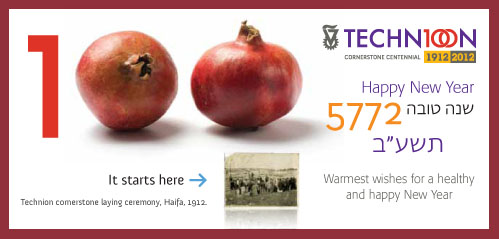
Welcome to this festive issue of TechnionLIVE, in which we celebrate the entry of the Jewish New Year. New Year is all about rejuvenation, initiation and new enterprise. You will notice that in this issue, we have received flattering coverage in the international press. While we love people to learn about Technion, it is important to remember that an institute of technology can never rest proudly on its laurels and announce its work is done. The spirit of innovation, progress and fresh inquiries into old problems is more alive now, in Technion’s Centennial Year, than ever before.
According to recent statistics, Israel has become an innovation superpower. To upkeep and develop this position, the innovation, excellence in teaching and application must go on. This means being alive and responsive to the needs of tomorrow – whether in areas on the national agenda such as social justice, or in outreach projects to bring engineering skills to developing nations.
Technion prides itself as the high-tech Eden – the creative force behind Israel’s emerging status as Silicon Valley’s single serious competitor. 41 Technion graduates are listed in Dun & Bradstreet’s List of Top 125 business leaders. More than 70 percent of our graduates are employed in the high-tech sectors that drive the country’s economic growth; 25 percent of them are CEOs and vice presidents, and 39 percent fill other management positions. 17 percent of our alumni are involved in start-ups – a figure without parallel in the entire developed world. In 2010, exports of services from start-up companies in Israel accounted for more than $622 million. 59 of 121 Israeli companies on Nasdaq are founded or run by Technion graduates. In November 2010, these companies were given a market value of more than $28.2 billion. In real terms, this means that Technion alumni have created wealth in excess of $28 billion. As I write, leaders from Intel are at Technion City tapping into this flare for innovation at the 2011 Technion-Intel Symposium.
Beyond the statistics, our deeper pride is in a loyalty to basic research – the fertile soil from which all innovation springs. In the coming year, we will continue to take global responsibility in pioneering energy research, life science, nanotechnology and medicine.
A Happy New Year to you all. We look forward to meeting you at various events throughout our centennial celebrations – in which we celebrate the century that was and the century that is to come. May this next year bring us a renewed passion for pure and applied research, and an even wider capacity for standards of excellence and innovation for the benefit of all the planet.

Peretz Lavie.
New Year Greetings from Technion President
From the President
Welcome to this festive issue of TechnionLIVE, in which we celebrate the entry of the Jewish New Year. New Year is all about rejuvenation, initiation and new enterprise. You will notice that in this issue, we have received flattering coverage in the international press. While we love people to learn about Technion, it is important to remember that an institute of technology can never rest proudly on its laurels and announce its work is done. The spirit of innovation, progress and fresh inquiries into old problems is more alive now, in Technion’s Centennial Year, than ever before.
According to recent statistics, Israel has become an innovation superpower. To upkeep and develop this position, the innovation, excellence in teaching and application must go on. This means being alive and responsive to the needs of tomorrow – whether in areas on the national agenda such as social justice, or in outreach projects to bring engineering skills to developing nations.
Technion prides itself as the high-tech Eden – the creative force behind Israel’s emerging status as Silicon Valley’s single serious competitor. 41 Technion graduates are listed in Dun & Bradstreet’s List of Top 125 business leaders. More than 70 percent of our graduates are employed in the high-tech sectors that drive the country’s economic growth; 25 percent of them are CEOs and vice presidents, and 39 percent fill other management positions. 17 percent of our alumni are involved in start-ups – a figure without parallel in the entire developed world. In 2010, exports of services from start-up companies in Israel accounted for more than $622 million. 59 of 121 Israeli companies on Nasdaq are founded or run by Technion graduates. In November 2010, these companies were given a market value of more than $28.2 billion. In real terms, this means that Technion alumni have created wealth in excess of $28 billion. As I write, leaders from Intel are at Technion City tapping into this flare for innovation at the 2011 Technion-Intel Symposium.
Beyond the statistics, our deeper pride is in a loyalty to basic research – the fertile soil from which all innovation springs. In the coming year, we will continue to take global responsibility in pioneering energy research, life science, nanotechnology and medicine.
A Happy New Year to you all. We look forward to meeting you at various events throughout our centennial celebrations – in which we celebrate the century that was and the century that is to come. May this next year bring us a renewed passion for pure and applied research, and an even wider capacity for standards of excellence and innovation for the benefit of all the planet.
Peretz Lavie.
Bright lights of Moshal
Highly motivated, determined to be of service to others, passionate about excellence, Technion’s Moshal scholars are exemplary students – showing the value of a program that determines that bright minds from underprivileged background must be given the chance to pursue their dreams.
Through the generosity of Mr. Martin Moshal, the Moshal Scholarship Program provides scholarships to needy and deserving undergraduate students at the Technion. The scholarships are granted to approximately 20 students for the four years of their undergraduate studies at the Technion. The scholarship includes tuition fees, dorm accommodation and an allowance.
The Moshal Scholarship Program is now entering its third year at the Technion and the third class of first-year students is under selection. Recipients of the scholarship may study in any of the Technion’s 17 faculties.
In addition, the Moshal Scholarship Program grants scholarships to students studying at Bar Ilan and Ben Gurion Universities in Israel.
Following are the touching, inside stories of two Moshal scholars currently studying at Technion.
Savi Esacov
Age: 25
Born: The former USSR.
Raised: Nazareth Illit.
Studying: Electrical engineering, entering his second year.
“I made aliya eighteen years ago from the former USSR, in 1993. My parents and I went to live in Nazareth Illit, where I studied through junior high. After that I attended the military boarding school that is part of the Hebrew Reali School of Haifa, where I was an honors student. I was an athlete, and I participated in various competitions. I’m still active, even after my legs were injured during my military service.
After high school I was drafted to the army, where I was an infantry combat soldier. Due to injuries I was transferred to the Field Intelligence Corps. I went on to become an officer and performed six years of army service, attaining the rank of Captain. I decided to finish my army service last year. Thursday was my last day of military service, and the following Sunday I began my studies at the Technion.
What made you choose to study electrical engineering?
“I’ve always been interested in exact sciences. I had very good grades, and I was drawn to this field specifically because of the challenge it poses. I always aim high.
Having said that, I just barely got through my first year. The coursework was difficult, it was a very different experience than anything I ever encountered. I know that in colleges there is more of an emphasis on students’ social lives, while here at the Technion all we do is study hard.
Tell me about your background.
I come from a family with no formal education. Neither of my parents studied at university, but I think that the environment you grow up in has a critical impact. It can help you make it to university, even though parents sometimes lack the means to help, like in my case.
When I was a child, I received a computer as part of a project for computer literacy among children. I’m proof of the project’s success.
I went to a private high school and then to the army; people helped me, and the army helped. During my army service as an officer I was unable to save up anything because I had to support my family. I was frightened of leaving the army – how was I going to make it financially?
The Dean of Students office at the Technion found me the Moshal Scholarship Program. Without this scholarship I would have no way of being here at the Technion, and I’m truly grateful. My chance of graduating is thanks to the Moshal Scholarship Program. People who have to study less because they have to support themselves, or take a break from studying have less of a chance of graduating. There’s a chance of not coming back.
I’ve met the other scholarship recipients. I believe that when people are able and willing, they can get a higher education. That’s what I like about Israel. I don’t know what it’s like in other places, but here, even when things get tough, people help you out.
What do you do besides school?
My girlfriend and I have been together for over three years. She’s studying nursing. I live at the dorms on campus, and have been granted permission to live there next year too. People have helped me a lot to
make that work out.
I’ve started doing some work for “Acharai”, a project that prepares young people for the army. We hold workshops in high schools, mainly working with underprivileged communities.
I really love mountain bike riding. During the summer vacation I managed to bike a lot, several times a week. I rode about 30-40 km every trip. It’s amazing, I love it. I think it’s a sport that is really being developed here in Israel.
I also get called up for reserve service, I’m an army intelligence officer in reserves.
What are your aspirations for the future?
To study and graduate with high grades, having acquired the necessary tools to help me join the industry. There is a lot of competition out there and I’m going to have to work hard after I graduate. The Technion
is probably the hardest place to study in Israel, and I hope to learn as much as possible I can find a job I enjoy. In order to find a management position in a technological company, I have to be very professional.
I also hope to start a family, and I think that’s the most important thing in the world.
Why did you choose to study at the Technion?
I always try to choose the biggest challenge, that’s how I get my satisfaction. Everyone around me is giving their best effort, we all have the same goal, and that helps a lot.
Do you want to add anything?
I’d like to thank the Moshal Scholarship Program for making my studies possible. I’m truly grateful.
 |
| Savi Esacov, Electrical Engineering |
Oshrat Israel
Age: 24
Born and raised: Haifa.
Studies: Faculty of Chemical Engineering, 3rd year.
Hobbies: Swimming; reading.
“Though I undoubtedly have a special background and a unique family, I have never lacked anything. My parents have always provided me with everything I’ve needed and have always stressed the importance of education.
I was born and raised in Haifa; both my parents are deaf. I’m the eldest child. I have a younger sister and brother who are twins; my sister is doing her military service, and my brother lives at home with me and my
parents, he has Down syndrome.
Growing up, my childhood was pretty ordinary. People always ask me, what was growing up in your family like? But this is the only family I’ve ever had, and everything I’ve achieved is thanks to them, especially in terms of education.
My sister and I attended one of the very best schools in Haifa, and we were both honor students. My academic achievements are very important to my parents, especially to my father. He believes that academic excellence comes first. He wants us to accomplish everything he hasn’t managed because of his disability.
My father is retired. In the past, he worked for the Rambam Hospital. My mother is a homemaker.
I do my best to help out at home. I live with my parents; I’m their ears and mouth, their way of communicating with the world. I’m glad I can help out. That’s who I am.
Why did you choose chemical engineering?
After high school, I searched for a field that would combine my interest in science and management, so I chose chemical engineering. I’m enjoying my studies, I’m about to start my third year. I’m especially interested in nanotechnology.
What are your aspirations?
I hope to graduate successfully, then go on to graduate studies or find work in my field in Israel. My parents are very proud of me for studying.
How does the Moshal Scholarship affect your studies?
I’m really enjoying my studies, but it isn’t easy. The Moshal Scholarship helps very much by enabling me to dedicate myself to my studies, along with helping my family. Last year I volunteered for a chemistry project
for junior high school students, which included conducting experiments with the kids. I enjoyed that. This year I’m hoping to help a first or second year student at the Technion with hearing disabilities make a fresh start in his or her studies.
I’m very grateful for Moshal Scholarship, it isn’t something I take for granted. My family and I are very thankful for the options it’s given me to dedicate myself to my studies while helping my family. It’s an incredible gift.
How do you juggle your intensive studies with helping your family?
I live with my parents and brother, and I try to be around the house to help. Thanks to wonderful improvements in technology, even if I’m not home, my parents can call me and we can have video calls so they can sign me what they need, or send me text messages.
 |
| Oshrat Israel, Chemical Engineering |
“Education is the most powerful weapon you can use to change the world.”
Nelson Mandela
Bright lights of Moshal
Highly motivated, determined to be of service to others, passionate about excellence, Technion’s Moshal scholars are exemplary students – showing the value of a program that determines that bright minds from underprivileged background must be given the chance to pursue their dreams.
Through the generosity of Mr. Martin Moshal, the Moshal Scholarship Program provides scholarships to needy and deserving undergraduate students at the Technion. The scholarships are granted to approximately 20 students for the four years of their undergraduate studies at the Technion. The scholarship includes tuition fees, dorm accommodation and an allowance.
The Moshal Scholarship Program is now entering its third year at the Technion and the third class of first-year students is under selection. Recipients of the scholarship may study in any of the Technion’s 17 faculties.
In addition, the Moshal Scholarship Program grants scholarships to students studying at Bar Ilan and Ben Gurion Universities in Israel.
Following are the touching, inside stories of two Moshal scholars currently studying at Technion.
Savi Esacov
Age: 25
Born: The former USSR.
Raised: Nazareth Illit.
Studying: Electrical engineering, entering his second year.
“I made aliya eighteen years ago from the former USSR, in 1993. My parents and I went to live in Nazareth Illit, where I studied through junior high. After that I attended the military boarding school that is part of the Hebrew Reali School of Haifa, where I was an honors student. I was an athlete, and I participated in various competitions. I’m still active, even after my legs were injured during my military service.
After high school I was drafted to the army, where I was an infantry combat soldier. Due to injuries I was transferred to the Field Intelligence Corps. I went on to become an officer and performed six years of army service, attaining the rank of Captain. I decided to finish my army service last year. Thursday was my last day of military service, and the following Sunday I began my studies at the Technion.
What made you choose to study electrical engineering?
“I’ve always been interested in exact sciences. I had very good grades, and I was drawn to this field specifically because of the challenge it poses. I always aim high.
Having said that, I just barely got through my first year. The coursework was difficult, it was a very different experience than anything I ever encountered. I know that in colleges there is more of an emphasis on students’ social lives, while here at the Technion all we do is study hard.
Tell me about your background.
I come from a family with no formal education. Neither of my parents studied at university, but I think that the environment you grow up in has a critical impact. It can help you make it to university, even though parents sometimes lack the means to help, like in my case.
When I was a child, I received a computer as part of a project for computer literacy among children. I’m proof of the project’s success.
I went to a private high school and then to the army; people helped me, and the army helped. During my army service as an officer I was unable to save up anything because I had to support my family. I was frightened of leaving the army – how was I going to make it financially?
The Dean of Students office at the Technion found me the Moshal Scholarship Program. Without this scholarship I would have no way of being here at the Technion, and I’m truly grateful. My chance of graduating is thanks to the Moshal Scholarship Program. People who have to study less because they have to support themselves, or take a break from studying have less of a chance of graduating. There’s a chance of not coming back.
I’ve met the other scholarship recipients. I believe that when people are able and willing, they can get a higher education. That’s what I like about Israel. I don’t know what it’s like in other places, but here, even when things get tough, people help you out.
What do you do besides school?
My girlfriend and I have been together for over three years. She’s studying nursing. I live at the dorms on campus, and have been granted permission to live there next year too. People have helped me a lot to
make that work out.
I’ve started doing some work for “Acharai”, a project that prepares young people for the army. We hold workshops in high schools, mainly working with underprivileged communities.
I really love mountain bike riding. During the summer vacation I managed to bike a lot, several times a week. I rode about 30-40 km every trip. It’s amazing, I love it. I think it’s a sport that is really being developed here in Israel.
I also get called up for reserve service, I’m an army intelligence officer in reserves.
What are your aspirations for the future?
To study and graduate with high grades, having acquired the necessary tools to help me join the industry. There is a lot of competition out there and I’m going to have to work hard after I graduate. The Technion
is probably the hardest place to study in Israel, and I hope to learn as much as possible I can find a job I enjoy. In order to find a management position in a technological company, I have to be very professional.
I also hope to start a family, and I think that’s the most important thing in the world.
Why did you choose to study at the Technion?
I always try to choose the biggest challenge, that’s how I get my satisfaction. Everyone around me is giving their best effort, we all have the same goal, and that helps a lot.
Do you want to add anything?
I’d like to thank the Moshal Scholarship Program for making my studies possible. I’m truly grateful.
|
| Savi Esacov, Electrical Engineering |
Oshrat Israel
Age: 24
Born and raised: Haifa.
Studies: Faculty of Chemical Engineering, 3rd year.
Hobbies: Swimming; reading.
“Though I undoubtedly have a special background and a unique family, I have never lacked anything. My parents have always provided me with everything I’ve needed and have always stressed the importance of education.
I was born and raised in Haifa; both my parents are deaf. I’m the eldest child. I have a younger sister and brother who are twins; my sister is doing her military service, and my brother lives at home with me and my
parents, he has Down syndrome.
Growing up, my childhood was pretty ordinary. People always ask me, what was growing up in your family like? But this is the only family I’ve ever had, and everything I’ve achieved is thanks to them, especially in terms of education.
My sister and I attended one of the very best schools in Haifa, and we were both honor students. My academic achievements are very important to my parents, especially to my father. He believes that academic excellence comes first. He wants us to accomplish everything he hasn’t managed because of his disability.
My father is retired. In the past, he worked for the Rambam Hospital. My mother is a homemaker.
I do my best to help out at home. I live with my parents; I’m their ears and mouth, their way of communicating with the world. I’m glad I can help out. That’s who I am.
Why did you choose chemical engineering?
After high school, I searched for a field that would combine my interest in science and management, so I chose chemical engineering. I’m enjoying my studies, I’m about to start my third year. I’m especially interested in nanotechnology.
What are your aspirations?
I hope to graduate successfully, then go on to graduate studies or find work in my field in Israel. My parents are very proud of me for studying.
How does the Moshal Scholarship affect your studies?
I’m really enjoying my studies, but it isn’t easy. The Moshal Scholarship helps very much by enabling me to dedicate myself to my studies, along with helping my family. Last year I volunteered for a chemistry project
for junior high school students, which included conducting experiments with the kids. I enjoyed that. This year I’m hoping to help a first or second year student at the Technion with hearing disabilities make a fresh start in his or her studies.
I’m very grateful for Moshal Scholarship, it isn’t something I take for granted. My family and I are very thankful for the options it’s given me to dedicate myself to my studies while helping my family. It’s an incredible gift.
How do you juggle your intensive studies with helping your family?
I live with my parents and brother, and I try to be around the house to help. Thanks to wonderful improvements in technology, even if I’m not home, my parents can call me and we can have video calls so they can sign me what they need, or send me text messages.
|
| Oshrat Israel, Chemical Engineering |
“Education is the most powerful weapon you can use to change the world.”
Nelson Mandela