Category Archives: News
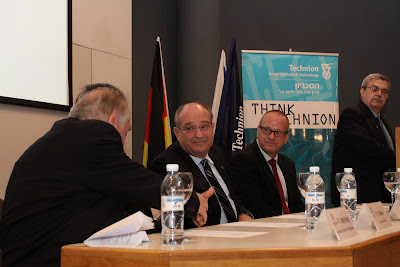
Press Conference of Nobel Laureates in Sweden
“Our graduates know that they receive the best training in engineering and high-technology.”
Message from Professor Dan Shechtman: “Believe in Your Science.”
Press Conference of Nobel Laureates in Sweden
“Our graduates know that they receive the best training in engineering and high-technology.”
Message from Professor Dan Shechtman: “Believe in Your Science.”
Technion LIVE e-newsletter December 2011, breaking science & technology news from Israel
|
||||||||||||||||||||||||||||||||||||||||||||||||||||||||||||||||||||||||||||||||||||||||||
|
||||||||||||||||||||||||||||||||||||||||||||||||||||||||||||||||||||||||||||||||||||||||||
| Unsubscribe from Technion Live | ||||||||||||||||||||||||||||||||||||||||||||||||||||||||||||||||||||||||||||||||||||||||||
Technion LIVE e-newsletter December 2011, breaking science & technology news from Israel
|
||||||||||||||||||||||||||||||||||||||||||||||||||||||||||||||||||||||||||||||||||||||||||
|
||||||||||||||||||||||||||||||||||||||||||||||||||||||||||||||||||||||||||||||||||||||||||
| Unsubscribe from Technion Live | ||||||||||||||||||||||||||||||||||||||||||||||||||||||||||||||||||||||||||||||||||||||||||
Israel’s 10th Nobel laureate on his way to Stockholm!
Blogged from the Jerusalem Post
By JUDY SIEGEL
12/05/2011 05:52
Shechtman, 70, discovered in 1982 that atoms in rigid crystals can be packed together in unusual ways.
Dozens of European ambassadors to Israel met with Nobel Prize in Chemistry laureate Prof. Dan Shechtman over the weekend to wish him luck before he leaves with his family for Stockholm on Monday to receive his prize. In addition to his delivery of lectures and attendance at symposia and receptions, the peak event will be the award ceremony and the gala ball on Saturday night.
Shechtman – a 70-year-old expert in materials science at Haifa’s Technion-Israel Institute of Technology – discovered in 1982 that atoms in rigid crystals can be packed together in unusual ways. This breakthrough led to the development of extremely strong materials from metal surgical tools and razor blades to diesel engines and as protective coatings and metal alloys. In addition, what have become known as quasiperiodic or quasicrystals, do not rust or become oxidized and have almost no surface friction.
The Tel Aviv-born scientist, who is also an associate of the US Department of Energy’s Ames Laboratory and professor at Iowa State University, found that atoms in crystals could be structured in an unrepeatable pattern that looked like the Arab-style floor mosaics. In fact, the structure was described as “the fascinating mosaics of the Arabic world reproduced at the level of atoms.”
Israel – Germany: transcript of Technion President Speech
| Handshake of 2 Technion Presidents: Yitchak Apeloig (left), Peretz Lavie (center) |
The relationship between the Technion and Germany dates back to the establishment of the Technion 100 years ago when Ezra, a Jewish philanthropic group from Berlin took upon themselves to build the Technikum, the first Jewish University modeled after German Midlevel technical schools. The War of languages between German – the language of the first teachers of the Technion, and Hebrew – the language of the students who refused to study in German, has been considered to be a landmark of revival of the ancient language that was dead for almost 2000 years. Berlin was also the site of the first Technion support group that was headed by no other than Albert Einstein.
The Second World War and the Holocaust demolished these special relationships and casted a huge shadow on the relationship between the Federal Republic of Germany and the State of Israel. For many years these relationships have been a very emotional issue, where painful memories and hopes for a better world are mixed, sometimes almost in a surreal way.
The relationship between The Federal Republic of Germany and the State of Israel can be seen as a delicate and sensitive plant that needs special care to ensure its proper growth and development. On both sides we need talented gardeners who have not only open minds but also open hearts, who can provide this plant with the special care it needs. Today, we honor such a “gardener”; Technion President Emeritus, Distinguished Professor Yitzhak Apeloig, who is honored by the Federal Republic of Germany with the Order of Merit for nurturing this delicate plant.
I had the pleasure to work with Distinguished Professor Yitzhak Apeloig for seven years, as the Vice President for Resource Development and External Relations. Now in my capacity as the President of the Technion and his successor I can fully appreciate the spirit of harmony in which we worked under his leadership during these very hectic and eventful years.
Yitzhak, or Itzik as we call him here, knew that one of the secrets of how to establish a relationship between people who share such a traumatic history is to make them use a common language. When people use the same language they feel closer to each other. Using a common language removes barriers and builds mutual trust and understanding. The common language that Prof. Apeloig chose was neither Hebrew nor German. He chose the language of science. There is no place like a small intimate scientific meeting where scientists share their knowledge and experience with fellow scientists having the same interests, and with students who are eager to learn from the elders. As many of you know and most probably experienced, the scientific exchange starts at the lecture hall and continues around the table during lunch time and dinner, and later on, late into the night at the bar or coffee corner. Such meetings are the recipe to build bridges between people.
Prof. Apeloig initiated many German-Israeli scientific meetings during which to use his own words:
“With time the ties became closer and collaborators became friends, some of them even life-time friends. I indeed truly believe that science can be a bridge for uniting cultures and nations.”
Itzik conducted many joint research projects with his life-time friends who visited each other’s laboratories numerous times. Together with Prof. Sasson Shaik (צֽחָייק) from the Hebrew University he is heading the Lise Meitner – Minerva Center for Computational Quantum Chemistry, one of more than 20 Minerva Centers in Israel that further strengthen the cooperation between Israeli and German Scientists.
Yitzik, my friend, I congratulate you on behalf of the entire Technion Family for being awarded this prestigious honor, to be joining numerous great prizes and awards, such as membership in the US National Academy of Sciences, the American Chemical Society Award in Chemistry, and the Israel Chemical Society Award and the Honorary Doctorate bestowed on you by the Technical University of Berlin.
Thank you, Yitzhak, for bringing us this honor, and thank you – the Government of the Federal Republic of Germany for acknowledging your achievements and activities.
German Order of Merit to former Technion President
“There is no German, American, Chinese, or “Jewish” science- an infamous term coined by the Nazi regime – there is only one type of science, science which searches for the scientific truth and tries to understand our universe.”
“The relationship between The Federal Republic of Germany and the State of Israel can be seen as a delicate and sensitive plant that needs special care to ensure its proper growth and development. On both sides we need talented gardeners who have not only open minds but also open hearts, who can provide this plant with the special care it needs.”
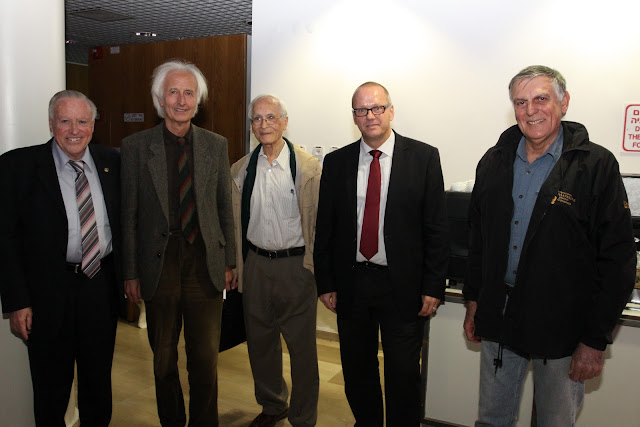
| l-r: Prof. Apeloig, Prof. Helmut Schwarz, President of the Alexander von Humboldt Foundation and prof at Technische Universitat of Berlin; Distinguished Prof Jacob Ziv; Andreas Michaelis; Distinguished Prof. Dan Shechtman. |
German Order of Merit to Distinguished Prof. Yitzhak Apeloig
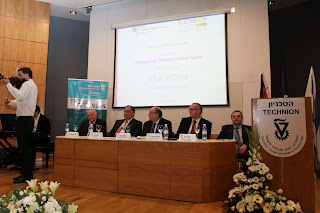
Distinguished Prof. Yitzhak Apeloig from the Schulich Faculty of Chemistry received the Order of Merit (First Degree) of the Federal Republic of Germany from Bundespräsident Christian Wulff, represented by H.E. Andreas Michaelis, Ambassador of Germany to Israel, at a ceremony held at Technion on November 28, 2011.
“We feel honored that you allow us to honor you,” said the ambassador.
Distinguished Prof. Apeloig receives the Order of Merit for his important contributions throughout his scientific career towards building German-Israeli scientific relations and further strengthening them during his presidency of the Technion (2001-2009).
President of Technion Prof. Peretz Lavie said that Prof. Apeloig was being honored for nurturing the relationship between Germany and Israel; he chose the language of science to remove barriers and build mutual trust and understanding between the two peoples. “Thank you, Yitzhak, for bringing us this honor, and thank you – the government of the Federal Republic of Germany – for acknowledging his achievements and activities,” Lavie said.
A transcript of the speech from Technion President Prof. Peretz Lavie.
http://www.technioniit.com/2011/12/israel-germany-transcript-of-technion.html

German Order of Merit to former Technion President
“There is no German, American, Chinese, or “Jewish” science- an infamous term coined by the Nazi regime – there is only one type of science, science which searches for the scientific truth and tries to understand our universe.”
“The relationship between The Federal Republic of Germany and the State of Israel can be seen as a delicate and sensitive plant that needs special care to ensure its proper growth and development. On both sides we need talented gardeners who have not only open minds but also open hearts, who can provide this plant with the special care it needs.”
| l-r: Prof. Apeloig, Prof. Helmut Schwarz, President of the Alexander von Humboldt Foundation and prof at Technische Universitat of Berlin; Distinguished Prof Jacob Ziv; Andreas Michaelis; Distinguished Prof. Dan Shechtman. |
German Order of Merit to Distinguished Prof. Yitzhak Apeloig
Distinguished Prof. Yitzhak Apeloig from the Schulich Faculty of Chemistry received the Order of Merit (First Degree) of the Federal Republic of Germany from Bundespräsident Christian Wulff, represented by H.E. Andreas Michaelis, Ambassador of Germany to Israel, at a ceremony held at Technion on November 28, 2011.
“We feel honored that you allow us to honor you,” said the ambassador.
Distinguished Prof. Apeloig receives the Order of Merit for his important contributions throughout his scientific career towards building German-Israeli scientific relations and further strengthening them during his presidency of the Technion (2001-2009).
President of Technion Prof. Peretz Lavie said that Prof. Apeloig was being honored for nurturing the relationship between Germany and Israel; he chose the language of science to remove barriers and build mutual trust and understanding between the two peoples. “Thank you, Yitzhak, for bringing us this honor, and thank you – the government of the Federal Republic of Germany – for acknowledging his achievements and activities,” Lavie said.
A transcript of the speech from Technion President Prof. Peretz Lavie.
http://www.technioniit.com/2011/12/israel-germany-transcript-of-technion.html

The bus stop legacy… innovation + people power
How to Spread a Small Idea Into a Big Deal: Bus Stop Libraries
| Book ‘em Danno Technion Focus |
|
![]() Going public takes on a whole new meaning as researchers from Technion’s Faculty of Architecture and Town Planning establish ad hoc micro lending libraries at local bus stops. Dr Danny Shoshan, senior teaching associate at the Faculty, and Amit Matalon, final year architecture student, devised the public library as an art experiment in the urban landscape, to see how the city and its residents interact. First, they placed two sets of bookshelves at bus shelters in the Ziv neighborhood of Haifa, near the Technion, stocked them with books and monitored what happened over a 3-week period. “After some time, a miracle took place,” says Shoshan. “People took over the role of stocking and returning the books.” Next, the urban researchers expanded the project to six locations including the Technion campus. “We saw that Technion students began to put their theses and textbooks on the shelves for sharing,” Shoshan explains. “In the ultra-Orthodox section of the neighborhood, the residents brought religious books and even CDs with religious content.” Matalon says, “It’s important to note that our motivation for the project was Art. Public space is the place to bring Art.” ![]() Shoshan and Matalon continue to check that the shelves remain stocked and observe different urban settings with diverse responses on the part of the citizens and the authorities. “The passive ‘viewer’ becomes involved in the process and turns into an active ‘user’ of this urban art form,” they note. Similar libraries were built in Tirat HaCarmel, Kfar Saba and Tel Aviv. Other cities will soon be added. “We have also had orders from abroad,” Shoshan reveals. Mayor of Kfar Saba, Yehuda Ben Hemo, said, “With minimal investment and very, very creative thinking, we can make municipal libraries accessible to the general public.” “This project is really going viral! It works, it’s successful, and it creates additional facilities within the existing urban framework,” Shoshan explains
Several weeks ago the Kfar Saba Municipality set up libraries along Weizmann Street, on both sides of the road, in the least expected place. Shelves installed on the bus stops’ walls were filled with books in different languages, of various genres, including cookbooks and poetry collections. Passengers may borrow a book while waiting for the bus, read it during the ride, and return it wherever they get off. Those who would like to finish reading the book may take it home and return it several days later. “Residents here are deeply rooted and take an interest in culture,” says Kfar Saba Mayor Yehuda Ben-Hamo. “In order to meet the residents’ needs, we have launched an initiative making books more accessible to our residents and encouraging them to use public transportation as part of the agenda of a healthy and green city.” The project was initiated by Daniel Shushan and Amir Matalon, a graduate of the Technion’s Faculty of Architecture, two urban artists who suggested the idea to the mayor with the aim of giving the city’s residents access to books. Residents are invited to add their own books, the municipal library fills the shelves on a daily basis, and at this stage the municipality has decided not to keep records of those who borrow the books or check whether they are returned. “At first we asked ourselves how long it would last,” says Ossi, a city resident. “But then we decided to get rid of the negative thoughts because this is a good thing which has proved itself after only one week. At the beginning of the week the shelf was full of books, throughout the week they disappeared, and suddenly there are new books.” |
|
PRESIDENT’S REPORT 2015