Category Archives: News

Can you see Mars? Technion Science.

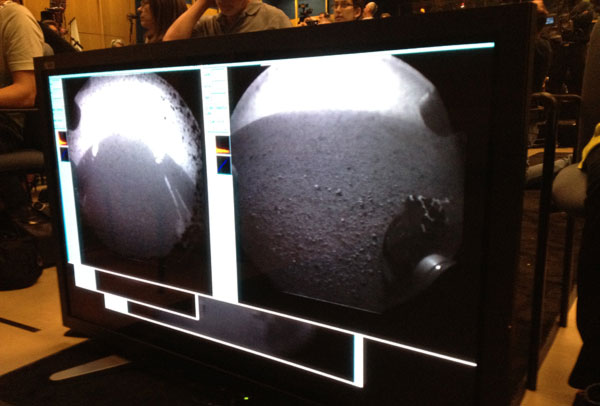
Mars is live – thanks to the Lempel Ziv algorithm for lossless data compression developed at Technion.


“The video compression on Curiosity rover is indeed a version of the LOCO system that was developed by Marcelo Weinberger  and Gadiel Seroussi -both are Technion graduates,” says Technion Distinguishe Prof. Jacob Ziv

Images sent back to Earth from the Curiosity rover are using a version of the LOCO system for video compression developed by Technion alumni, Drs Marcelo Weinberger and Gadiel Seroussi. Weinberger and Seroussi’s doctoral advisors were Profs. Abraham Lempel and Jacob Ziv, developers of the Lempel-Ziv coding algorithm – a world standard for compressed information transmission.
 
NASA’s groundbreaking mission seeks to determine whether Mars is or has ever been capable of supporting life and to assess the planet’s habitability for future human missions. 

To maximize the number of images acquired during the mission, virtually all image data will be compressed by the rover CPU (using either lossy or lossless compression) prior to placement into the telemetry stream. To perform this task the rovers will utilize a software implementation of the JPL-developed ICER wavelet-based image compressor [Kiely and Klimesh, 2003], capable of providing lossy and lossless compression. In cases where lossless compression is desired and speed is particularly important, compression will be performed (in software) by a modified version of the low-complexity (LOCO) lossless image compression algorithm [Klimesh et al., 2001; Weinberger et al., 1996]. The MER mission is utilizing state of the art image compression technology by flying compressors that deliver compression effectiveness comparable to that achieved by the JPEG- 2000 image compression standard [Adams, 2001], but with lower computational complexity [Kiely and Klimesh, 2003].

Did you know? 
Mars’s average distance from the Sun is roughly 230 million km (1.5 AU, or 143 million miles) and its orbital period is 687 (Earth) days as depicted by the red trail, with Earth’s orbit shown in blue.(Animation)

Can you see Mars? Technion Science.

Mars is live – thanks to the Lempel Ziv algorithm for lossless data compression developed at Technion.


“The video compression on Curiosity rover is indeed a version of the LOCO system that was developed by Marcelo Weinberger  and Gadiel Seroussi -both are Technion graduates,” says Technion Distinguishe Prof. Jacob Ziv

Images sent back to Earth from the Curiosity rover are using a version of the LOCO system for video compression developed by Technion alumni, Drs Marcelo Weinberger and Gadiel Seroussi. Weinberger and Seroussi’s doctoral advisors were Profs. Abraham Lempel and Jacob Ziv, developers of the Lempel-Ziv coding algorithm – a world standard for compressed information transmission.
 
NASA’s groundbreaking mission seeks to determine whether Mars is or has ever been capable of supporting life and to assess the planet’s habitability for future human missions. 


To maximize the number of images acquired during the mission, virtually all image data will be compressed by the rover CPU (using either lossy or lossless compression) prior to placement into the telemetry stream. To perform this task the rovers will utilize a software implementation of the JPL-developed ICER wavelet-based image compressor [Kiely and Klimesh, 2003], capable of providing lossy and lossless compression. In cases where lossless compression is desired and speed is particularly important, compression will be performed (in software) by a modified version of the low-complexity (LOCO) lossless image compression algorithm [Klimesh et al., 2001; Weinberger et al., 1996]. The MER mission is utilizing state of the art image compression technology by flying compressors that deliver compression effectiveness comparable to that achieved by the JPEG- 2000 image compression standard [Adams, 2001], but with lower computational complexity [Kiely and Klimesh, 2003].

Did you know? 
Mars’s average distance from the Sun is roughly 230 million km (1.5 AU, or 143 million miles) and its orbital period is 687 (Earth) days as depicted by the red trail, with Earth’s orbit shown in blue.(Animation)

The Technion Birthright

Birthright Bar Mitzvah Celebrated in Haifa
Date: 06/08/2012
Source: Technion FOCUS.
Taglit – also known as the Birthright Israel program – is celebrating its Bar Mitzvah (13th anniversary). To mark the occasion, more than 500 current participants came to Technion where they heard two lectures from dynamic faculty who are both immigrants to Israel: Dr. Josue Sznitman of Technion’s Faculty of Biomedical Engineering and Prof. Mark Talesnick of the Faculty of Civil and Environmental Engineering.
Talesnick spoke about Technion’s Engineers Without Borders outreach program that he initiated and Sznitman discussed his cutting-edge research.
Albert Sweet, of Los Angeles, CA, has been one of Technion’s generous supporters for many years as well as a supporter of the Birthright program. Through an initiative he started a few years ago Birthright participants are brought to Technion to get a sense of Technion’s contribution to Israel’s becoming a high-technology superpower and a critical player in helping drive Israel’s economy, medical research and security.


The Technion Birthright

Birthright Bar Mitzvah Celebrated in Haifa
Date: 06/08/2012
Source: Technion FOCUS.
Taglit – also known as the Birthright Israel program – is celebrating its Bar Mitzvah (13th anniversary). To mark the occasion, more than 500 current participants came to Technion where they heard two lectures from dynamic faculty who are both immigrants to Israel: Dr. Josue Sznitman of Technion’s Faculty of Biomedical Engineering and Prof. Mark Talesnick of the Faculty of Civil and Environmental Engineering.
Talesnick spoke about Technion’s Engineers Without Borders outreach program that he initiated and Sznitman discussed his cutting-edge research.
Albert Sweet, of Los Angeles, CA, has been one of Technion’s generous supporters for many years as well as a supporter of the Birthright program. Through an initiative he started a few years ago Birthright participants are brought to Technion to get a sense of Technion’s contribution to Israel’s becoming a high-technology superpower and a critical player in helping drive Israel’s economy, medical research and security.


All eyes on CORTICA as it raises +7 million.

Cortica gets $7M to bestow computers with the power of sight.

Israeli startup Cortica raised $7 in a second round of funding. The investment was led by Horizons Ventures, owned by the Hong Kong billionaire Li Ka-Shing. Venture capitalist Ynon Kreiz also participated in the round, as did Ynon Kreiz, the former Chairman & CEO of the Endemol Group, the world’s largest independent television production company. The company had already raised $4 million from a group of high quality angel investors. Mr. Kreiz joins Cortica as its Chairman; founder Technion graduate Igal Raichelgauz continues as CEO.

Cortica’s image recognition technology fuses neuroscience and computer science by imbuing computers the ability to comprehend visual content on the web in real-time. The core technology was developed at Technion, in Haifa, Israel, by a team of neuroscientists and digital media experts. The technology functions similarly to the human cortex and can identify patterns, and make classifications.

Cortica was conceived in 2006 with a vision to fundamentally revolutionize the way computers understand images and video. The essence of Cortica’s Image2Text™ technology lies in its ability to automatically extract the core concepts in images and video, and map these concepts to key-words and textual taxonomies.

By virtue of their ability to simulate the appearance of the physical world, pictures drive interest, sentiment and commercial intent. Cortica’s product reads and automatically associates images with relevant ads. This groundbreaking model gives publishers a completely new monetization stream and provides brands and marketers the opportunity to reach highly targeted mass audiences.

Cortica was founded by Technion researchers, Prof. Yehoshua (Josh) Zeevi (Faculty of Electrical Engineering); Karina Odinaev; and engineer Igal Raichelgauz, who assembled a multi-disciplinary team of neuroscience researchers, digital multimedia experts and veterans of Israeli military intelligence to develop and commercialize the technology. The underlying technology was derived from scientific research focused on understanding how neural networks of the human cortex perform complex computational tasks, such as identifying patterns, classifying natural signals and understanding concepts.

Cortica’s commercial team will relocate to the US and will be based in NY with an office in Silicon Valley. The first commercial applications of the technology will transform advertising, search and image analytics

The Technion has an unmatched position within (and outside) Israel in neuro-engineering, and is recognized as a leader in the application of engineering methods and principles to the study of neural systems. Indeed, in addition to Cortica, several successful companies have stemmed from the Technion’s activity in this field (e.g., “BrainsGate”, “Elminda”, “GeneGrafts”, “Neurovibes”).

Cortica

All eyes on CORTICA as it raises +7 million.

Cortica gets $7M to bestow computers with the power of sight.

Israeli startup Cortica raised $7 in a second round of funding. The investment was led by Horizons Ventures, owned by the Hong Kong billionaire Li Ka-Shing. Venture capitalist Ynon Kreiz also participated in the round, as did Ynon Kreiz, the former Chairman & CEO of the Endemol Group, the world’s largest independent television production company. The company had already raised $4 million from a group of high quality angel investors. Mr. Kreiz joins Cortica as its Chairman; founder Technion graduate Igal Raichelgauz continues as CEO.

Cortica’s image recognition technology fuses neuroscience and computer science by imbuing computers the ability to comprehend visual content on the web in real-time. The core technology was developed at Technion, in Haifa, Israel, by a team of neuroscientists and digital media experts. The technology functions similarly to the human cortex and can identify patterns, and make classifications.

Cortica was conceived in 2006 with a vision to fundamentally revolutionize the way computers understand images and video. The essence of Cortica’s Image2Text™ technology lies in its ability to automatically extract the core concepts in images and video, and map these concepts to key-words and textual taxonomies.

By virtue of their ability to simulate the appearance of the physical world, pictures drive interest, sentiment and commercial intent. Cortica’s product reads and automatically associates images with relevant ads. This groundbreaking model gives publishers a completely new monetization stream and provides brands and marketers the opportunity to reach highly targeted mass audiences.

Cortica was founded by Technion researchers, Prof. Yehoshua (Josh) Zeevi (Faculty of Electrical Engineering); Karina Odinaev; and engineer Igal Raichelgauz, who assembled a multi-disciplinary team of neuroscience researchers, digital multimedia experts and veterans of Israeli military intelligence to develop and commercialize the technology. The underlying technology was derived from scientific research focused on understanding how neural networks of the human cortex perform complex computational tasks, such as identifying patterns, classifying natural signals and understanding concepts.

Cortica’s commercial team will relocate to the US and will be based in NY with an office in Silicon Valley. The first commercial applications of the technology will transform advertising, search and image analytics

The Technion has an unmatched position within (and outside) Israel in neuro-engineering, and is recognized as a leader in the application of engineering methods and principles to the study of neural systems. Indeed, in addition to Cortica, several successful companies have stemmed from the Technion’s activity in this field (e.g., “BrainsGate”, “Elminda”, “GeneGrafts”, “Neurovibes”).

Cortica

Ingenuity within Olympic broadcasting

Image: LiveU Website 

Technion graduates are bringing pictures of the 2012 London Olympics live to your homes. Going live with the 2012 Olympic games, the innovative Israel-born company LiveU introduced an innovative technology that allows a small device to use conventional mobile network signals to broadcast live events, as they happen.


The Technion brain-powered start-up already has a powerful global track record: it delivered live broadcasts of events such as the Royal Wedding of Prince William to Catherine Middleton; the 2011 Oscars and the Grammy Awards 2011; and the 2012 Super Bowl.

London 2012 is also hosting another new Israeli technology: Mobli – according to the Embassy of Israel in London. Mobli – a real-time visual media platform – is being employed by Serena Williams to update her followers on the action in London. Williams is an investor in the company, which is also populated by Technion graduates and was founded by Israeli entrepreneur Moshe Hogeg.
Mobli is the perfect platform for me for sharing my experiences, both the great and the not so great, during the Olympic Games,” said Williams. “I hope that my fans will connect to the channel, to participate and share with me in this unique experience.” 


Ingenuity within Olympic broadcasting

Image: LiveU Website 

Technion graduates are bringing pictures of the 2012 London Olympics live to your homes. Going live with the 2012 Olympic games, the innovative Israel-born company LiveU introduced an innovative technology that allows a small device to use conventional mobile network signals to broadcast live events, as they happen.


The Technion brain-powered start-up already has a powerful global track record: it delivered live broadcasts of events such as the Royal Wedding of Prince William to Catherine Middleton; the 2011 Oscars and the Grammy Awards 2011; and the 2012 Super Bowl.

London 2012 is also hosting another new Israeli technology: Mobli – according to the Embassy of Israel in London. Mobli – a real-time visual media platform – is being employed by Serena Williams to update her followers on the action in London. Williams is an investor in the company, which is also populated by Technion graduates and was founded by Israeli entrepreneur Moshe Hogeg.
Mobli is the perfect platform for me for sharing my experiences, both the great and the not so great, during the Olympic Games,” said Williams. “I hope that my fans will connect to the channel, to participate and share with me in this unique experience.” 


FDA Approved. Corindus – making heart surgery safer

FDA CLEARS FIRST ROBOTIC-ASSISTED SYSTEM FOR CORONARY ARTERY DISEASE STENT PROCEDURES

Corindus Vascular Robotics wins 510(k) clearance for CorPath® 200 System; Robotic-assisted percutaneous coronary interventions (PCI) enhances control and protects physicians from radiation


Continue reading FDA Approved. Corindus – making heart surgery safer

FDA Approved. Corindus – making heart surgery safer

FDA CLEARS FIRST ROBOTIC-ASSISTED SYSTEM FOR CORONARY ARTERY DISEASE STENT PROCEDURES

Corindus Vascular Robotics wins 510(k) clearance for CorPath® 200 System; Robotic-assisted percutaneous coronary interventions (PCI) enhances control and protects physicians from radiation


Continue reading FDA Approved. Corindus – making heart surgery safer