Tag Archives: medicine.

The future: knife-free non-invasive cancer surgery.

Insightec – voted a top innovator by TIME Magazine for its revolutionary ultrasound system for non-invasive surgery, is a powerhouse of Technion graduates. Here, Yoav Medan, who has taught at the department of electrical engineering at the Technion and who has graduated from there in aeronautical engineering, discusses how this patented Israeli system could soon be saving lives across the planet.

Imagine having a surgery with no knives involved. At TEDMED, surgeon Yoav Medan shares a technique that uses MRI to find trouble spots and focused ultrasound to treat such issues as brain lesions, uterine fibroids and several kinds of cancerous growths.

‘TIME’ honors InSightec’s Focused Ultrasound

By Viva Sarah Press
December 06, 2011
TIME magazine recently called InSightec’s MR Guided Focused Ultrasound (MRgFUS) one of the 50 best inventions of the year.

“Magnetic-resonance-imaging (MRI) and ultrasound technologies are each remarkable in their own right, but combine them and you get something life-changing,” the magazine wrote about InSightec’s technique.

Read full story at Israel 21C

Yoav Medan

Vice President and Chief Systems Architect, Insightec

Yoav Medan, Vice President and Chief Systems Architect, is responsible for developing new platforms for the Magnetic Resonance guided Focused Ultrasound technology.
Prior to joining InSightec in 1999, Dr. Medan spent 17 years in various senior research and management positions at the IBM Research Division and was elected to the IBM Academy of Technology.
In addition to technical and managerial experience, Dr. Medan has academic experience as well, teaching at the EE department at the Technion, Israel Institute of Technology, in addition to serving as a lecturer for Avionic Systems at the Aeronautical Engineering faculty. He is also a Senior Member of the Institute of Electrical and Electronics Engineers.
Dr. Medan has widely published and holds nine IBM as well as several other patents. He was awarded the IBM Outstanding Technical Achievement Award, the 3rd Invention Achievement Award and the Outstanding Research Division Award.
Dr. Medan received his D.Sc. and B.Sc.(Summa Cum Laude) in Aeronautical Engineering from the Technion, Israel Institute of Technology, and a M.B.A diploma from Bradford University, UK.

The focused ultrasound beam can be seen during the treatment to ensure taht the ultrasound travels through a safe pathway to the focus. This ensures that the correct region is targeted.  Sonication parameters can be adjusted to optimize the treatment and are monitored by the physician during the treatment.

The future: knife-free non-invasive cancer surgery.

Insightec – voted a top innovator by TIME Magazine for its revolutionary ultrasound system for non-invasive surgery, is a powerhouse of Technion graduates. Here, Yoav Medan, who has taught at the department of electrical engineering at the Technion and who has graduated from there in aeronautical engineering, discusses how this patented Israeli system could soon be saving lives across the planet.

Imagine having a surgery with no knives involved. At TEDMED, surgeon Yoav Medan shares a technique that uses MRI to find trouble spots and focused ultrasound to treat such issues as brain lesions, uterine fibroids and several kinds of cancerous growths.

‘TIME’ honors InSightec’s Focused Ultrasound

By Viva Sarah Press
December 06, 2011
TIME magazine recently called InSightec’s MR Guided Focused Ultrasound (MRgFUS) one of the 50 best inventions of the year.

“Magnetic-resonance-imaging (MRI) and ultrasound technologies are each remarkable in their own right, but combine them and you get something life-changing,” the magazine wrote about InSightec’s technique.

Read full story at Israel 21C

Yoav Medan

Vice President and Chief Systems Architect, Insightec

Yoav Medan, Vice President and Chief Systems Architect, is responsible for developing new platforms for the Magnetic Resonance guided Focused Ultrasound technology.
Prior to joining InSightec in 1999, Dr. Medan spent 17 years in various senior research and management positions at the IBM Research Division and was elected to the IBM Academy of Technology.
In addition to technical and managerial experience, Dr. Medan has academic experience as well, teaching at the EE department at the Technion, Israel Institute of Technology, in addition to serving as a lecturer for Avionic Systems at the Aeronautical Engineering faculty. He is also a Senior Member of the Institute of Electrical and Electronics Engineers.
Dr. Medan has widely published and holds nine IBM as well as several other patents. He was awarded the IBM Outstanding Technical Achievement Award, the 3rd Invention Achievement Award and the Outstanding Research Division Award.
Dr. Medan received his D.Sc. and B.Sc.(Summa Cum Laude) in Aeronautical Engineering from the Technion, Israel Institute of Technology, and a M.B.A diploma from Bradford University, UK.

The focused ultrasound beam can be seen during the treatment to ensure taht the ultrasound travels through a safe pathway to the focus. This ensures that the correct region is targeted.  Sonication parameters can be adjusted to optimize the treatment and are monitored by the physician during the treatment.

Breath-test for MS (Multiple Sclerosis) – JPOST


MS can be diagnosed early with ‘electronic nose’

Ariel Miller and Hossam Haick
Ariel Miller, Prof. Haick

By JUDY SIEGEL-ITZKOVICH 
Jerusalem Post

10/14/2011 03:18

Young chemical engineer and colleagues at Technion has been proven to detect lung and other cancers from breath, also multiple sclerosis.

The “electronic nose,” developed by a young chemical engineer and his colleagues at the Technion-Israel Institute of Technology, has been proven to detect lung and other cancers from breath. It has also succeeded in diagnosing in the same way multiple sclerosis.

The non-invasive technique using sensors, which has been called a “breakthrough” in early diagnosis of the disease that first appears in young adults, was reported in the latest issue of the journal ACS Chemical Neuroscience.

Prof. Hossam Haick, who still in his 30s has received numerous prestigious scientific awards, developed the electronic sensor in the Technion’s chemical engineering faculty and the Russell Berrie Institute for Nanotechnology Research, together with Prof. Ariel Miller of the Technion’s Rappaport Medical Faculty and Carmel Medical Center in Haifa.

While no cure has yet been found for MS, in which the immune system of the body mistakenly regards the myelin coating of nerves as a “stranger” and attacks it, a number of medications – most of them, like Copaxone, developed in Israel – can slow and reduce the neurological attacks that can cause loss of muscle function, paralysis and pain.

Conventional diagnosis of MS, which first appears as numbed nerves, has been via expensive MRI scanning and the examination of spinal fluid. But in their first clinical study, Haick and Miller identified organic compounds in the breath that are a sign of MS. They developed nanometric sensors and tested them on 34 MS patients and 17 normal volunteers. The results were found to be accurate.

The NaNose is also being developed to detect cancer & kidney disease.

The researchers predicted that MS could be diagnosed at an early stage and non-invasively using the sensors.

“It is a very early stage, and the research will continue with the aim of developing speedy diagnosis for MS and other chronic neurological diseases. The sensors could also detect neurological attacks after the disease is diagnosed so treatment to halt the attacks can be given.”

Haick is the founder and chief scientific officer of the Nanose Ltd., a leading developer of advanced nanotechnology for cancer detection by breath analysis.

He received his BSc. from Ben-Gurion University of the Negev and completed his PhD in chemical engineering at the Technion in 2002. After a two-year period at the Weizmann Institute of Science, he went to the California Institute of Technology-Caltech for postdoctoral research and returned to the Technion in 2006. He has received a Fulbright fellowship, the Science and Technology Ministry award, Prof. Avrahami prize, and CNR-IMIP prize.

Breath-test for MS (Multiple Sclerosis) – JPOST


MS can be diagnosed early with ‘electronic nose’

Ariel Miller and Hossam Haick
Ariel Miller, Prof. Haick

By JUDY SIEGEL-ITZKOVICH 
Jerusalem Post

10/14/2011 03:18

Young chemical engineer and colleagues at Technion has been proven to detect lung and other cancers from breath, also multiple sclerosis.

The “electronic nose,” developed by a young chemical engineer and his colleagues at the Technion-Israel Institute of Technology, has been proven to detect lung and other cancers from breath. It has also succeeded in diagnosing in the same way multiple sclerosis.

The non-invasive technique using sensors, which has been called a “breakthrough” in early diagnosis of the disease that first appears in young adults, was reported in the latest issue of the journal ACS Chemical Neuroscience.

Prof. Hossam Haick, who still in his 30s has received numerous prestigious scientific awards, developed the electronic sensor in the Technion’s chemical engineering faculty and the Russell Berrie Institute for Nanotechnology Research, together with Prof. Ariel Miller of the Technion’s Rappaport Medical Faculty and Carmel Medical Center in Haifa.

While no cure has yet been found for MS, in which the immune system of the body mistakenly regards the myelin coating of nerves as a “stranger” and attacks it, a number of medications – most of them, like Copaxone, developed in Israel – can slow and reduce the neurological attacks that can cause loss of muscle function, paralysis and pain.

Conventional diagnosis of MS, which first appears as numbed nerves, has been via expensive MRI scanning and the examination of spinal fluid. But in their first clinical study, Haick and Miller identified organic compounds in the breath that are a sign of MS. They developed nanometric sensors and tested them on 34 MS patients and 17 normal volunteers. The results were found to be accurate.

The NaNose is also being developed to detect cancer & kidney disease.

The researchers predicted that MS could be diagnosed at an early stage and non-invasively using the sensors.

“It is a very early stage, and the research will continue with the aim of developing speedy diagnosis for MS and other chronic neurological diseases. The sensors could also detect neurological attacks after the disease is diagnosed so treatment to halt the attacks can be given.”

Haick is the founder and chief scientific officer of the Nanose Ltd., a leading developer of advanced nanotechnology for cancer detection by breath analysis.

He received his BSc. from Ben-Gurion University of the Negev and completed his PhD in chemical engineering at the Technion in 2002. After a two-year period at the Weizmann Institute of Science, he went to the California Institute of Technology-Caltech for postdoctoral research and returned to the Technion in 2006. He has received a Fulbright fellowship, the Science and Technology Ministry award, Prof. Avrahami prize, and CNR-IMIP prize.

TeAMS – International Medical Studies at Technion.

A True Voice of TeAMS
Dr. Michael Star: “The research opportunities here were fantastic.”

An interview with Dr. Michael Star, a student of the Technion American Medical Students program (TeAMS)

Q: How did studying medicine at TeAMS give an extra dimension to medical studies?


A: I think that, first and foremost, being in Israel is a great part of being at the Technion.  I came here to experience life here, and get a medical degree, and both ended up being very successful experiences. On the medical side, there is no question that the approach to the patient, both from the perspective of the doctor, and the system as a whole, is very different from that in the States. There is no question in my mind that the medical system, as a whole, is more efficient at delivering quality medical care, from preventative medicine to acute care, and having the privilege of experiencing this system from the inside will definitely give me a unique perspective on the timely issue of health care in the States.


Q: What is your medical passion/direction. How did studies in Israel support that?


A: I am going into neurology, and will start my residency at Loyola University Hospital in June.  I got interested in neurology after my 3rd year clinical rotation in Nahariya with Dr. Bella Gross, who is not only a world-renowned researcher, but also a fantastic teacher and clinician who really turned me onto the field of neurology by showing a more human side to the treatment of neurological disorders.  I was able to achieve this residency in no small part due to fourth year rotations that the Technion helped me acquire through relationships fostered by the former of the medical school Dean, Ido Perlman.  In addition, since returning for the remainder of my fourth year here, I have been working on some clinical neurology cases with Dr. Beth Murinson, a neurologist at Rambam, which has already been a tremendous learning experience into the in’s-and-out’s of writing and publishing in the academic medical world.


Q: How was it to live here… community, Technion integration, support infrastructure, language?


A: Living here in Haifa was absolutely a pleasure.  My first two years here, I lived in Bat Galim so I could be close to the Faculty, and there was a small community of medical students, which helped.  While some students have chosen to live on the Technion’s campus in Neve Sha’anan. During my third year, I chose to move to Ahuza to be part of a larger, more established religious community, which has proven to be an amazing and warm community of families that has taken me in as one of their own.


Q: How would you sum up your experience at TeAMS?


A: The research opportunities here were fantastic, and the clinical teaching, where we got personal attention from doctors at the top of their respective fields, is something you don’t find very often even at top medical schools in the States.  And while there is certainly room for improvement, I think that the TeAMS program, which is still in its infancy, has the potential to be a world-class medical program that would attract the best and brightest from North America to study here in Israel.  Not only would it continue be an asset for the Technion, but is also good for Israel to be training medical students who go on to be top doctors in their fields.  

TeAMS Students – hands-on English language medical training.

Holocaust Memorial Day 2011

French Technion Society Mission honors the Righteous among the Nations.
 Prof. Shmuel Reis addresses the mission of the French Technion Society (ATF) on Holocaust Memorial Day.

Together with the Annual Mission of the French Technion Society to Israel, Technion honored the grandchildren of those who helped Jews during the Holocaust in Europe this Holocaust Memorial Day. Pictured above, Prof. Shmuel Reis shared his research and reflections with the distinguished Technion guests.

Prof. Reis gives the Holocaust and Medicine Course at the Technion’s Rappaport Faculty of Medicine. Physicians and health care professionals had a central role in every phase of the holocaust, and the lessons of the holocaust, says Prof. Reis, may contribute to the education of present and future physicians in the fields of medical ethics. The course addresses the roles of Nazi and Jewish physicians at that time, the treatment of survivors, the issues of next generations and the prevention of genocide.

Some snapshots of the ATF mission to Technion in May 2011.

Holocaust Memorial Day 2011

French Technion Society Mission honors the Righteous among the Nations.
 Prof. Shmuel Reis addresses the mission of the French Technion Society (ATF) on Holocaust Memorial Day.

Together with the Annual Mission of the French Technion Society to Israel, Technion honored the grandchildren of those who helped Jews during the Holocaust in Europe this Holocaust Memorial Day. Pictured above, Prof. Shmuel Reis shared his research and reflections with the distinguished Technion guests.

Prof. Reis gives the Holocaust and Medicine Course at the Technion’s Rappaport Faculty of Medicine. Physicians and health care professionals had a central role in every phase of the holocaust, and the lessons of the holocaust, says Prof. Reis, may contribute to the education of present and future physicians in the fields of medical ethics. The course addresses the roles of Nazi and Jewish physicians at that time, the treatment of survivors, the issues of next generations and the prevention of genocide.

Some snapshots of the ATF mission to Technion in May 2011.

Nanomed: the secrets of cell fusion

The treatment of worm parasites will be upgraded thanks to a discovery by researchers at the Technion-Israel Institute of Technology in Haifa. The work of biology Prof. Benjamin Podbilewicz and his colleagues can be implemented immediately to develop the treatment, he says, after discovering proteins that merge any two animal cells – even a virus – with mammalian cells.

Podbilewicz and his colleagues discovered a family of genes in many organisms that normally merge cells to form body organs. Transfer of such genes to mammalian cells is enough to fuse any two cells, even those that do not naturally fuse. An engineered pseudo-virus was successfully targeted with this technology to infect animal cells. This discovery, which recently appeared in Science, is aimed at treating parasites not only in plants and cattle but also in humans.

The ability of two or more cells to fuse into one is vital for the initial development of an embryo by fusing the sperm and ovum, and for the development of body organs such asthe skeleton, muscles and placenta. Despite the importance of the fusion process for human health and reproduction, the cell fusion mechanism is still unknown. Yet certain enveloped viruses use similar strategies, which have been deciphered in detail, to fuse and infect body cells of their host such as flu and the HIV virus.

These processes are being unraveled in Podbilewicz’s lab, as critical proteins mediating the process in animals have now been identified for the first time and their operating mechanism characterized at the molecular level.

In the just-published research, his doctoral student Ori Avinoam discovered that this fusion family (“FF”) of genes – initially discovered by their lab in common C. elegans worms – also exists in other organisms, and that when transferred to mammalian cells, are enough to force any two cells to fuse.

“In the beginning we thought we had discovered a gene family that exists only in nematode worms,” says Podbilewicz. “We were surprised to discover that these genes also exist in other organisms, which makes them or others similar to them the leading candidates for being responsible for the fusion process between cells in all kingdoms of life.”

In the future, they conclude, this discovery will enable scientists to understand how cells in the human body fuse, and then help treat diseases stemming from defects in the fusion process that are liable to cause serious problems in fertility and the musculoskeletal system.

img_05064
Ori Avinoam

2006-2  Podbilewicz, B., Leikina, E., Sapir, A., Valansi, C., Suissa, M., Shemer, G. and Chernomordik, L. V. (2006). The C. elegans developmental fusogen EFF-1 mediates homotypic fusion in heterologous cells and in vivoDev Cell 11, 471-81.  
2004-2  Shemer, G., Suissa, M., Kolotuev, I., Nguyen, K. C., Hall, D. H. and Podbilewicz, B. (2004). EFF-1 is sufficient to initiate and execute tissue-specific cell fusion in C. elegans. Curr Biol 14, 1587-91.  
developmental_cell 
Mohler, W. A., Shemer, G., del Campo, J. J., Valansi, C., Opoku-Serebuoh, E., Scranton, V., Assaf, N., White, J. G. and Podbilewicz, B. (2002). The type I membrane protein EFF-1 is essential for developmental cell fusion. Dev Cell 2, 355-62.  

Nanomed: the secrets of cell fusion

The treatment of worm parasites will be upgraded thanks to a discovery by researchers at the Technion-Israel Institute of Technology in Haifa. The work of biology Prof. Benjamin Podbilewicz and his colleagues can be implemented immediately to develop the treatment, he says, after discovering proteins that merge any two animal cells – even a virus – with mammalian cells.

Podbilewicz and his colleagues discovered a family of genes in many organisms that normally merge cells to form body organs. Transfer of such genes to mammalian cells is enough to fuse any two cells, even those that do not naturally fuse. An engineered pseudo-virus was successfully targeted with this technology to infect animal cells. This discovery, which recently appeared in Science, is aimed at treating parasites not only in plants and cattle but also in humans.

The ability of two or more cells to fuse into one is vital for the initial development of an embryo by fusing the sperm and ovum, and for the development of body organs such asthe skeleton, muscles and placenta. Despite the importance of the fusion process for human health and reproduction, the cell fusion mechanism is still unknown. Yet certain enveloped viruses use similar strategies, which have been deciphered in detail, to fuse and infect body cells of their host such as flu and the HIV virus.

These processes are being unraveled in Podbilewicz’s lab, as critical proteins mediating the process in animals have now been identified for the first time and their operating mechanism characterized at the molecular level.

In the just-published research, his doctoral student Ori Avinoam discovered that this fusion family (“FF”) of genes – initially discovered by their lab in common C. elegans worms – also exists in other organisms, and that when transferred to mammalian cells, are enough to force any two cells to fuse.

“In the beginning we thought we had discovered a gene family that exists only in nematode worms,” says Podbilewicz. “We were surprised to discover that these genes also exist in other organisms, which makes them or others similar to them the leading candidates for being responsible for the fusion process between cells in all kingdoms of life.”

In the future, they conclude, this discovery will enable scientists to understand how cells in the human body fuse, and then help treat diseases stemming from defects in the fusion process that are liable to cause serious problems in fertility and the musculoskeletal system.

img_05064
Ori Avinoam

2006-2  Podbilewicz, B., Leikina, E., Sapir, A., Valansi, C., Suissa, M., Shemer, G. and Chernomordik, L. V. (2006). The C. elegans developmental fusogen EFF-1 mediates homotypic fusion in heterologous cells and in vivoDev Cell 11, 471-81.  
2004-2  Shemer, G., Suissa, M., Kolotuev, I., Nguyen, K. C., Hall, D. H. and Podbilewicz, B. (2004). EFF-1 is sufficient to initiate and execute tissue-specific cell fusion in C. elegans. Curr Biol 14, 1587-91.  
developmental_cell 
Mohler, W. A., Shemer, G., del Campo, J. J., Valansi, C., Opoku-Serebuoh, E., Scranton, V., Assaf, N., White, J. G. and Podbilewicz, B. (2002). The type I membrane protein EFF-1 is essential for developmental cell fusion. Dev Cell 2, 355-62.  

Technion Harvey Prize, 2011

Technion’s 2010 Harvey Prize 

“The two brilliant men of science we honor today epitomize the same spirit which is honored by the Harvey Prize.  Each, in his own field, has made ground-breaking discoveries and has reached the peaks of scientific excellence.”
President Peretz Lavie

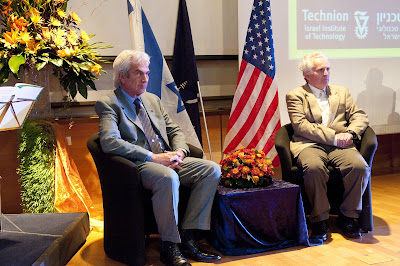
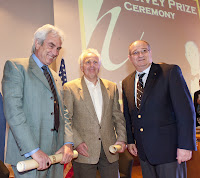
Prof. Michael Karin and Prof. Alexander Polyakov, Harvey Prize 2010 Laureates, with Technion President Prof. Peretz Lavie


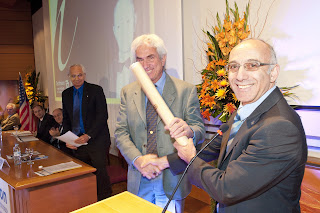
Prof. Michael Karin and Prof. Alexander Polyakov are the winners of the Technion’s 2010 Harvey Prize. The festive ceremony took place on March 15th, 2011.


“The road to discovery is not an easy one,” said Technion President Prof. Peretz Lavie.  “It is time-consuming and at times can come at great personal and professional costs.  However, discovery is the engine which drives the human race.  Without it, we would not be able to survive.  Furthermore, it is the greatest and most wondrous feat of our nature.”  


Prof. Karin, from the University of California, San Diego, received the prize in the field of human health. He discovered the strong link between obesity, inflammation and cancer. The judges decided to award the prize to Prof. Karin for “his pioneering contribution that led to deciphering the molecular mechanism through which mammalian cells react to cytokines which cause inflammation, to adverse environmental conditions and also to various pathogens. His research laid the foundations for our understanding of the control mechanisms of transcription factor activities influenced by external stimulations, especially the transcription factors of the AP-1 family and NF-B. These discoveries led to the identification of new target protein cells that have recently been used to develop new medications for preventing and treating various malignant tumors.”


Prof. Polyakov, from Princeton University, received the prize in the field of science and technology. “He developed revolutionary theories that shaped our contemporary understanding of elementary particles in nature. In addition, he significantly contributed to condensed matter physics, statistical mechanics and mathematics. Among the ideas credited to him are topological structures (such as magnetic monopoles) in gauge field theories, which are important in understanding the confinement of quarks in the nucleus. Polyakov also contributed to the foundations of string theory, the unification of quantum mechanics and gravity, and to the idea of duality between string theory and gauge field theory.”


The Technion’s prestigious Harvey Prize foresaw the winning of the Nobel Prize for two of the latest Nobel laureates – Elizabeth Blackburn (Medicine) and Ada Yonath of the Weizmann Institute of Science (Chemistry). To date, 13 Harvey Prize winners have gone on to win the Nobel Prize.


The Harvey Prize was first awarded in 1972 from a fund established by the late Leo M. Harvey of Los Angeles in order to recognize those who have made great contributions to advancing humanity in science and technology and in human health, as well as advancing peace in the Middle East. Every year, prizes totaling $75,000 per winner are awarded from the fund’s income.


Among the winners of the prestigious Harvey Prize are scientists from the US, Great Britain, Russia, Sweden, France and Israel. These include Nobel Prize laureate Mikhail Gorbachev, former leader of the USSR, who was awarded the prize for his activities aimed at reducing regional tensions; Prof. Bert Sakmann who won the Nobel Prize in Medicine; Prof. Pierre-Gilles de Gennes who won the Nobel Prize in Physics; Prof. Edward Teller for his discoveries in solid state physics, atomic physics and nuclear physics; and Prof. William J. Kolff for his invention of the artificial kidney.


Proposals for candidates for the Harvey Prize are received from leading scientists and personalities in Israel and the world. The prize laureates are chosen by the Harvey Prize committee in a stringent process at the Technion.

Prof. Karin (left) and Prof. Polyakov (right)


Description: Description: Description: TechnionLive - Technion’s e-newsletter Description: Description: Description: Technion Live on FaceBook Description: Description: Description: Technion’s YouTube Channel Description: Description: Description: Subscribe to RSS News Feeds