Tag Archives: Nobel

Jewelry ~ a whole new matter ~ Technion Nobel Laureate.

Private Collection: A Jewel for My Wife
Nobel Laureate 2011 Prof. Dan Shechtman

A JEWEL FOR MY WIFE

By Curator: Anat Har-gil

1972, Dayton, Ohio.  It all began innocently enough. Zippi, Dan’s wife, was busy in the evenings studying for a Master’s Degree in Sociology, and Dan Shechtman, a postdoctoral fellow, found himself studying stone polishing in the arts center during his free time.

Before long, five pairs of polished stones accumulated. Each pair, a different color. What would he do with them? He found himself attending a silver jewelry making course led by Mrs. Audrey Cray: “A very dear and special woman who taught me that esthetics is not an exact science. “Jewelry is created with feeling, love and patience,”

From that moment onwards, sensitively and delicately, Dan has been creating and designing jewelry. Jewelry for his wife: only for his wife.

The art of jewelry making became incorporated and condensed into the inherent knowledge he already possessed. Working with metal is familiar for Dan since he is a metallurgist. He understands metal; he handles it, in this case, to create his jewelry. The  enamel is sealed, at times melting in his hands until it becomes transparent. The metal expands and contracts. Together, enamel, metal and stone merge into a melting pot of
matter and spirit.

The scientific thinking behind his art is very powerful. Yet, at the same time, jewelry making is an excuse for him, a reason to be released from the clutches of the laboratory. The thinking is now visual in form and it begs awareness for its own existence.

Professional knowledge is translated into plastic values, and what really takes place is the transformation of his sketches and his technical ability into a beautiful creation.
Behind every design lies the story. Each piece of jewelry serves as an expression of emotion or the marking of an event. The process is fed, fertilized, and examined by “an audience of one” – his wife Zippi.

When this journey comes to end, it is not yet completed. A ceremony – heartfelt and modest then begins. The piece of jewelry is presented to Zippi as a surprise. Even though she is present before it is even made, she is not a partner in its making.

Dan Shechtman is a research professor in the Faculty of Materials Engineering at the Technion – Israel Institute of Technology. In the year 2011, he was awarded the Nobel Prize in Chemistry for his discovery of quasicrystals.

An exhibition of handcrafted jewelry created by Nobel Laureate Dan Shechtman is to be displayed on campus.Designed exclusively for his wife, Prof. Zipora Shechtman, the exhibition showcases 15 unique pieces ranging from earrings to bracelets with a single item — an Aztec-inspired silver belt buckle pictured bottom left — which Distinguished Prof. Shechtman made for himself. The exhibition, curated by Anat Har-Gil, will show June 10 to June 14, 2012, on the 4th floor of the Ullmann Teaching Center at Technion City in Haifa.


Jewelry ~ a whole new matter ~ Technion Nobel Laureate.

Private Collection: A Jewel for My Wife
Nobel Laureate 2011 Prof. Dan Shechtman

A JEWEL FOR MY WIFE

By Curator: Anat Har-gil

1972, Dayton, Ohio.  It all began innocently enough. Zippi, Dan’s wife, was busy in the evenings studying for a Master’s Degree in Sociology, and Dan Shechtman, a postdoctoral fellow, found himself studying stone polishing in the arts center during his free time.

Before long, five pairs of polished stones accumulated. Each pair, a different color. What would he do with them? He found himself attending a silver jewelry making course led by Mrs. Audrey Cray: “A very dear and special woman who taught me that esthetics is not an exact science. “Jewelry is created with feeling, love and patience,”

From that moment onwards, sensitively and delicately, Dan has been creating and designing jewelry. Jewelry for his wife: only for his wife.

The art of jewelry making became incorporated and condensed into the inherent knowledge he already possessed. Working with metal is familiar for Dan since he is a metallurgist. He understands metal; he handles it, in this case, to create his jewelry. The  enamel is sealed, at times melting in his hands until it becomes transparent. The metal expands and contracts. Together, enamel, metal and stone merge into a melting pot of
matter and spirit.

The scientific thinking behind his art is very powerful. Yet, at the same time, jewelry making is an excuse for him, a reason to be released from the clutches of the laboratory. The thinking is now visual in form and it begs awareness for its own existence.

Professional knowledge is translated into plastic values, and what really takes place is the transformation of his sketches and his technical ability into a beautiful creation.
Behind every design lies the story. Each piece of jewelry serves as an expression of emotion or the marking of an event. The process is fed, fertilized, and examined by “an audience of one” – his wife Zippi.

When this journey comes to end, it is not yet completed. A ceremony – heartfelt and modest then begins. The piece of jewelry is presented to Zippi as a surprise. Even though she is present before it is even made, she is not a partner in its making.

Dan Shechtman is a research professor in the Faculty of Materials Engineering at the Technion – Israel Institute of Technology. In the year 2011, he was awarded the Nobel Prize in Chemistry for his discovery of quasicrystals.

An exhibition of handcrafted jewelry created by Nobel Laureate Dan Shechtman is to be displayed on campus.Designed exclusively for his wife, Prof. Zipora Shechtman, the exhibition showcases 15 unique pieces ranging from earrings to bracelets with a single item — an Aztec-inspired silver belt buckle pictured bottom left — which Distinguished Prof. Shechtman made for himself. The exhibition, curated by Anat Har-Gil, will show June 10 to June 14, 2012, on the 4th floor of the Ullmann Teaching Center at Technion City in Haifa.


Outsmarting HIV with X-Ray Crystallography

Dr, Alian Akram, Lorry I. Lokey Center for Life Science & Engineering, Technion.

Outsmarting HIV


It sound like modern warfare, and indeed, even when aiming to outsmart a killer virus on a scale of about 100 nanometers, the latest technology makes all the difference. One of the deep passions behind Dr. Alian Akram’s pioneering crystallographic work in the Technion is a desire to advance treatments for HIV, the causative agent of AIDS.


Scientists in Akram’s lab investigate the general principles of how aggressive virus lock into the genetic resources of a patient – and how to prevent them from doing this. “It is a MUST to learn about the critical interactions and the mechanisms of resistance,” says Akram. The team is taking a sharp look at pathogen-host interaction and how the HIV virus literally hijacks the machinery of the host cell in order to replicate itself, and how it escapes the immune system. “We are hoping to determine the structures of key interacting molecules and develop new intervening strategies and drugs that prevent their interaction. We also want to understand the mechanism of emergent resistance in the proteins of this virus.”


Current drugs for HIV bind viral proteins – and yet it continues to mutate and regenerate. Akram’s team is working on a protein discovered in 2004 – intrinsic immunity APOBEC3G. This protein attacks the genome of HIV and causes hypermutation that leads to an abortive replication cycle for HIV. However, HIV expresses a protein that destroys APOBEC, so the Akram’s group wants to understand this process better so that it can be blocked.
Crystal structure of Pseudouridine synthase in complex with RNA solved by  Akram Alian. The structure reveals base-pair rearrangement as the key mechanism to rRNA substrate selectivity  (http://rnajournal.cshlp.org/content/16/6.cover-expansion)”

Outsmarting HIV with X-Ray Crystallography

Dr, Alian Akram, Lorry I. Lokey Center for Life Science & Engineering, Technion.

Outsmarting HIV


It sound like modern warfare, and indeed, even when aiming to outsmart a killer virus on a scale of about 100 nanometers, the latest technology makes all the difference. One of the deep passions behind Dr. Alian Akram’s pioneering crystallographic work in the Technion is a desire to advance treatments for HIV, the causative agent of AIDS.


Scientists in Akram’s lab investigate the general principles of how aggressive virus lock into the genetic resources of a patient – and how to prevent them from doing this. “It is a MUST to learn about the critical interactions and the mechanisms of resistance,” says Akram. The team is taking a sharp look at pathogen-host interaction and how the HIV virus literally hijacks the machinery of the host cell in order to replicate itself, and how it escapes the immune system. “We are hoping to determine the structures of key interacting molecules and develop new intervening strategies and drugs that prevent their interaction. We also want to understand the mechanism of emergent resistance in the proteins of this virus.”


Current drugs for HIV bind viral proteins – and yet it continues to mutate and regenerate. Akram’s team is working on a protein discovered in 2004 – intrinsic immunity APOBEC3G. This protein attacks the genome of HIV and causes hypermutation that leads to an abortive replication cycle for HIV. However, HIV expresses a protein that destroys APOBEC, so the Akram’s group wants to understand this process better so that it can be blocked.
Crystal structure of Pseudouridine synthase in complex with RNA solved by  Akram Alian. The structure reveals base-pair rearrangement as the key mechanism to rRNA substrate selectivity  (http://rnajournal.cshlp.org/content/16/6.cover-expansion)”

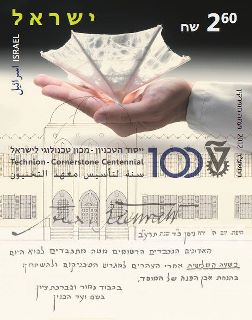
National Stamp Marks 100 years of Technion

Israeli post gets smart with the Technion Centennial Stamp

The Israel Postal Company’s Philatelic Service is issuing a stamp celebrating the 100th anniversary of the cornerstone laying ceremony in Haifa of the Technion.


The new stamp will be unveiled as part of the Technion’s centennial activities, which will be launched on Tuesday President, Prof. Peretz Lavie, Haifa Mayor Yona Yahav and the postal authorities. 


The stamp shows a sketch of the old Technion building’s plans and the image of a nano parachute developed at the Technion at the lab of Prof. Eyal Zussman.  The Nanofiber technology recently led to the establishment of a prize-winning new company, NanoSpun through the T3 Technion Technology Transfer office. 


The Technion was Israel’s first academic institution and is today one of the most prominent in its field, Postal Company board chairman Sasii Shilo told the Jerusalem Post.


Ubiquitin gets ubiquitous through the post… Technion’s first Nobel Laureates in Chemistry were also honored last year by a stamp released to celebrate their discovery. Read the full story here.

National Stamp Marks 100 years of Technion

Israeli post gets smart with the Technion Centennial Stamp

The Israel Postal Company’s Philatelic Service is issuing a stamp celebrating the 100th anniversary of the cornerstone laying ceremony in Haifa of the Technion.


The new stamp will be unveiled as part of the Technion’s centennial activities, which will be launched on Tuesday President, Prof. Peretz Lavie, Haifa Mayor Yona Yahav and the postal authorities. 


The stamp shows a sketch of the old Technion building’s plans and the image of a nano parachute developed at the Technion at the lab of Prof. Eyal Zussman.  The Nanofiber technology recently led to the establishment of a prize-winning new company, NanoSpun through the T3 Technion Technology Transfer office. 


The Technion was Israel’s first academic institution and is today one of the most prominent in its field, Postal Company board chairman Sasii Shilo told the Jerusalem Post.


Ubiquitin gets ubiquitous through the post… Technion’s first Nobel Laureates in Chemistry were also honored last year by a stamp released to celebrate their discovery. Read the full story here.

The Nobel Rap… In Israel, high science is STREET CRED

Some great Israeli artists, inspired by the 2011 Nobel Prize in Chemistry awarded to Dan Shechtman of Technion – Israel Institute of Technology…! A rap song for history.

מלים: איתי נבו
לחן עיבוד והפקה מוסיקלית: קובי אשרת

מבצעים: הרכב ההיפ הופ Mononova וקובי אשרת

הקלטה: אולפני Sound Garden ת”א

טכנאי הקלטה ומיקס: רועי עוזרי

יש לציין שכל המשתתפים הנ”ל עשו זאת בהתנדבות מלאה

Notice the Quasicrystal Tie?
You too could be wearing one soon!

The Nobel Rap… In Israel, high science is STREET CRED

Some great Israeli artists, inspired by the 2011 Nobel Prize in Chemistry awarded to Dan Shechtman of Technion – Israel Institute of Technology…! A rap song for history.

מלים: איתי נבו
לחן עיבוד והפקה מוסיקלית: קובי אשרת

מבצעים: הרכב ההיפ הופ Mononova וקובי אשרת

הקלטה: אולפני Sound Garden ת”א

טכנאי הקלטה ומיקס: רועי עוזרי

יש לציין שכל המשתתפים הנ”ל עשו זאת בהתנדבות מלאה

Notice the Quasicrystal Tie?
You too could be wearing one soon!

The Technion Nobel Tradition

The Technion Nobel Laureates

Nobel Laureate Albert Einstein used to play violin in a string quartet with historic Technion architect and faculty member Prof. Alexander Baerwald. In the recession after WW1, dreams of making the Technion a functioning reality were slim, and Einstein was invited to come visit the waiting buildings designed by his friend and to advise on the dream of opening a technical institute in Haifa. On that day, the Nobel Laureate and his wife planted two trees to mark the occasion. On his return to Berlin, Einstein would open and chair the world’s first Technion society – the initiation of an apparatus that would generate a century of progress, teaching and expansion as the decade by decade, the Technion could anticpate and meet the needs of a fledgling nation.
On the 100th anniversary of the Technion’s first cornerstone, Technion’s Prof. Dan Shechtman was awarded the Nobel Prize for Chemistry. He is today Technion’s third Nobel Laureate, joining Prof. Avraham Hershko and Aaron Ciechanover. All three of them follow the spirit of scientific integrity and excellence in pure research displayed by founding father Albert Einstein, to whom the Technion owes so much. Scroll down to absorb a little of the Technion’s Nobel legacy.


LOKEY PARK ~ TECHNION GARDEN OF NOBEL LAUREATES


Click here to ZOOM4
Lokey Park – a garden of trees planted by
global Nobel Laureates at Technion City.

Technion 2011 Nobel Laureate Danny Shectman will be joining a list of Nobel Laureates who planted trees to celebrate their visit to Technion. The tradition was begun by Prof. Albert Einstein – Chairman of the first Technion Society, who planted two palm trees in 1923 in front of the Technion’s majestic first building in Hadar, Haifa.
1921: Albert Einstein initiates the Technion Nobel tradition.

Nobel Laureate Trees planted at Lokey Park and on Technion soil.

  • Prof. Venkatraman Ramakrishnan, UK; Nobel Laureate in Chemistry, 2009
  • Professor Ada Yonath, Israel; Nobel Laureate in Chemistry, 2009
  • Professor Linda B. Buck, USA; Nobel Laureate in Physiology/Medicine 2004
  • Prof. Avram Hershko, Israel; Nobel Laureate in Chemistry 2004
  • Prof. Aaron Ciechanover, Israel; Nobel Laureate in Chemistry 2004
  • Prof. Tim Hunt. U.K; Nobel Laureate in Medicine, 2001
  • Prof. Kurt Wüthrich, Switzerland; Nobel Laureate in Chemistry, 2002
  • Prof. Günter Blobel, USA; Nobel Laureate in Medicine, 1999
  • Prof. Ferid Murad, USA; Nobel Laureate in Medicine, 1998
  • Prof. Jean-Marie Lehn, France; Nobel Laureate in Chemistry, 1987
  • Prof. David Gross, USA; Nobel Laureate in Physics, 2004
  • Prof. Elie Wiesel, USA; Nobel Laureate in Peace, 1986
  • Rita Levi-Montalcini, Italy; Nobel Prize in Physiology or Medicine, 1986
  • Albert Einstein, Germany/USA at old site; Nobel Prize in Physics, 1923


Click here to ZOOM2Click here to ZOOM3Click here to ZOOM4Click here to ZOOM5Click here to ZOOM7


Technion’s Nobel Laureates in Chemistry – Collect the stamp, and watch this space for a New Nobel Edition!


ISRAEL POST – INTERNATIONAL YEAR OF CHEMISTRY 2011


Technion Prof. Ehud Keinan, President of the Israel Chemical Society, had the vision to celebrate the international year of chemistry in a manner suited to the world-class position of Israel’s three Nobel Laureates in science. With determination and application, he engineered the release of official stamps celebrating the Year of Chemistry, and Israel’s Nobel Laureates.
Ubiquitin
Why our proteins must die so that we may live
Proteins are the machines that drive our bodies. They are responsible for all our activities, from the beating of our hearts, to walking, seeing, hearing, digestion, respiration and even the secretion of waste materials. Unlike useful items that surround us, like furniture and clothing, our bodies’ proteins are dynamic. They are constantly being destroyed and rebuilt, again and again. Our bodies destroy on a daily basis up to 10% of our proteins and generate new ones instead. This phenomenon raises interesting questions: why does this process occur at all, and how does it occur? Which diseases would happen if this mechanism was to fail? How can we cure such diseases? As part of the body’s quality control mechanism, proteins are destroyed after fulfilling their specific function in case they have been damaged by heat, by pollutants, by genetic mutation, or simply because they are no longer needed. Professors Aaron Ciechanover and Avram Hershko of the Technion – Israel Institute of Technology, and Irwin Rose of the University of California, Irvine, USA, were jointly awarded the 2004 Nobel Prize in Chemistry for discovering the mechanism that removes damaged or unnecessary proteins. These proteins are labeled for destruction by another small protein called ubiquitin, whose general structure is shown on the stamp. The structure was adopted from W. J. Cook and his coworkers, the Journal of Molecular Biology, 1987. Once tagged by this “kiss of death” the labeled proteins are removed by a biological shredding machine called the proteasome, while sparing healthy, untagged proteins. Aberrations in this protein destruction process may result in numerous sicknesses, including certain types of cancers and brain diseases. Many pharmaceutical companies are working to develop drugs to combat such diseases. One such drug to treat multiple myeloma, which is a form of blood cancer, is already used clinically.


Ehud Keinan
Professor of Chemistry
Technion – Israel Institute of Technology,
President of the Israel Chemical Society,
Editor in Chief, Israel Journal of Chemistry,
Chairman of the Chemistry Committee,
Ministry of Education
 
Dr. Joerg Harms of the University of Hamburg is
acknowledged for the ribosome graphics.
Technical Details:
Issue: January 2011
Design: Haimi Kivkovitch
Stamp Size: 30 mm x 40 mm
Plate nos: 823 (two phosphor bars)
824 (two phosphor bars)
Sheet of 15 stamps, Tabs: 5
Printers: Joh. Enschede, The Netherlands
Method of printing: Offset
 

The Technion Nobel Tradition

The Technion Nobel Laureates

Nobel Laureate Albert Einstein used to play violin in a string quartet with historic Technion architect and faculty member Prof. Alexander Baerwald. In the recession after WW1, dreams of making the Technion a functioning reality were slim, and Einstein was invited to come visit the waiting buildings designed by his friend and to advise on the dream of opening a technical institute in Haifa. On that day, the Nobel Laureate and his wife planted two trees to mark the occasion. On his return to Berlin, Einstein would open and chair the world’s first Technion society – the initiation of an apparatus that would generate a century of progress, teaching and expansion as the decade by decade, the Technion could anticpate and meet the needs of a fledgling nation.
On the 100th anniversary of the Technion’s first cornerstone, Technion’s Prof. Dan Shechtman was awarded the Nobel Prize for Chemistry. He is today Technion’s third Nobel Laureate, joining Prof. Avraham Hershko and Aaron Ciechanover. All three of them follow the spirit of scientific integrity and excellence in pure research displayed by founding father Albert Einstein, to whom the Technion owes so much. Scroll down to absorb a little of the Technion’s Nobel legacy.


LOKEY PARK ~ TECHNION GARDEN OF NOBEL LAUREATES


Click here to ZOOM4
Lokey Park – a garden of trees planted by
global Nobel Laureates at Technion City.

Technion 2011 Nobel Laureate Danny Shectman will be joining a list of Nobel Laureates who planted trees to celebrate their visit to Technion. The tradition was begun by Prof. Albert Einstein – Chairman of the first Technion Society, who planted two palm trees in 1923 in front of the Technion’s majestic first building in Hadar, Haifa.
1921: Albert Einstein initiates the Technion Nobel tradition.

Nobel Laureate Trees planted at Lokey Park and on Technion soil.

  • Prof. Venkatraman Ramakrishnan, UK; Nobel Laureate in Chemistry, 2009
  • Professor Ada Yonath, Israel; Nobel Laureate in Chemistry, 2009
  • Professor Linda B. Buck, USA; Nobel Laureate in Physiology/Medicine 2004
  • Prof. Avram Hershko, Israel; Nobel Laureate in Chemistry 2004
  • Prof. Aaron Ciechanover, Israel; Nobel Laureate in Chemistry 2004
  • Prof. Tim Hunt. U.K; Nobel Laureate in Medicine, 2001
  • Prof. Kurt Wüthrich, Switzerland; Nobel Laureate in Chemistry, 2002
  • Prof. Günter Blobel, USA; Nobel Laureate in Medicine, 1999
  • Prof. Ferid Murad, USA; Nobel Laureate in Medicine, 1998
  • Prof. Jean-Marie Lehn, France; Nobel Laureate in Chemistry, 1987
  • Prof. David Gross, USA; Nobel Laureate in Physics, 2004
  • Prof. Elie Wiesel, USA; Nobel Laureate in Peace, 1986
  • Rita Levi-Montalcini, Italy; Nobel Prize in Physiology or Medicine, 1986
  • Albert Einstein, Germany/USA at old site; Nobel Prize in Physics, 1923


Click here to ZOOM2Click here to ZOOM3Click here to ZOOM4Click here to ZOOM5Click here to ZOOM7


Technion’s Nobel Laureates in Chemistry – Collect the stamp, and watch this space for a New Nobel Edition!


ISRAEL POST – INTERNATIONAL YEAR OF CHEMISTRY 2011


Technion Prof. Ehud Keinan, President of the Israel Chemical Society, had the vision to celebrate the international year of chemistry in a manner suited to the world-class position of Israel’s three Nobel Laureates in science. With determination and application, he engineered the release of official stamps celebrating the Year of Chemistry, and Israel’s Nobel Laureates.
Ubiquitin
Why our proteins must die so that we may live
Proteins are the machines that drive our bodies. They are responsible for all our activities, from the beating of our hearts, to walking, seeing, hearing, digestion, respiration and even the secretion of waste materials. Unlike useful items that surround us, like furniture and clothing, our bodies’ proteins are dynamic. They are constantly being destroyed and rebuilt, again and again. Our bodies destroy on a daily basis up to 10% of our proteins and generate new ones instead. This phenomenon raises interesting questions: why does this process occur at all, and how does it occur? Which diseases would happen if this mechanism was to fail? How can we cure such diseases? As part of the body’s quality control mechanism, proteins are destroyed after fulfilling their specific function in case they have been damaged by heat, by pollutants, by genetic mutation, or simply because they are no longer needed. Professors Aaron Ciechanover and Avram Hershko of the Technion – Israel Institute of Technology, and Irwin Rose of the University of California, Irvine, USA, were jointly awarded the 2004 Nobel Prize in Chemistry for discovering the mechanism that removes damaged or unnecessary proteins. These proteins are labeled for destruction by another small protein called ubiquitin, whose general structure is shown on the stamp. The structure was adopted from W. J. Cook and his coworkers, the Journal of Molecular Biology, 1987. Once tagged by this “kiss of death” the labeled proteins are removed by a biological shredding machine called the proteasome, while sparing healthy, untagged proteins. Aberrations in this protein destruction process may result in numerous sicknesses, including certain types of cancers and brain diseases. Many pharmaceutical companies are working to develop drugs to combat such diseases. One such drug to treat multiple myeloma, which is a form of blood cancer, is already used clinically.


Ehud Keinan
Professor of Chemistry
Technion – Israel Institute of Technology,
President of the Israel Chemical Society,
Editor in Chief, Israel Journal of Chemistry,
Chairman of the Chemistry Committee,
Ministry of Education
 
Dr. Joerg Harms of the University of Hamburg is
acknowledged for the ribosome graphics.
Technical Details:
Issue: January 2011
Design: Haimi Kivkovitch
Stamp Size: 30 mm x 40 mm
Plate nos: 823 (two phosphor bars)
824 (two phosphor bars)
Sheet of 15 stamps, Tabs: 5
Printers: Joh. Enschede, The Netherlands
Method of printing: Offset