Category Archives: News

What they’re saying about Nobel Laureate Dan Shechtman

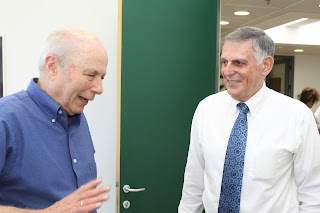
Technion Nobel Laureate (Chemistry 2004) shares his experience
with his colleague Shechtman, Nobel Laureate (Chemistry, 2011)


“I salute you, you gave the people of Israel a wonderful gift. This is a great day for Haifa, a great day for the Technion.”

President of the State of Israel Shimon Peres

“It’s been an honor to congratulate him today and I look forward to working more with the Technion in the future.”

Swedish Ambassador to Israel Elinor Hammarskjöld 


“I would like to congratulate you, on behalf of the citizens of Israel, for your award, which expresses the intellect of our people. Every Israeli is happy today and every Jew in the world is proud. I also congratulated your institution, the Technion, on the centenary of its founding.”


Prime Minister of the State of Israel Benyamin Netanyahu


“Congratulations from your your granddaughter’s school in California….our class is so proud of you for your research and findings.”
KIM PRESCOTT, TEACHER


From the Scientists


“Dan Shechtman comes along and proves us all wrong. It’s the next step in crystallography. It is outrageous. It is fantastic. Before Dr. Shechtman’s discovery, this was thought impossible. It absolutely deserves the Nobel.” 


Peter Mueller, MIT

“Dan is a very careful experimentalist and what he did, he did right. He violated a dogma of crystallography – at that time some 200 years old – and nevertheless defended it”.

Prof. Knut Urban, professor of experimental physics at RWTH Aachen University, Germany


“Dan spent two years convincing everybody  about his discovery. This is a revolution in physics, in crystallography.”


Prof. An-Pang Tsai, Tohuku University, Japan,

“I had more or less the same alloys as Shechtman at the same time, but I did not recognize them to be quasicrystals.”


Prof. Jean-Marie Dubois, CNRS—French National Center for Scientific Research,


“It is not always enough to make the discovery, you have to fight and advocate on its behalf…without Danny’s patience, stubbornness, and tenacity it would have been much more challenging.”


Prof. Peretz Lavie, Technion president:

“It became clear that an old paradigm had crashed and a new one was emerging.”


Prof. Marjorie Senechal, mathematical crystallographer at Smith College, Massachusetts

“Dan Shechtman is a real teacher and mentor and role model in the faculty.”


Dr Boaz Pokroy, Senior Lecturer in the Faculty of Materials Engineering

“Danny Shechtman made a very important discovery. I think this discovery is an excellent example for which a Nobel Prize should be given.”


Prof. István Hargittai, Budapest University of Technology and Economics

“There is a community of international scientists who couldn’t communicate with each other before the discovery of quasicrystals and now speak the language of quasiperiodicity.”


Distinguished Prof. Dan Shechtman

 “There is no such thing as quasicrystals, only quasi-scientists.”


Linus Pauling, Nobel laureate. 

Quasicrystals & the Speed of Light


“Science” reveals: Quasicrystals enhance transmission properties.
A research team under Prof. Moti Segev at the Technion Faculty of Physics have shown that quasicrystals unveiled in 1982 by Technion Nobel Laureate Dan Shechtman have advanced properties in transmitting electrons. The research, published in Science, is in direct contradiction to the belief that non-periodic crystals could limit transmission properties of materials. Furthermore, the team revealed that the more the disorder, the more enhanced the expansion of the beam propagating through the medium. 
The researchers used an optical system to build a quasi-crystal photon, to track the speed of light.

“The assumption that nature is basically formed of solid, cyclical structures is incorrect,” say the researchers. Until the eighties, all the crystals investigated were composed of a basic structure (unit cell). “However, in 1982 Professor Dan Shechtman revealed evidence of Quasi-cyclical materials in which the atoms / molecules are arranged in Periodic (crystalline) patterns on the one hand, but are scattered randomly on the other. This discovery is shaking the scientific world.” Conclusions from this study have implications for the study of electron conduction.

QuasiCrystals, Shechtmanite… Future Applications.


Surface Coatings

An important area of application is the use of quasicrystals as materials for surface coatings, which benefit from the hardness of quasicrystals. The most prominent example is the use of quasicrystalline coatings in frying pans – an application famous in the quasicrystal community as it has served as a key example. Recently, quasicrystal-coated frying pans appeared on the market, and are sold by the French company Sitram under the trademark Cybernox.

Due to their particular physical and chemical properties, quasicrystalline coatings are suited for this kind of application. They are also rather cheap which makes them even more interesting for industrial applications. 

Alloys Containing Quasicrystalline Nanoparticles

A different way to circumvent the brittleness of quasicrystalline bulk material while preserving some of its useful properties is the use of an Al-based alloy reinforced by precipitation of icosahedral particles in the nanometer range. Such materials, which are now commercially available in Japan, are of great technological interest as they can be strong but much lighter than other materials with comparable physical properties.

Examples of existing applications include razor blades and surgeon’s instruments, though this may have been more by chance than being an intentional application of quasicrystals. Experts predict that a similar use could soon find its way to the aviation industry.

Hydrogen Storage

A third, and maybe more speculative, application concerns the use of quasicrystals as a reversible storage medium for hydrogen. The most promising quasicrystal materials for hydrogen storage are Zr-based quasicrystals. For such systems, storage capabilities of almost two hydrogen atoms per metal atom have been reported, comparable to the storage capability of the Ti-Fe hybrides which have already been applied in non-polluting internal combustion engines. Further investigation are being carried out to reach the stage of industrial applicability.

Prof. Dan Shechtman Discusses Quasicrystal Applications 
(Oct. 2011)
“There is always something new in quasicrystals. There are so many people working on it around the world, so every month there are new developments. If you use a material for an application, then you need a special property that will be better than other materials—otherwise, why use this material? Quasi-periodic materials have certain properties which are unique, such as electrical properties, optical properties, hardness and nonstick properties. The direction of light through this material is different. Electrically, they behave in a very peculiar way depending on temperature. Some of these properties have been put to use. 
The first application was nonstick coating on frying pans and cooking utensils. If you cook on quasicrystals, your omelet will not stick to it, like Teflon. But unlike Teflon, if you use a knife in the [quasicrystal] skillet, you will ruin the knife. When you have Teflon and you use a knife, you ruin the Teflon. Ruined Teflon is not healthy. I have a frying pan which is plasma-coated with quasicrystals and it works fine. It was made by a French company, Sitram. They closed the production line because they had a few problems in the reaction of the coating with salt. If people cook with a lot of salt it will etch the quasicrystalline coating. People didn’t like it, so they did not continue.
Sandvik, a company in Sweden, produces a precipitation-hardened stainless steel that has interesting properties. The steel is strengthened by small quasicrystalline particles and it does not corrode. It is an extremely strong steel. It is used for anything that touches the skin, for instance, razor blades or surgery tools. When a material deforms in such a way that it will not spring back, in most cases, the deformation is due to a process called dislocation glide. There are defects in the material that cause dislocations. If they are free to move, then it is easy to bend the material. But if something stops them, then it is more difficult and the material is harder and stronger. These little quasicrystalline particles impede the motion of dislocation in the material.
Because some of these materials have a low coefficient of friction, and they have nonstick properties and are also hard, imagine what would happen if you produce quasicrystalline powder in tiny little balls by rapid solidification process, a gas-atomizing process, then you can embed the fine powders in plastic. Because these particles are strong and can withstand friction and wear, you can make gears from this plastic and the gears will not erode because of these embedded particles. It’s like a protection from erosion. This can serve in ventilators and fans that have plastic gears. Also, the heat conductivity of some of these quasicrystals is very poor. It’s almost an insulator. So you can coat with it and it will insulate against heat transfer.
This is an important discovery, because it’s the first one found in nature, but there are no practical applications. There are many, many metals, but if you think that all the metals can be used for something useful, think again. Look at construction materials. We have steel, which is based on iron, we have aluminum alloys, magnesium alloys, titanium-based alloys, nickel-based alloys, copper alloys, and that’s about all, if I haven’t forgotten any. What do all the other metals do? What are the applications of ytterbium? What are the applications of all the other metals? So to have an application for a material is not trivial.”

QuasiCrystals, Shechtmanite… Future Applications.


Surface Coatings

An important area of application is the use of quasicrystals as materials for surface coatings, which benefit from the hardness of quasicrystals. The most prominent example is the use of quasicrystalline coatings in frying pans – an application famous in the quasicrystal community as it has served as a key example. Recently, quasicrystal-coated frying pans appeared on the market, and are sold by the French company Sitram under the trademark Cybernox.

Due to their particular physical and chemical properties, quasicrystalline coatings are suited for this kind of application. They are also rather cheap which makes them even more interesting for industrial applications. 

Alloys Containing Quasicrystalline Nanoparticles

A different way to circumvent the brittleness of quasicrystalline bulk material while preserving some of its useful properties is the use of an Al-based alloy reinforced by precipitation of icosahedral particles in the nanometer range. Such materials, which are now commercially available in Japan, are of great technological interest as they can be strong but much lighter than other materials with comparable physical properties.

Examples of existing applications include razor blades and surgeon’s instruments, though this may have been more by chance than being an intentional application of quasicrystals. Experts predict that a similar use could soon find its way to the aviation industry.

Hydrogen Storage

A third, and maybe more speculative, application concerns the use of quasicrystals as a reversible storage medium for hydrogen. The most promising quasicrystal materials for hydrogen storage are Zr-based quasicrystals. For such systems, storage capabilities of almost two hydrogen atoms per metal atom have been reported, comparable to the storage capability of the Ti-Fe hybrides which have already been applied in non-polluting internal combustion engines. Further investigation are being carried out to reach the stage of industrial applicability.

Prof. Dan Shechtman Discusses Quasicrystal Applications 
(Oct. 2011)
“There is always something new in quasicrystals. There are so many people working on it around the world, so every month there are new developments. If you use a material for an application, then you need a special property that will be better than other materials—otherwise, why use this material? Quasi-periodic materials have certain properties which are unique, such as electrical properties, optical properties, hardness and nonstick properties. The direction of light through this material is different. Electrically, they behave in a very peculiar way depending on temperature. Some of these properties have been put to use. 
The first application was nonstick coating on frying pans and cooking utensils. If you cook on quasicrystals, your omelet will not stick to it, like Teflon. But unlike Teflon, if you use a knife in the [quasicrystal] skillet, you will ruin the knife. When you have Teflon and you use a knife, you ruin the Teflon. Ruined Teflon is not healthy. I have a frying pan which is plasma-coated with quasicrystals and it works fine. It was made by a French company, Sitram. They closed the production line because they had a few problems in the reaction of the coating with salt. If people cook with a lot of salt it will etch the quasicrystalline coating. People didn’t like it, so they did not continue.
Sandvik, a company in Sweden, produces a precipitation-hardened stainless steel that has interesting properties. The steel is strengthened by small quasicrystalline particles and it does not corrode. It is an extremely strong steel. It is used for anything that touches the skin, for instance, razor blades or surgery tools. When a material deforms in such a way that it will not spring back, in most cases, the deformation is due to a process called dislocation glide. There are defects in the material that cause dislocations. If they are free to move, then it is easy to bend the material. But if something stops them, then it is more difficult and the material is harder and stronger. These little quasicrystalline particles impede the motion of dislocation in the material.
Because some of these materials have a low coefficient of friction, and they have nonstick properties and are also hard, imagine what would happen if you produce quasicrystalline powder in tiny little balls by rapid solidification process, a gas-atomizing process, then you can embed the fine powders in plastic. Because these particles are strong and can withstand friction and wear, you can make gears from this plastic and the gears will not erode because of these embedded particles. It’s like a protection from erosion. This can serve in ventilators and fans that have plastic gears. Also, the heat conductivity of some of these quasicrystals is very poor. It’s almost an insulator. So you can coat with it and it will insulate against heat transfer.
This is an important discovery, because it’s the first one found in nature, but there are no practical applications. There are many, many metals, but if you think that all the metals can be used for something useful, think again. Look at construction materials. We have steel, which is based on iron, we have aluminum alloys, magnesium alloys, titanium-based alloys, nickel-based alloys, copper alloys, and that’s about all, if I haven’t forgotten any. What do all the other metals do? What are the applications of ytterbium? What are the applications of all the other metals? So to have an application for a material is not trivial.”

Technion President on the 2011 Nobel Prize.


From the President


Welcome to this special edition of TechnionLIVE with which we share with you our joy and excitement over this week’s announcement that Distinguished Prof. Dan Shechtman is to receive the 2011 Nobel Prize in Chemistry. With this, Dan becomes Technion’s 3rd Nobel Laureate in chemistry. The announcement also brings new accolade to our department of Materials Engineering – which has recently gained repute as a leading center worldwide in the science of matter. Indeed, Danny’s discovery in April, 1982 unveiled a whole new class of matter. Just when science had moved into a kind of closure with established laws regarding the material world, a young, insignificant scientist began publishing the opposite. The idea of quasicrystals – observed by Shechtman on sabbatical in 1982 – was an affront to material science, and was fought to the end by Nobel Laureates such as Linus Pauling. 

Yet Danny clung to the truth as if it was a rock in a sea of rejection.

Danny did his 1st, 2nd and 3rd degrees at Technion before joining the Technion faculty. Technion is his home, and supported him in his vigilant adherence to scientific truth then, just as today it joins him to celebrate the world’s highest honor. The career and characer of Dan Shechtman reflects so much of what we love about Technion and its scientists. Loyalty to objective, basic research; a grounded, thorough ability to prove controversial results; an ability to think “out-of-the-box”; and in scientific terms: excellence, courage and pure Chutzpah.

The wonderful news comes as we open our 100 year cornerstone centennial year. 70 years (to the month!) after the first cornerstone of Technion was laid, Danny discovered Shechtmanite. 30 years later, the breakthrough has brought Shechtman the world’s highest scientific honor.  In a manner of speaking, Shechtmanite – or the discovery of quasicrystals – was embedded in that first rock – the Technion cornerstone. It was a rock on which 100 years of progress, teaching, wonder and innovation would be built. The cornerstone today reverberates with the miracle of matter, where the beautiful “Shechtmanite” – perfect in its quasiperiodic form – unveils a myriad of new possibilities and a new century of hope and manifestation for Technion, Israel and the world.


Technion President Peretz Lavie (left)
with new Nobel Laureate Dan Shechtman

On the way to Stockholm, Proud 2B NOBEL

On the way to Stockholm
~Following daily events of Israel’s 2011 Nobel Prize Laureate~

October 9th, 2011
Global Press Conference. Jerusalem.

Q: Jewish telegraphic Agency.  Why are Israelis so successful in winning Nobel Prizes in Science?

The universities are excellent. Technion is a very good school for engineering and science.
We have not only good education but the system here encourages originality. We are free thinkers. This si the Israeli spirit. Sometimes this leads to chaos but free thinking encourages successful scientists. But also we are living here in a free society. Many of us do not follow the rules, and this is part of the national character of a free-thinking people.

Q: Fati – from  Turkish TV.  What did you feel when you heard the announcement?

I’m never aware of when the prizes are announced, the date etc. Usually, friends tell me about the Nobel Prize in Physics. I told my wife. It felt great. I’m not the type to feel elated and jump up and down. Then, everyone arrived and started celebrating in my little office. I’m happy to talk to you; It’s for science, for Technion, and for Israel. I’m the spearhead. Behind me there are thousands of scientists and I represent them all.

Q: Norwegian Daily Newspaper. Can you explain what is this science?

It was difficult to discover non-periodic crystals by x-ray. The first quasicrystals were discovered by me. Grain size is 1 micron – which is not a problem for the electron microscope. You need a single crystal. You couldn’t discover this by x-ray, so long as the size is so small. The trusted tool of choice was x-ray diffraction. It is very precise BUT you cannot discover quasicrystals there. So the international community of quasicrystallographers didn’t accept my results.
In 1987, colleagues managed to create a large-enough crystal [to be viewed by] for x-ray. In 1983 I returned to Technion. The first person willing to help me decipher what I had found was Prof. Ilan Blech. We joined forces. He proposed a model.
In 1984, the first paper was rejected. Then with John Cahn and Denis Gratias, the 4 of us composed a short paper to Physical Review Letters and published it November 1984. Then all hell broke loose. It was easy to repeat my experiment, I gave instructions, and all over the world people started doing it.

Q: Berlin correspondent. What is the practical, applied use?

As opposed to the greatness of the scientific achievement, the applications are few and far between  Quasi materials have certain unique properties. Hardness, electrical, optical, and non-stick. For example, if you cook on a quasi pan, your omelette will not stick. Like Teflon. But unlike Teflon, if you use a knife, it will ruin the knife, not the Teflon. There is a French company producing the frying pans. They have a low coefficient of friction. If you embed the powder of these materials in plastic, then make gears, they will not erode. For example, in ventilators and fans.
To have an application for a material is not trivial. Most metals do not have. There is a steel made in Sweden, precipitation hardened stainless steel. It does not corrode. It is used in razor blades, surgical tools. The steel is strengthened by tiny quasicrystalline particles.

Q: Tell us about your confidence
I tell students: First be an expert on something. Great discoveries come by serendipity. Usually, you stumble upon it. In many cases, it weill be an artifact but in other cases it will be something new. Then study it thoroughly. Here is a real test: if you believe in yourself, listen to others but don’t let them discourage you unless you are convinced they are right and you are wrong. In my case, I knew I was right from Day One.

Q: What will you do with the money?
It will all be dedicated to education – mainly of my grandchildren.

Q: How do you relate to Judaism as a scientist and to science as a Jew?
I am a Jew because I was born to a Jewish family. My father’s grandfather was a religious Jew in Russia. He was a religious leader (not a rabbi). My grandfather and father were not religious. My grandfather was a socialist. Most of my family is not religious. I feel that I am as good a Jew as anybody else. I cherish Jewish heritage and tradition and I respect the Jewish religion.
How do I relate to science as a Jew? I don’t see why there is a difference. In our community of scientists, the question of ethnic origin or religion NEVER comes up.
I have excellent relations with countries that don’t always have relations with Israel. Science continues.

Q: AP. To follow up on education. You are the 10th Israeli Nobel laureate. Israel has the second-highest rate of Nobel laureates.

I’m talking about science. The universities do a great job and will continue to do so. But candidates to the universities must be with motivation and know how to behave in civilization, with a knowledge of the Arts, music. This depends on education, which is a broader term than teaching. Teachers must encourage and support. I will never forget my physics teacher who told me “Dan knows Physics.” He will have forgotten it straight after, but I carry it with me to this day.

Q: Israel21c Abigail Leifmann: Is there anything specifically Israeli which helped you to persevere when you could have given up?

Definitely. We have learned in school, and at a leftist Youth Movement. We were educated to become physically and mentally independent. One such task was to walk in the dark through orchards. We all had paramilitary education in high school. Everybody did it. Like running in a field with barbed wire… I was a sharpshooter when I was young. One of the best in the country. There was a competition in Jerusalem and I was one of 5 in the team representing the Petach-Tikva school. I had to shoot 5 bullets into one point. We learned to be independent – if you threw us on a Desert Island we would survive. That’s the Israeli character.


October 6th, 2011


Israel PM Netanyahu dons the now famous quasicrystal tie.


Shechtman Netanyahu - GPO - October 6, 2011
 Photo by: Amos Ben-Gershom / GPO


Morning: Visit of the Swedish Ambassador Elinor Hammarskjöld to Technion to meet with Prof. Shechtman 

Dan Shechtman and Ellinor Hammarskjöld. Photo: Carl-Magnus Nilsson
Shechtman with Swedish Ambassador to
Israel Elinor Hammarskjöld 


“Technion is one of the Israeli academic institutions that is well known in Sweden, it is an institute with great international repute. Sweden cooperates with many scientists from Israel some from the Technion and Prof. Shechtman talked about his previous visits to Sweden, so it’s been an honor to congratulate him today and I look forward to working more with the Technion in the future.”


“One of our focus areas is cooperation with universities. I look forward to visiting Technion again in the future and learning more about the institute.”
“This is very exciting for me, I’ve been in my position here for only one year, in my previous posts I never had the pleasure of congratulating a Nobel laureate.”
“It’s not easy being a celebrity, it could impede future research. The Nobel ceremony itself is nothing to be anxious about…the problem is surviving all the events that follow,” 

Technion Nobel Laureate 2004 (Chemistry) Avraham Hershko.

October 5th, 2011
The 2011 Nobel Prize for Chemistry is announced


From Stockholm, and through the Technion LIVE:
News Spreads fast through the social media. The Technion is swamped with phone-calls. Technion President Peretz Lavie rushes to the senate. “Does anyone know where Danny is?” he asks.

Emergency Press Conference at Technion

An emergency Press Conference is called. Danny is found. The room is swamped with reporters.
Technion staff remember a stock of ties produced by our genius graphic designer Guy Nawy some time earlier (just because he loves Shectmanite). The ties are rapidly donned by Technion President Peretz Lavie, New Nobel Laureate Prof. Danny Shechtman and dean of the Department of Materials Engineering Wayne Kaplan.

MEET THE PRESS! (Get used to it Danny!)

President Peretz Lavie & Prof. Dan Shechtman
sport the legendary quasicrystal ties.

Prime Minister Netanyahu adds his congratulations to the millions of others flooding through all communication channels:
“I would like to congratulate you, on behalf of the citizens of Israel, for your award, which expresses the intellect of our people. Every Israeli is happy today and every Jew in the world is proud. I also congratulated your institution, the Technion, on the centenary of its founding.”


The Technion Nobel Tradition

The Technion Nobel Laureates

Nobel Laureate Albert Einstein used to play violin in a string quartet with historic Technion architect and faculty member Prof. Alexander Baerwald. In the recession after WW1, dreams of making the Technion a functioning reality were slim, and Einstein was invited to come visit the waiting buildings designed by his friend and to advise on the dream of opening a technical institute in Haifa. On that day, the Nobel Laureate and his wife planted two trees to mark the occasion. On his return to Berlin, Einstein would open and chair the world’s first Technion society – the initiation of an apparatus that would generate a century of progress, teaching and expansion as the decade by decade, the Technion could anticpate and meet the needs of a fledgling nation.
On the 100th anniversary of the Technion’s first cornerstone, Technion’s Prof. Dan Shechtman was awarded the Nobel Prize for Chemistry. He is today Technion’s third Nobel Laureate, joining Prof. Avraham Hershko and Aaron Ciechanover. All three of them follow the spirit of scientific integrity and excellence in pure research displayed by founding father Albert Einstein, to whom the Technion owes so much. Scroll down to absorb a little of the Technion’s Nobel legacy.


LOKEY PARK ~ TECHNION GARDEN OF NOBEL LAUREATES


Click here to ZOOM4
Lokey Park – a garden of trees planted by
global Nobel Laureates at Technion City.

Technion 2011 Nobel Laureate Danny Shectman will be joining a list of Nobel Laureates who planted trees to celebrate their visit to Technion. The tradition was begun by Prof. Albert Einstein – Chairman of the first Technion Society, who planted two palm trees in 1923 in front of the Technion’s majestic first building in Hadar, Haifa.
1921: Albert Einstein initiates the Technion Nobel tradition.

Nobel Laureate Trees planted at Lokey Park and on Technion soil.

  • Prof. Venkatraman Ramakrishnan, UK; Nobel Laureate in Chemistry, 2009
  • Professor Ada Yonath, Israel; Nobel Laureate in Chemistry, 2009
  • Professor Linda B. Buck, USA; Nobel Laureate in Physiology/Medicine 2004
  • Prof. Avram Hershko, Israel; Nobel Laureate in Chemistry 2004
  • Prof. Aaron Ciechanover, Israel; Nobel Laureate in Chemistry 2004
  • Prof. Tim Hunt. U.K; Nobel Laureate in Medicine, 2001
  • Prof. Kurt Wüthrich, Switzerland; Nobel Laureate in Chemistry, 2002
  • Prof. Günter Blobel, USA; Nobel Laureate in Medicine, 1999
  • Prof. Ferid Murad, USA; Nobel Laureate in Medicine, 1998
  • Prof. Jean-Marie Lehn, France; Nobel Laureate in Chemistry, 1987
  • Prof. David Gross, USA; Nobel Laureate in Physics, 2004
  • Prof. Elie Wiesel, USA; Nobel Laureate in Peace, 1986
  • Rita Levi-Montalcini, Italy; Nobel Prize in Physiology or Medicine, 1986
  • Albert Einstein, Germany/USA at old site; Nobel Prize in Physics, 1923


Click here to ZOOM2Click here to ZOOM3Click here to ZOOM4Click here to ZOOM5Click here to ZOOM7


Technion’s Nobel Laureates in Chemistry – Collect the stamp, and watch this space for a New Nobel Edition!


ISRAEL POST – INTERNATIONAL YEAR OF CHEMISTRY 2011


Technion Prof. Ehud Keinan, President of the Israel Chemical Society, had the vision to celebrate the international year of chemistry in a manner suited to the world-class position of Israel’s three Nobel Laureates in science. With determination and application, he engineered the release of official stamps celebrating the Year of Chemistry, and Israel’s Nobel Laureates.
Ubiquitin
Why our proteins must die so that we may live
Proteins are the machines that drive our bodies. They are responsible for all our activities, from the beating of our hearts, to walking, seeing, hearing, digestion, respiration and even the secretion of waste materials. Unlike useful items that surround us, like furniture and clothing, our bodies’ proteins are dynamic. They are constantly being destroyed and rebuilt, again and again. Our bodies destroy on a daily basis up to 10% of our proteins and generate new ones instead. This phenomenon raises interesting questions: why does this process occur at all, and how does it occur? Which diseases would happen if this mechanism was to fail? How can we cure such diseases? As part of the body’s quality control mechanism, proteins are destroyed after fulfilling their specific function in case they have been damaged by heat, by pollutants, by genetic mutation, or simply because they are no longer needed. Professors Aaron Ciechanover and Avram Hershko of the Technion – Israel Institute of Technology, and Irwin Rose of the University of California, Irvine, USA, were jointly awarded the 2004 Nobel Prize in Chemistry for discovering the mechanism that removes damaged or unnecessary proteins. These proteins are labeled for destruction by another small protein called ubiquitin, whose general structure is shown on the stamp. The structure was adopted from W. J. Cook and his coworkers, the Journal of Molecular Biology, 1987. Once tagged by this “kiss of death” the labeled proteins are removed by a biological shredding machine called the proteasome, while sparing healthy, untagged proteins. Aberrations in this protein destruction process may result in numerous sicknesses, including certain types of cancers and brain diseases. Many pharmaceutical companies are working to develop drugs to combat such diseases. One such drug to treat multiple myeloma, which is a form of blood cancer, is already used clinically.


Ehud Keinan
Professor of Chemistry
Technion – Israel Institute of Technology,
President of the Israel Chemical Society,
Editor in Chief, Israel Journal of Chemistry,
Chairman of the Chemistry Committee,
Ministry of Education
 
Dr. Joerg Harms of the University of Hamburg is
acknowledged for the ribosome graphics.
Technical Details:
Issue: January 2011
Design: Haimi Kivkovitch
Stamp Size: 30 mm x 40 mm
Plate nos: 823 (two phosphor bars)
824 (two phosphor bars)
Sheet of 15 stamps, Tabs: 5
Printers: Joh. Enschede, The Netherlands
Method of printing: Offset
 

The Technion Nobel Tradition

The Technion Nobel Laureates

Nobel Laureate Albert Einstein used to play violin in a string quartet with historic Technion architect and faculty member Prof. Alexander Baerwald. In the recession after WW1, dreams of making the Technion a functioning reality were slim, and Einstein was invited to come visit the waiting buildings designed by his friend and to advise on the dream of opening a technical institute in Haifa. On that day, the Nobel Laureate and his wife planted two trees to mark the occasion. On his return to Berlin, Einstein would open and chair the world’s first Technion society – the initiation of an apparatus that would generate a century of progress, teaching and expansion as the decade by decade, the Technion could anticpate and meet the needs of a fledgling nation.
On the 100th anniversary of the Technion’s first cornerstone, Technion’s Prof. Dan Shechtman was awarded the Nobel Prize for Chemistry. He is today Technion’s third Nobel Laureate, joining Prof. Avraham Hershko and Aaron Ciechanover. All three of them follow the spirit of scientific integrity and excellence in pure research displayed by founding father Albert Einstein, to whom the Technion owes so much. Scroll down to absorb a little of the Technion’s Nobel legacy.


LOKEY PARK ~ TECHNION GARDEN OF NOBEL LAUREATES


Click here to ZOOM4
Lokey Park – a garden of trees planted by
global Nobel Laureates at Technion City.

Technion 2011 Nobel Laureate Danny Shectman will be joining a list of Nobel Laureates who planted trees to celebrate their visit to Technion. The tradition was begun by Prof. Albert Einstein – Chairman of the first Technion Society, who planted two palm trees in 1923 in front of the Technion’s majestic first building in Hadar, Haifa.
1921: Albert Einstein initiates the Technion Nobel tradition.

Nobel Laureate Trees planted at Lokey Park and on Technion soil.

  • Prof. Venkatraman Ramakrishnan, UK; Nobel Laureate in Chemistry, 2009
  • Professor Ada Yonath, Israel; Nobel Laureate in Chemistry, 2009
  • Professor Linda B. Buck, USA; Nobel Laureate in Physiology/Medicine 2004
  • Prof. Avram Hershko, Israel; Nobel Laureate in Chemistry 2004
  • Prof. Aaron Ciechanover, Israel; Nobel Laureate in Chemistry 2004
  • Prof. Tim Hunt. U.K; Nobel Laureate in Medicine, 2001
  • Prof. Kurt Wüthrich, Switzerland; Nobel Laureate in Chemistry, 2002
  • Prof. Günter Blobel, USA; Nobel Laureate in Medicine, 1999
  • Prof. Ferid Murad, USA; Nobel Laureate in Medicine, 1998
  • Prof. Jean-Marie Lehn, France; Nobel Laureate in Chemistry, 1987
  • Prof. David Gross, USA; Nobel Laureate in Physics, 2004
  • Prof. Elie Wiesel, USA; Nobel Laureate in Peace, 1986
  • Rita Levi-Montalcini, Italy; Nobel Prize in Physiology or Medicine, 1986
  • Albert Einstein, Germany/USA at old site; Nobel Prize in Physics, 1923


Click here to ZOOM2Click here to ZOOM3Click here to ZOOM4Click here to ZOOM5Click here to ZOOM7


Technion’s Nobel Laureates in Chemistry – Collect the stamp, and watch this space for a New Nobel Edition!


ISRAEL POST – INTERNATIONAL YEAR OF CHEMISTRY 2011


Technion Prof. Ehud Keinan, President of the Israel Chemical Society, had the vision to celebrate the international year of chemistry in a manner suited to the world-class position of Israel’s three Nobel Laureates in science. With determination and application, he engineered the release of official stamps celebrating the Year of Chemistry, and Israel’s Nobel Laureates.
Ubiquitin
Why our proteins must die so that we may live
Proteins are the machines that drive our bodies. They are responsible for all our activities, from the beating of our hearts, to walking, seeing, hearing, digestion, respiration and even the secretion of waste materials. Unlike useful items that surround us, like furniture and clothing, our bodies’ proteins are dynamic. They are constantly being destroyed and rebuilt, again and again. Our bodies destroy on a daily basis up to 10% of our proteins and generate new ones instead. This phenomenon raises interesting questions: why does this process occur at all, and how does it occur? Which diseases would happen if this mechanism was to fail? How can we cure such diseases? As part of the body’s quality control mechanism, proteins are destroyed after fulfilling their specific function in case they have been damaged by heat, by pollutants, by genetic mutation, or simply because they are no longer needed. Professors Aaron Ciechanover and Avram Hershko of the Technion – Israel Institute of Technology, and Irwin Rose of the University of California, Irvine, USA, were jointly awarded the 2004 Nobel Prize in Chemistry for discovering the mechanism that removes damaged or unnecessary proteins. These proteins are labeled for destruction by another small protein called ubiquitin, whose general structure is shown on the stamp. The structure was adopted from W. J. Cook and his coworkers, the Journal of Molecular Biology, 1987. Once tagged by this “kiss of death” the labeled proteins are removed by a biological shredding machine called the proteasome, while sparing healthy, untagged proteins. Aberrations in this protein destruction process may result in numerous sicknesses, including certain types of cancers and brain diseases. Many pharmaceutical companies are working to develop drugs to combat such diseases. One such drug to treat multiple myeloma, which is a form of blood cancer, is already used clinically.


Ehud Keinan
Professor of Chemistry
Technion – Israel Institute of Technology,
President of the Israel Chemical Society,
Editor in Chief, Israel Journal of Chemistry,
Chairman of the Chemistry Committee,
Ministry of Education
 
Dr. Joerg Harms of the University of Hamburg is
acknowledged for the ribosome graphics.
Technical Details:
Issue: January 2011
Design: Haimi Kivkovitch
Stamp Size: 30 mm x 40 mm
Plate nos: 823 (two phosphor bars)
824 (two phosphor bars)
Sheet of 15 stamps, Tabs: 5
Printers: Joh. Enschede, The Netherlands
Method of printing: Offset
 

Who is Dan Shechtman?


“His discovery was extremely controversial. In the course of defending his findings, he was asked to leave his research group… However, his battle eventually forced scientists to reconsider their conception of the very nature of matter… Scientists are currently experimenting with using quasicrystals in different products such as frying pans and diesel engines.”

The Nobel Committee at the Royal Swedish Academy of Sciences

Dan Shectman in 1983, shortly after his discovery

Dan Shechtman in 2010…
still unravelling the implications.


“This is the Israeli spirit. Sometimes this leads to chaos; but free thinking encourages successful scientists. We are living here in a free society… many of us do not follow the rules, and this is part of the national character of a free-thinking people.”


In 1906, 105 years ago, Dan Shechtman’s grandparents came from Russia to Israel . His grandfather, he recalls, was one of the leaders of the Labor Movement. He set up a printing house. “It was the time of the 2nd Aliyah,” Shechtman told international press in Jerusalem this week, “Ninety percent subsequently left but the ten percent who stayed made Israel into the great country it is.”

Dan Shechtman was born in Tel Aviv on January 24, 1941. “I went to a youth movement – HaShomer Hatzair. In 1959, I started my military service – it was 2.5 years then. During which, I met my future wife. Then I went to Technion to study engineering. It was the dream of my life. I thought it was the best thing a man could be. I read a book in my youth by Jules Verne, The Mysterious Island. There was a character, Cyrus Smith, who could do everything. He was an engineer, and I wanted to be like him.  

Shechtman received his BSc, MSc, and PhD from Technion in 1966, 1968, and 1972, respectively. He joined the Technion Faculty of Materials Engineering in 1975, and was made Distinguished Professor in 1998. He holds the Philip Tobias Chair in Material Sciences, and heads the Louis Edelstein Centre for Quasicrystals.  “In 1975, I was offered a position at Technion. I was made a Distinguished Professor – there are some 7 and 3 of us are Nobel laureates.”


Dan Shechtman discovered the Icosahedral Phase in 1982. It is the first structure in the field of quasi-periodic crystals, and was discovered in aluminum transition metal alloys.


He instigated the course Technological Entrepreneurship in 1986, referring to it as “my baby,” and has overseen it annually ever since.  The course is offered in the winter semester each year and comprises 14 guest lectures, some of which are inspirational talks delivered by successful Israeli entrepreneurs. Shechtman is invited to lecture worldwide about the Technological Entrepreneurship course, arousing much interest. He considers himself a missionary, “I coordinate the course with pleasure. I do it for Israel.”


“This is the Israeli spirit. Sometimes this leads to chaos; but free thinking encourages successful scientists. We are living here in a free society… many of us do not follow the rules, and this is part of the national character of a free-thinking people.”


Between 2001 and 2004, Shechtman served as chairperson of the sciences division, Israel Academy of Sciences and Humanities. Now as a member, he continues to oversee the translation of the Nobel Prize scientific posters into Hebrew, and their annual distributes to schools throughout the country.


Shechtman has been voted as an outstanding lecturer by his students at the Technion for ten years consecutively. He is married and lives in Haifa. He has four children and nine grandchildren.

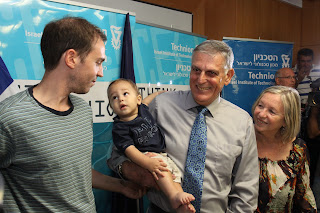
Shechtman with his family after the spontaneous press meeting at Technion (Oct. 5th, 2011).


Who is Dan Shechtman?


“His discovery was extremely controversial. In the course of defending his findings, he was asked to leave his research group… However, his battle eventually forced scientists to reconsider their conception of the very nature of matter… Scientists are currently experimenting with using quasicrystals in different products such as frying pans and diesel engines.”

The Nobel Committee at the Royal Swedish Academy of Sciences

Dan Shectman in 1983, shortly after his discovery

Dan Shechtman in 2010…
still unravelling the implications.


“This is the Israeli spirit. Sometimes this leads to chaos; but free thinking encourages successful scientists. We are living here in a free society… many of us do not follow the rules, and this is part of the national character of a free-thinking people.”


In 1906, 105 years ago, Dan Shechtman’s grandparents came from Russia to Israel . His grandfather, he recalls, was one of the leaders of the Labor Movement. He set up a printing house. “It was the time of the 2nd Aliyah,” Shechtman told international press in Jerusalem this week, “Ninety percent subsequently left but the ten percent who stayed made Israel into the great country it is.”

Dan Shechtman was born in Tel Aviv on January 24, 1941. “I went to a youth movement – HaShomer Hatzair. In 1959, I started my military service – it was 2.5 years then. During which, I met my future wife. Then I went to Technion to study engineering. It was the dream of my life. I thought it was the best thing a man could be. I read a book in my youth by Jules Verne, The Mysterious Island. There was a character, Cyrus Smith, who could do everything. He was an engineer, and I wanted to be like him.  

Shechtman received his BSc, MSc, and PhD from Technion in 1966, 1968, and 1972, respectively. He joined the Technion Faculty of Materials Engineering in 1975, and was made Distinguished Professor in 1998. He holds the Philip Tobias Chair in Material Sciences, and heads the Louis Edelstein Centre for Quasicrystals.  “In 1975, I was offered a position at Technion. I was made a Distinguished Professor – there are some 7 and 3 of us are Nobel laureates.”


Dan Shechtman discovered the Icosahedral Phase in 1982. It is the first structure in the field of quasi-periodic crystals, and was discovered in aluminum transition metal alloys.


He instigated the course Technological Entrepreneurship in 1986, referring to it as “my baby,” and has overseen it annually ever since.  The course is offered in the winter semester each year and comprises 14 guest lectures, some of which are inspirational talks delivered by successful Israeli entrepreneurs. Shechtman is invited to lecture worldwide about the Technological Entrepreneurship course, arousing much interest. He considers himself a missionary, “I coordinate the course with pleasure. I do it for Israel.”


“This is the Israeli spirit. Sometimes this leads to chaos; but free thinking encourages successful scientists. We are living here in a free society… many of us do not follow the rules, and this is part of the national character of a free-thinking people.”


Between 2001 and 2004, Shechtman served as chairperson of the sciences division, Israel Academy of Sciences and Humanities. Now as a member, he continues to oversee the translation of the Nobel Prize scientific posters into Hebrew, and their annual distributes to schools throughout the country.


Shechtman has been voted as an outstanding lecturer by his students at the Technion for ten years consecutively. He is married and lives in Haifa. He has four children and nine grandchildren.

Shechtman with his family after the spontaneous press meeting at Technion (Oct. 5th, 2011).