
 PRESIDENT’S REPORT 2015


| Newly Created UNESCO Chair at Technion for Sustainable Engineering Date: 13/06/2012 |
 |
| Prof. Mark Talesnick of the Faculty of Civil and Environmental Engineering is the incumbent of the newly established UNESCO Chair in Sustainable Engineering in Developing Communities.
The specific objectives of this Chair are to develop undergraduate and graduate teaching programs in engineering for developing communities, in cooperation with partners; carry out research on engineering for developing communities and disseminate results widely; design, test and apply, jointly with partners, ground-level projects to test and further refine the concept of sustainable engineering; and, provide short-term theoretical and practical training, as well as facilitate visiting professorships. Talesnick reports that the University of Colorado and Kathmandu Universities are also involved and that he will be travelling to Ghana, Ethiopia and Batswana soon to enlist their collaboration as well. Talesnick also spearheads Engineers Without Borders – Technion (EWB). Currently, 739 UNESCO Chairs and 70 UNITWIN Networks in 134 countries provide an innovative modality for international academic cooperation. They act as think-tanks and bridge- builders between research and policy-making, and between academia, civil society, local communities and the productive sector. |
Tag Archives: education
2012 Centennial Technion Board of Governors
Among the International Board of Governors June 2012 events in this cornerstone centennial year were dedications of new facilities, prizes for research and academic excellence, book launches celebrating Technion’s contributions to Israel and the world, and honorary awards to public figures.
Opening the week, Technion President Prof. Peretz Lavie described the Technion in 2012, as it is poised to meet the challenged of the next century. Read more.
100 years of Technion history was celebrated at the 2012 Board of Governors meeting at Technion City with the festive dedication of the 234-page history book: Together: the Story of the Century on June 10th.

An exhibition of handcrafted jewelry created by Nobel Laureate Dan Shechtman was opened at Technion City. Designed for his wife, Prof. Zipora Shechtman, the exhibition showcases 15 unique pieces ranging from earrings to bracelets with a single item – an Aztec-inspired silver belt buckle – which he made for himself.

In this year’s Dr. Bob’s TechnoBrain competition, supported by Dr. Robert Shillman in memory of Neev-Ya Durban, students met the challenge to recreate the laying of Technion’s cornerstone in new and original ways. As part of Technion’s 100th anniversary since the cornerstone was laid in 1912, TechnoBrain 2012 took place on June 13, 2012 – the last day of Technion’s annual International Board of Governors meeting.
Microsoft CEO Danny Yamin: New Chairman of Technion Council.
 |
| Danny Yamin with Technion President Peretz Lavie. |
Microsoft CEO Appointed to Leading Technion Position
Danny Yamin, head of Microsoft Israel,
is new chairman of the Technion Council, succeeding Yoram Alster
Danny Yamin, CEO of Microsoft Israel, has been appointed chairman of the Technion Council.
He replaces Yoram Alster, who served in this position for nine years.
The Council serves as the guiding and deciding authority with regard to Technion matters, between meetings of the Board of Governors, which the highest authority of the Technion. Among its powers are supervision of administrative and financial matters, enactment of regulations and appointments, awarding of honorary degrees, and more.
Danny Yamin, who is a Technion graduate, has been serving as CEO of Microsoft Israel since 2004. In recent years he has also held various positions in the Technion, including member of the Council and Chairman of the Technion alumni’s ‘100 Club’.
Technion President Prof. Peretz Lavie: “Danny Yamin’s vast management experience in a global organization is essential at a time when the Technion itself is treading deeper into the global arena. The establishment of the Technion and Cornell research campus in New York is one type of the challenges we will be contending with in the coming years, as is the advancement of the Technion in Israel. I am looking forward to working with Danny in his new role, and believe that his vast experience will ccontribute greatly to the way we contend with the new local and global challenges”.
Danny Yamin: “I am pleased to expand my activity in the Technion, an institute which plays a major role in the State of Israel. The relationship between industry and academia is essential to both sides, and it is my hope that together with Technion President Peretz Lavie, the Technion’s management and its Council members, we will continue to realize the Technion’s great potential in Israel and worldwide”.
Microsoft CEO Danny Yamin: New Chairman of Technion Council.
|
| Danny Yamin with Technion President Peretz Lavie. |
Microsoft CEO Appointed to Leading Technion Position
Danny Yamin, head of Microsoft Israel,
is new chairman of the Technion Council, succeeding Yoram Alster
Danny Yamin, CEO of Microsoft Israel, has been appointed chairman of the Technion Council.
He replaces Yoram Alster, who served in this position for nine years.
The Council serves as the guiding and deciding authority with regard to Technion matters, between meetings of the Board of Governors, which the highest authority of the Technion. Among its powers are supervision of administrative and financial matters, enactment of regulations and appointments, awarding of honorary degrees, and more.
Danny Yamin, who is a Technion graduate, has been serving as CEO of Microsoft Israel since 2004. In recent years he has also held various positions in the Technion, including member of the Council and Chairman of the Technion alumni’s ‘100 Club’.
Technion President Prof. Peretz Lavie: “Danny Yamin’s vast management experience in a global organization is essential at a time when the Technion itself is treading deeper into the global arena. The establishment of the Technion and Cornell research campus in New York is one type of the challenges we will be contending with in the coming years, as is the advancement of the Technion in Israel. I am looking forward to working with Danny in his new role, and believe that his vast experience will ccontribute greatly to the way we contend with the new local and global challenges”.
Danny Yamin: “I am pleased to expand my activity in the Technion, an institute which plays a major role in the State of Israel. The relationship between industry and academia is essential to both sides, and it is my hope that together with Technion President Peretz Lavie, the Technion’s management and its Council members, we will continue to realize the Technion’s great potential in Israel and worldwide”.
1912-2012: Technion Timeline of a Century.
Landmark behind Time

The Technion’s historic building was designed by the renowned Jewish German architect, Alexander Baerwald. His design includes both oriental and European motives. It is built from sandstone quarried in Tantura and Atlit. The building was part of Baerwald’s plan of an open corridor leading directly to the bay. He also designed buildings that would line the road, of which some were built, indeed (e.g. the Hebrew Reali School).
The building’s cornerstone was laid in 1912. The building’s construction was delayed during the First World War. The partially completed building was used, then, as a military hospital. In 1925 it became the home of Israel’s first institute of higher education – The Technion, Israel Institute of Technology. Until 1953, all the Technion Faculties were located there. By 1965, most of them have moved to the Technion new campus in Haifa’s Nave Shaanan. The Faculty of Architecture and Town Planning stayed in the historic Technion building until 1985.
Timeline of the Century
2012: Technion partners with Cornell University to found the Technion Cornell Institute of Innovation (TCII), an international ‘School of Genius’ in the heart of New York City.
2011: Technion Prof. Dan Shechtman receives the Nobel Prize in Chemistry for his discovery of quasicrystals.
2007: Technion pools its brainpower in a unique multidisciplinary center for research into energy science, technology and engineering: The Grand Technion Energy Program.
2006: Technion is Israel’s 1st university to receive the Nobel Prize for Science. Prof. Aaron Ciechanover and Prof. Avram Hershko jointly receive the Nobel Prize in Chemistry for their discovery, together with Irwin Rose, of the ubiquitin system within living cells.
2005: Technion opens the Russell Berrie Nanotechnology Institute (RBNI) to further empower and concentrate the plethora of excellent scientists, researchers and students pioneering science in the nano dimension.
2001: Technion scientists reveal they have long been quietly researching solutions to meet the threat of 3rd millennium terrorism as revealed by the horrific events in the US of September 11th
1998: Combining microbiology and microelectronics, scientists show how to make a transistor 1/100,000th the size of a human hair
1993: Technion students design and launch their own satellite: Gurwin Tech Sat. The satellite is still in orbit.
1991: Gulf War – Technion shows that the integration of expertise of Israel’s top institute of technology with its dynamic medical school makes Technion first responders in responding to missile attack on the home-front.
1989: Optoelectronics: A new center of excellence pioneering the technological promise of an expert understanding of light.
1982: The Rappaport Family Institute for Research in the Medical Sciences is established. During more than two decades of activity, the Institute has established itself as an internationally recognized research center and counts among its members several world-renowned scientists.
1981: Fiberoptics is pioneered by Technion
1978: Camp David accords with Egypt: the scientific challenges of peace and nation-planning means that in addition to its many projects in water management and environmental engineering, the Technion sets up the Samuel Neaman Institute.
1973: Yom Kippur War
1971: The Faculty of Biology is set up.
1969: The faculty of medicine is born. The first class consists of 43 students who had their preclinical education abroad. They were admitted to the fourth year and finished the requirements for the degree of Medical Doctor (M.D.), after two years of clinical training in the hospitals. The same year also sees the birth of the Department of Biomedical Engineering and the Faculty of Computer Science.
1967: Six-Day War, Faculty of Materials Engineering is set up.
1966: Agricultural engineering degrees awarded to students from Africa and Asia
1965: Department of Education in Technology and Science
1962: Faculty of Food Engineering and Biotechnology
1961: Technion offers a flourishing graduate school and R&D foundation
1960: The Faculty of Mathematics and the Faculty of Physics are formed.
1958: The opening of the Faculty of Chemistry, the Faculty of Industrial Engineering and Management, and The Department of Humanities and Arts
1956: Students take part in the Sinai War
1954: Technion founding father Prof. Albert Einstein is awarded a Technion honorary doctorate. The Faculty of Chemical Engineering is opened.
1953:The Department of Aeronautical Engineering and the Faculty of Agricultural Engineering are set up in the new campus.
1952: Rapid growth and expansion and increasing demand for Technion graduates and engineers nation-wide means the Technion leaves its first home in the historic building in down-town Haifa. Prime-Minister David Ben Gurion selects the new site for Technion City further up the slopes of Mount Carmel.
1948: With 680 students, Technion celebrates the declaration of independence. Studies are disrupted for most of the year as faculty and students fight for independence. The Faculty of Electrical Engineering and the Faculty of Mechanical Engineering are opened.
1944: Survival tasks – Technion develops early warning systems against air attacks as well as weapons for the Hagannah, the Israeli underground army that are preparing for the War of Independence.
1943: 1000 skilled Technion graduates join the war effort against Nazi Germany
1938: The Faculties of civil engineering, architecture, industrial engineering and opened, together with 11 new labs and a nautical school
1935: The Polish government recognizes Technion
1934: The Faculty of Industrial Technology is established covering broad fields.
1931: Technion staff vote to work for nothing to ensure their institute survives.
1928: First class of 17 Technion engineers and architects graduates
1926: Zeev Jabotinsky addresses Technion Haganah members
1924: Technion officially enrolls 1st class of engineering students
1923: Einstein’s first visit in which he becomes president of the first Technion society, the German Technion Society

In 1923, Albert Einstein visited the empty building of the Technikum, where there was a plan to give courses for word workers, electricians and telephone and telegraph workers. Although the derelict buildings were being used as a hostel for immigrants from Europe, Albert Einstein did not think the dream of founding a technical university in the Middle East to be fantasy. As a great scientist, Einstein knew that what makes the impossible possible is the courage to follow an inspiration.
1920: The building is legally acquired and recruitment for staff begins
1914: 1918 German, Turkish and then British troops occupy the building
1913: A battle continues over the language of Technion instruction: German or revitalized Hebrew? Hebrew wins.
1912: The cornerstone is laid for Technion’s building
1908: Wissotzky, Schiff and the Jewish National Fund invest in the new “Technikum”
1903: Hebrew teachers association of Palestine calls for a polytechnic university
1902: Herzl publishes the novel Altneuland (The Old New Land), which takes place in Palestine, creating the vision for a Jewish state and Zionism.
1901: 5th Zionist congress calls for a Jewish technological university, as a first necessary step to realize the dream of a Jewish state.

We began with a thought…
“Our technical inventors, who are the true benefactors of humanity… will discover things as marvelous as those we have already seen, or indeed more wonderful than these…”
Theordor Herzl, 1896, The Jewish State
In 1902, Theodor Herzl envisioned Haifa as “a great park….with an overhead electrical train…. a city of magnificent homes and public institutions all made possible by applied science, engineering and technology.” (Altneuland)
At that time, even an automobile was an exceptional extravagance of engineering. Electricity was still an expensive luxury for the elite few.
Haifa was a small, remote, coastal town most easily accessed by boat.
The advance of science and technology; the creation of the State of Israel; the emergence of the global village connected by the information superhighway; discoveries in basic science that have fundamentally changed the way scientists think about the material world, and the tremendous applied advances taking place in every corner of Technion City are just some of the miracles witnessed in the past century.
It all began with an inspirational thought in the mind of one man, Binyamin Ze’ev Herzl. Prof. Albert Einstein later added his mind to the vision. Thousands of great thinkers have since added to the blaze of light which is Technion, creating an institute of technology that in the 3rd millennium is truly a light to the nations.
1912-2012: Technion Timeline of a Century.
Landmark behind Time
The Technion’s historic building was designed by the renowned Jewish German architect, Alexander Baerwald. His design includes both oriental and European motives. It is built from sandstone quarried in Tantura and Atlit. The building was part of Baerwald’s plan of an open corridor leading directly to the bay. He also designed buildings that would line the road, of which some were built, indeed (e.g. the Hebrew Reali School).
The building’s cornerstone was laid in 1912. The building’s construction was delayed during the First World War. The partially completed building was used, then, as a military hospital. In 1925 it became the home of Israel’s first institute of higher education – The Technion, Israel Institute of Technology. Until 1953, all the Technion Faculties were located there. By 1965, most of them have moved to the Technion new campus in Haifa’s Nave Shaanan. The Faculty of Architecture and Town Planning stayed in the historic Technion building until 1985.
Timeline of the Century
2012: Technion partners with Cornell University to found the Technion Cornell Institute of Innovation (TCII), an international ‘School of Genius’ in the heart of New York City.
2011: Technion Prof. Dan Shechtman receives the Nobel Prize in Chemistry for his discovery of quasicrystals.
2007: Technion pools its brainpower in a unique multidisciplinary center for research into energy science, technology and engineering: The Grand Technion Energy Program.
2006: Technion is Israel’s 1st university to receive the Nobel Prize for Science. Prof. Aaron Ciechanover and Prof. Avram Hershko jointly receive the Nobel Prize in Chemistry for their discovery, together with Irwin Rose, of the ubiquitin system within living cells.
2005: Technion opens the Russell Berrie Nanotechnology Institute (RBNI) to further empower and concentrate the plethora of excellent scientists, researchers and students pioneering science in the nano dimension.
2001: Technion scientists reveal they have long been quietly researching solutions to meet the threat of 3rd millennium terrorism as revealed by the horrific events in the US of September 11th
1998: Combining microbiology and microelectronics, scientists show how to make a transistor 1/100,000th the size of a human hair
1993: Technion students design and launch their own satellite: Gurwin Tech Sat. The satellite is still in orbit.
1991: Gulf War – Technion shows that the integration of expertise of Israel’s top institute of technology with its dynamic medical school makes Technion first responders in responding to missile attack on the home-front.
1989: Optoelectronics: A new center of excellence pioneering the technological promise of an expert understanding of light.
1982: The Rappaport Family Institute for Research in the Medical Sciences is established. During more than two decades of activity, the Institute has established itself as an internationally recognized research center and counts among its members several world-renowned scientists.
1981: Fiberoptics is pioneered by Technion
1978: Camp David accords with Egypt: the scientific challenges of peace and nation-planning means that in addition to its many projects in water management and environmental engineering, the Technion sets up the Samuel Neaman Institute.
1973: Yom Kippur War
1971: The Faculty of Biology is set up.
1969: The faculty of medicine is born. The first class consists of 43 students who had their preclinical education abroad. They were admitted to the fourth year and finished the requirements for the degree of Medical Doctor (M.D.), after two years of clinical training in the hospitals. The same year also sees the birth of the Department of Biomedical Engineering and the Faculty of Computer Science.
1967: Six-Day War, Faculty of Materials Engineering is set up.
1966: Agricultural engineering degrees awarded to students from Africa and Asia
1965: Department of Education in Technology and Science
1962: Faculty of Food Engineering and Biotechnology
1961: Technion offers a flourishing graduate school and R&D foundation
1960: The Faculty of Mathematics and the Faculty of Physics are formed.
1958: The opening of the Faculty of Chemistry, the Faculty of Industrial Engineering and Management, and The Department of Humanities and Arts
1956: Students take part in the Sinai War
1954: Technion founding father Prof. Albert Einstein is awarded a Technion honorary doctorate. The Faculty of Chemical Engineering is opened.
1953:The Department of Aeronautical Engineering and the Faculty of Agricultural Engineering are set up in the new campus.
1952: Rapid growth and expansion and increasing demand for Technion graduates and engineers nation-wide means the Technion leaves its first home in the historic building in down-town Haifa. Prime-Minister David Ben Gurion selects the new site for Technion City further up the slopes of Mount Carmel.
1948: With 680 students, Technion celebrates the declaration of independence. Studies are disrupted for most of the year as faculty and students fight for independence. The Faculty of Electrical Engineering and the Faculty of Mechanical Engineering are opened.
1944: Survival tasks – Technion develops early warning systems against air attacks as well as weapons for the Hagannah, the Israeli underground army that are preparing for the War of Independence.
1943: 1000 skilled Technion graduates join the war effort against Nazi Germany
1938: The Faculties of civil engineering, architecture, industrial engineering and opened, together with 11 new labs and a nautical school
1935: The Polish government recognizes Technion
1934: The Faculty of Industrial Technology is established covering broad fields.
1931: Technion staff vote to work for nothing to ensure their institute survives.
1928: First class of 17 Technion engineers and architects graduates
1926: Zeev Jabotinsky addresses Technion Haganah members
1924: Technion officially enrolls 1st class of engineering students
1923: Einstein’s first visit in which he becomes president of the first Technion society, the German Technion Society
In 1923, Albert Einstein visited the empty building of the Technikum, where there was a plan to give courses for word workers, electricians and telephone and telegraph workers. Although the derelict buildings were being used as a hostel for immigrants from Europe, Albert Einstein did not think the dream of founding a technical university in the Middle East to be fantasy. As a great scientist, Einstein knew that what makes the impossible possible is the courage to follow an inspiration.
1920: The building is legally acquired and recruitment for staff begins
1914: 1918 German, Turkish and then British troops occupy the building
1913: A battle continues over the language of Technion instruction: German or revitalized Hebrew? Hebrew wins.
1912: The cornerstone is laid for Technion’s building
1908: Wissotzky, Schiff and the Jewish National Fund invest in the new “Technikum”
1903: Hebrew teachers association of Palestine calls for a polytechnic university
1902: Herzl publishes the novel Altneuland (The Old New Land), which takes place in Palestine, creating the vision for a Jewish state and Zionism.
1901: 5th Zionist congress calls for a Jewish technological university, as a first necessary step to realize the dream of a Jewish state.
We began with a thought…
“Our technical inventors, who are the true benefactors of humanity… will discover things as marvelous as those we have already seen, or indeed more wonderful than these…”
Theordor Herzl, 1896, The Jewish State
In 1902, Theodor Herzl envisioned Haifa as “a great park….with an overhead electrical train…. a city of magnificent homes and public institutions all made possible by applied science, engineering and technology.” (Altneuland)
At that time, even an automobile was an exceptional extravagance of engineering. Electricity was still an expensive luxury for the elite few.
Haifa was a small, remote, coastal town most easily accessed by boat.
The advance of science and technology; the creation of the State of Israel; the emergence of the global village connected by the information superhighway; discoveries in basic science that have fundamentally changed the way scientists think about the material world, and the tremendous applied advances taking place in every corner of Technion City are just some of the miracles witnessed in the past century.
It all began with an inspirational thought in the mind of one man, Binyamin Ze’ev Herzl. Prof. Albert Einstein later added his mind to the vision. Thousands of great thinkers have since added to the blaze of light which is Technion, creating an institute of technology that in the 3rd millennium is truly a light to the nations.
NYC – Technion-Cornell Cornerstone of the Future
NYC Tech Campus:
“Our greatest strength is our diversity. This is the day we really do usher in the high tech economy.”
Technion President Peretz Lavie
“No more faculties but HUBS that are flexible, overlapping and interact with industry: an open very flexible system built around themes rather than traditional fields of science.
…We found a partner, and what a partner. A program of innovation. We are not going to have an extension of the Technion or Cornell but something new that will really energize this city.
…The links between Technion and New York go back to the 1910s, with a donation from US philanthropist Jacob Schiff….
…The Technion was founded in 1912…100 years later we come to New York to close the historic circle. We are building the bridge between Israel and the US, Technion and Cornell, New York and Haifa.”
...from Jaffa oranges to semiconductors
…I just came from Stockholm… this is as exciting as a Nobel”
Cornell President David J. Skorton:
“A story of connectivity, between people and their ideas, between teachers and their students…
…Success needs technology,innovation, entrepreneurial ecosystem…
…We need to extend the talent pool… and retain them in NYC – as many as possible for as long as possible.”
New campius: “An environmental standard bearer.”
Mayor Bloomberg:
“Today will be remembered as a defining moment.”
“A dynamic joint submission from two world class institutions”
“The economic impact will be greater than we thought. A game changer.”
“Transformative, cutting edge campus, pioneering green elements…”
The bid- “The most students, faculty, building space, environmentally sustainable”
“The element includes elements to integrate the campus with the city… “
“Unprecedented fund for start ups with high dividends”
“Technion sits at the center of an ecosystem of startups + hightech giants”
“3/4 nobel scientists in Israel came from Technion – “
Technion – Cornell: “A tantalizing groundbreaking partnership.”
“Cornell Tech campus will spin out more than 600 new companies over 30 yrs”
“The courage to expand… their success will be our success”
They are calling the Technion Israel’s version of MIT. This is very flattering, but there is a difference. Technion was founded in 1912 – decades before the birth of the State of Israel. It was the inculcation of expert skills, creativity and pioneering ingenuity among young people that facilitated the birth of a nation. You can check the Technion’s unique history on Wikipedia, or view it rapidly in the video below! If you want it in a different language, go to Technion Channel and take your pick!
100 years ago, the first cornerstone was laid for Israel’s 1st university. So much was embodied in that cornerstone, including the realization of the hopes, dreams and genius of a people who had been disenfranchised for centuries. The original charter of the Technion was not only Zionist. It was to bring skills, education and training to people denied access to higher education in the service of all humanity.
In 2012, in the year of the Technion’s cornestone centenary, a third millennium cornerstone is to be laid, on that realized the vision to be of service to all humankind. United with Cornell University – an institution unrivaled in its creativity, standards of excellence and flair for innovation, Technion will be working to establish the foundations of the global village of tomorrow – a center of higher education that will transform the New York of the coming 100 years – bringing innovation, employment and creativity, introducing tomorrows generation of medicine, life sciences, nanotechnology, software, electronics and global entrepreneurship.
At Technion, tomorrow begins today.
The path of progress. Technion & Cornell link up
to announce the bid for NYC ‘genius’ tech campus
 |
| Unconstrained by geography… the Technion – Cornell link-up to generate innovation at the heart of the global village. |
 |
| Green, clean and aesthetic… artists impression of the new campus on Roosevelt Island. |
 |
| A coalition to lay the scientific and technological foundations of tomorrow’s world. |
 |
| Cornell President Skorton in a video conference with Technion President Peretz Lavie. |

NYC – Technion-Cornell Cornerstone of the Future
NYC Tech Campus:
“Our greatest strength is our diversity. This is the day we really do usher in the high tech economy.”
Technion President Peretz Lavie
“No more faculties but HUBS that are flexible, overlapping and interact with industry: an open very flexible system built around themes rather than traditional fields of science.
…We found a partner, and what a partner. A program of innovation. We are not going to have an extension of the Technion or Cornell but something new that will really energize this city.
…The links between Technion and New York go back to the 1910s, with a donation from US philanthropist Jacob Schiff….
…The Technion was founded in 1912…100 years later we come to New York to close the historic circle. We are building the bridge between Israel and the US, Technion and Cornell, New York and Haifa.”
...from Jaffa oranges to semiconductors
…I just came from Stockholm… this is as exciting as a Nobel”
Cornell President David J. Skorton:
“A story of connectivity, between people and their ideas, between teachers and their students…
…Success needs technology,innovation, entrepreneurial ecosystem…
…We need to extend the talent pool… and retain them in NYC – as many as possible for as long as possible.”
New campius: “An environmental standard bearer.”
Mayor Bloomberg:
“Today will be remembered as a defining moment.”
“A dynamic joint submission from two world class institutions”
“The economic impact will be greater than we thought. A game changer.”
“Transformative, cutting edge campus, pioneering green elements…”
The bid- “The most students, faculty, building space, environmentally sustainable”
“The element includes elements to integrate the campus with the city… “
“Unprecedented fund for start ups with high dividends”
“Technion sits at the center of an ecosystem of startups + hightech giants”
“3/4 nobel scientists in Israel came from Technion – “
Technion – Cornell: “A tantalizing groundbreaking partnership.”
“Cornell Tech campus will spin out more than 600 new companies over 30 yrs”
“The courage to expand… their success will be our success”
They are calling the Technion Israel’s version of MIT. This is very flattering, but there is a difference. Technion was founded in 1912 – decades before the birth of the State of Israel. It was the inculcation of expert skills, creativity and pioneering ingenuity among young people that facilitated the birth of a nation. You can check the Technion’s unique history on Wikipedia, or view it rapidly in the video below! If you want it in a different language, go to Technion Channel and take your pick!
100 years ago, the first cornerstone was laid for Israel’s 1st university. So much was embodied in that cornerstone, including the realization of the hopes, dreams and genius of a people who had been disenfranchised for centuries. The original charter of the Technion was not only Zionist. It was to bring skills, education and training to people denied access to higher education in the service of all humanity.
In 2012, in the year of the Technion’s cornestone centenary, a third millennium cornerstone is to be laid, on that realized the vision to be of service to all humankind. United with Cornell University – an institution unrivaled in its creativity, standards of excellence and flair for innovation, Technion will be working to establish the foundations of the global village of tomorrow – a center of higher education that will transform the New York of the coming 100 years – bringing innovation, employment and creativity, introducing tomorrows generation of medicine, life sciences, nanotechnology, software, electronics and global entrepreneurship.
At Technion, tomorrow begins today.
The path of progress. Technion & Cornell link up
to announce the bid for NYC ‘genius’ tech campus
|
| Unconstrained by geography… the Technion – Cornell link-up to generate innovation at the heart of the global village. |
|
| Green, clean and aesthetic… artists impression of the new campus on Roosevelt Island. |
|
| A coalition to lay the scientific and technological foundations of tomorrow’s world. |
|
| Cornell President Skorton in a video conference with Technion President Peretz Lavie. |
The Great Leviathan… Engineering Israel’s Energy Hope
Natural Gas and Energy Engineering:
Technion Leads the Way
Technion Leads the Way
From: Technion Focus.
By: Prof. Shlomo Maital
“If Moses had turned right instead of left when he led his people out of the Sinai Desert,” goes an old joke, “the Jews would have had the oil and the Arabs would have ended up with the oranges.” We can’t tell that joke any more. Two major gas fields have been discovered offshore, in the Mediterranean, named Tamar and Leviathan. The latter is said to be the biggest gas find in the world in a decade.
Leviathan means “whale” in Hebrew and indeed is a whale of a find – new estimates show Leviathan has some 16 trillion cubic feet of gas, worth (at current European market prices, one cent per cubic foot) over $160 b. The Tamar gas field has an estimated eight trillion cubic feet of gas; it is located 90 km (54 miles) offshore, three miles deep, and its gas will reach Haifa in 2013. Leviathan is 130 km (78 miles) offshore. Many experts believe that in addition to the gas, there is also offshore oil.
The question now fiercely debated, is, what should Israel do with this new, incredible windfall? Liquify it and export it? Use it for gas-based industries, like petrochemicals? But first, a more pressing dilemma exists. Where will Israel find the hundreds of petroleum and natural gas engineers needed to bring the gas to shore safely and efficiently, and then process it optimally? This is a huge, enormously difficult and extremely costly challenge. Perhaps because Moses made that wrong turn, Israeli universities do not teach petroleum engineering.
That is, until now.
At the initiative of Technion President Prof. Peretz Lavie and Senior Executive Vice President Prof. Paul Feigin, Technion has moved with alacrity to launch a Master of Engineering program in Energy Engineering, with specialization in natural gas and petroleum engineering. The program is open for enrolment and formal studies will begin on December 28, 2011. For 18 months, some 25 engineers will study drilling engineering; production, transportation and storage engineering; or reservoir management, at their choice. Haifa University is an active collaborator through its Department of Marine Geosciences.
As Feigin notes, “the efficient, safe and environmentally responsible exploitation of [Israel’s] natural gas reserves is the major engineering challenge facing the State of Israel in the coming decades. The Technion, as it has done throughout its history, is taking the lead in providing the education and developing the know-how in order to meet this challenge.”
The director of the new program is Prof. Yair Ein-Eli of the Faculty of Materials Engineering. I asked him where the graduates of the program will be employed. He told me they would work for exploration companies (there may be vast additional reservoirs of oil and gas yet undiscovered), drilling groups, consulting companies, entities that process, transport and distribute the gas, and of course, for governmental ministries (Infrastructure, Finance, and Industry).
Finding top experts suitable to teach in this program was not easy. Technion found them at Technion itself, and at Haifa University, as well as at America’s University of Houston and Colorado School of Mines, and Norwegian Technological University. Both the U.S. and Norway have vast experience in exploiting oil and gas reserves.
Technion has a long history of anticipating Israel’s needs for engineering skills and with vision, supplying them. In November 1950, Prof. Sydney Goldstein, then head of the Aeronautical Research Council of Great Britain, arrived in Haifa to become dean of Technion’s fledgling Aeronautical Engineering Faculty. For a nation with barely a million people, and per capita GDP of $1,500, some thought this Faculty was folly. But 38 years later, on September 19, 1988, Israel became the eighth country in the world to launch a satellite. The effort was led by Technion-trained aeronautical engineers and students. Today space is a potential growth industry for Israel.
Technion petroleum and gas engineers will bring home the gas. Technion chemical engineers will show Israel how to best exploit this resource. And Technion graduates in management will lead the businesses that do so.
We owe Moses an apology for that tired joke. He knew precisely where he was going after all. In the end, we got the oranges – and the gas and oil as well.
Prof. Emeritus Shlomo Maital is a senior research fellow at Samuel Neaman Institute for National Policy Research, Technion. This article is based in part on Maital’s Marketplace column, Jerusalem Report, May 9, 2011.
© 2011 Technion-Israel Institute of Technology, Division of Publ
F.I.R.S.T. Robotics Competition ~ Technion
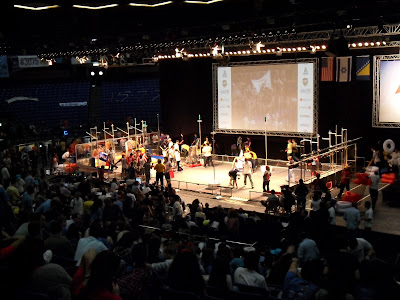
FIRST 2011 competition
The Nokia Arena, Tel aviv, 15-16th March 2011:
48 groups of students from Israel, a group from California and a group from Bosnia and Herzegovina participated in the finals of the seventh season of FIRST competitions – titled Logo Motion.The FIRST competition has been active in Israel since 2005, integrating about 3000 children and youth from across the country. This unique competition combines the excitement from the world of sports with the challenge for science and technology. The competition challenges participants to demonstrate excellence in design, team spirit, professionalism, maturity and problem-solving.
Technion has been involved with the competitions since they began in Israel ~ transferring funds through Technion Societies and the National Center for Robotics Center at the Faculty of Mechanical Engineering.
Beyond inspiring and motivating generations of future scientists and engineers, FIRST creates interaction and dialog between participants from all walks of Israeli life.
To read about the kind of things these kids get up to when they’re older, check Israel21C’s Surgery? Border patrol? Israeli robots can do that.
