Technion Autonomous Systems Program (TASP)
Technion student ingenuity wins 1st prize for Maglev car.
A student at the Technion has developed a magnetic hovering air vehicle
Inventors are not always connected to the ground: They like to dream big. Erez Horev, a student at the Technion, he decided to take it a step further and invented a tool – a vehicle that can hover through the magnet
Shay Zamir
Released: 03:05:11, 11:12
Tools – Magnetic car floating in the air powered tool box keeps track of the owners are two of the projects presented by students in the competition conducted by the Technion Atonomiut modeling unmanned systems within the Faculty of Aerospace.
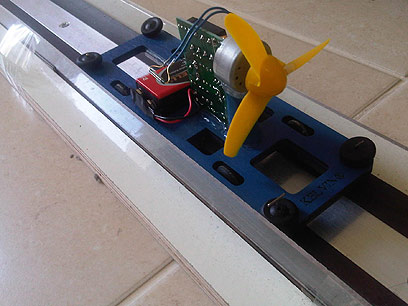
Erez Horev, a graduate student at the Faculty of Civil Engineering, Build Tools – vehicles moving on wheels but can also float in the air using sophisticated magnet. “Tool – based on motor vehicle and six magnets push, rejected the wheels up and allow the vehicle to float in the air travel,” said Horev.
Faster, more economical: magnetic car (Photo: Erez Horev)
Horev worked in the past on Highway 6 project matron (light rail Haifa) where the idea came to him Turnpike futuristic model that could compete with domestic flights and trains.
“It’s like working in Italy and live in Germany and do the distance in 50 minutes,” said Horev. “The car will go at 400 mph and the driver can go to sleep. It’s good long roads with no ports. “
Inventions and innovations
Students at the Technion have developed an elevator into space / Hayadan
Dragonfly flying unmanned aircraft Stealth lunar space elevator are just some outstanding projects created by students and will be presented this week at Jubilee to be held at the Technion Aerospace Sciences
Read more
Tool – ordinary vehicles, 99% of the energy used to overcome the friction wheels, so the selection tool – Vehicle compete only with negligible air friction will bring huge savings in fuel.
Other wins the contest, Dorothy light, built a model of the tool box follows the owner. Previously, he worked as a maintenance factory of Kibbutz Dan had to drag him the heavy toolbox. Model planned, could solve this problem by using electro-sensing system – enabling a mechanical trunk accompany its owner.
–

1. What is special to you about studying at the Technion?
I was a student of Civil Engineering, which includes a lot of courses in modern physics. I have gained knowledge in physics, mathematics, the building blocks of the physical world such as quantum science, physical organic chemistry. This has made me realize that with mind and will, I can learn and create anything.
2. What are your dreams / plans for the future?
Every day is a new day, and each year I look back, I’m again amazed again how my plans can differ from what happens.
3. What was the inspiration behind the current project?
My idea is to connect all the vehicles with magnetic wheels to reduce friction dramatically the use of energy.
Recently, I worked in two projects aimed at solving transportation problems in Israel, the first project is Highway 6 (Israel’s only toll road) and then I worked in the Haifa matron project (light rail)
I think the combination Between these two projects brought me the idea of another form of mass transport. Looking 20-30 years ahead, it is a very realistic idea and it would only be a matter of time until the amount of roads would decrease significantly.
Today, there is no research in the field of magnetic stability whip (Erez, do you have the English term for this?).
I asked to do my Technion thesis in magnetic stability, but was rejected on the grounds that the field too futuristic and did not represent the existential need of the market in Israel and abroad.
I recently got a lot of ideas in the whip(English?) and I hope to implement them privately in my spare time. This issue is close to my heart, and I’m going to go with it to the end.
4. Are you related to General Amos Horev? 🙂
No, my grandfather changed his name from “Julio” and “multi” when he immigrated to Israel in the 40, I was not involved in the decision 🙂
5. Some biographical info – your parents, where you grew up …
I am 29. I grew up in Netanya at 18 volunteer army performs Achachakcen intelligence,
Today, I am a man of peace and my children very gwa not mobilize the army, Israel has a lot of self-involved companies in the military, I would never work in them, and I try my circle of friends will not be consists of people who work in these companies, the year I started a master’s degree in project management in construction while I’m looking for a job that I could combine my studies came also, dear wife (to win the long life) also is a graduate of Technion, electrical engineer and works at Intel (is successful among us)
6. Something more …
I want to address a huge demand for governments and companies to invest in research and development of new transportation methods and efficiency, since citizens are tired of spending more than two hours in endless traffic jams.
To enhance their research, the Technion established the Technion Autonomous Systems Program(TASP), the only one of its kind in Israel, and the scientific home for dozens of advanced researchers from many faculties. Headed by Distinguished Professor Daniel Weihs, TASP has world-class facilities for application-oriented research and development of complete autonomous systems, including hardware, software, operations principles, and manufacturing and maintenance considerations. Developments in micro- and nanotechnology are also critical to the development and practical application of autonomous systems.

 PRESIDENT’S REPORT 2015