Tag Archives: Israel

Nobel Prize lecture in Chemistry, Stockholm.

The Nobel Lecture in Chemistry, Stockholm University, December 8, 2011
Courtesy of the American Technion Society

At the official Nobel lecture, Professor Dan Shechtman spoke about his groundbreaking discovery of quasicrystals in 1982.  He first explained periodicity and four-fold symmetry and that it looks the same, even if it is rotated. From 1912-1982 all crystals were considered to be ordered and periodic. No one expected something new to be discovered.

Using electron diffraction patterns, Prof. Shechtman was able to observe five-fold symmetry.  On the screen he shared a page from his original laboratory log book dated April 8, 1982 that listed the experiments that he performed and his observations on that day. Several years later he was joined by Ilan Blech and other scientists and together their work, initially rejected, was published and finally accepted in the scientific community.

Professor Shechtman asked why this discovery did not happen before 1982 as some 100,000 crystals were studied for a period of 70 years.  He said that quasicrystals are abundant, not rare. Aluminum alone has hundreds. They are stable and very easy and inexpensive to make.

He shared the five factors that helped lead to the discovery and acceptance:

1. TEM – Transition Electron Microscope. The discovery could not be made with x-rays and required this powerful tool that enabled scientists to see things at the atomic level.

2. Professionalism

3. Tenacity

4. Belief in self as a scientist

5.Courage

Israel Science Reaches for the Sun


GTEP ~ the Energy Core

Prof. Gideon Grader, director of the Grand Technion Energy Program (GTEP), was chosen to lead the Center of Excellence in Alternative Energies, as announced by the Council of Higher Education at the end of June 2011. This initiative, the fourth center to be named in the I-CORE (Israeli Centers of Research Excellence) framework, will incorporates 36 researchers at Technion, Weizmann Institute of Science, and Ben-Gurion University of the Negev (BGU).

GTEP together with Weizmann and BGU, combined efforts in a proposal for advanced research into solar fuels. This includes biomass generation; hydrogen production by water splitting; photo conversion of CO2 to CO; biomass conversion to ethanol and biodiesel; biomass gasification and catalytic fuel generation from H2, CO, CO2 and methanol.

The center, chosen by an international committee, is slated to enlist at least nine new researchers in the coming three years. Three new members, returning to Israel from Harvard and University of Michigan, will be recruited to Technion’s Faculty of Biology and Schulich Faculty of Chemistry this year.

Clean Hydogen Energy Solutions

Stop Press! December 5th, 2011: Dr. Avner Rothschild, will lecture on: Metal-oxide photoelectrodes for solar-induced water splitting: turning rust to gold. This seminar is part of the Technion-Monash: Nanosceince tele-seminar series, which is a cooperation of the Technion and the University of Melbourne in Australia. The seminar will take place at the Cooper building (main building of Industrial Engineering, Technion City), room 112, at 8 a.m.

Energy Transformers
By Georgina Johnson

Dr Avner Rothschild is working on new, efficient ways of using sunlight to split water into hydrogen and oxygen. Hydrogen is a clean and potentially abundant alternative to fossil fuels. Its large-scale use could lead to the sustainable development, energy independence, and security of many nations.

One of many powerful scientists tackling basic and applied problems in energy science and technology, Dr Avner Rothschild, of the Grand Technion Energy Program (GTEP) and the Faculty of Materials Engineering, has a penchant for high targets. Not only has his life-time hobby been climbing impossible cliff-faces, he also has a powerful vocation to make solar-produced hydrogen a viable future energy alternative.

Rothschild’s group in Technion’s Electroceramics Materials and Devices Laboratory is part of a large European collaborative project looking to split water into hydrogen and oxygen using the energy of the sun – thus creating a 100 percent clean fuel. “We try to produce hydrogen and oxygen by splitting water. The process is possible – it works – but the problem is low efficiency.”

His team is developing nanostructured metal-oxides for applications in environmental and energy conversion technologies. The group has a strong expertise in investigating electronic and ionic defects in semiconducting and mixed ionic-electronic conducting oxides and their effect on transport properties and electrochemical processes.

The scientific barrier is efficiency, says Rothschild, who sees the promise in the development of new electroceramic materials. “We are engineering tandem cells – several different cells, each one with a different aspect of energy from the sun. We are aiming at 5,000 hours stable operation at 10 percent efficiency.”

“We started this project at 3 percent efficiency,” says Rothschild. “Now we are at 5 percent. Our goal is still more – 10 percent – but it is within reach.”


NanoPECs

NanoPEC (Nanostructured Photoelectrodes for Energy Conversion) is the European consortium at work with Dr Avner Rothschild to crack the codes of clean hydrogen production and complement Rothschild’s studies in new materials with research from basic science to integration of total systems. The consortium, including groups from Italy, Netherlands, Norway, Poland, Portugal, and Switzerland which meet four times a year, is under the scientific leadership of Prof. Michael Grätzel, director of the Laboratory of Photonics and Interfaces (LPI) of the Swiss Federal Institute of Technology of Lausanne. In 2007, Grätzel received Technion’s prestigious Harvey Prize in science and technology and recently, in June 2010, the Finnish Millennium Technology Prize – the largest technology prize in the world – for development of dye-sensitized solar cells.

Photoelectrochemical cells (PECs) can split water directly into H2 and O2 via photoelectrolysis, and in so doing provide a basis for a renewable, clean production of hydrogen from sunlight. They rely on a photoactive material – a semiconductor – capable of harvesting and converting solar energy into stored chemical fuel, namely, hydrogen. Very little hydrogen gas is present in Earth’s atmosphere, but hydrogen is locked up in enormous quantities in water, hydrocarbons (such as methane), and other organic matter. Efficiently producing hydrogen from these compounds is one of the challenges of using hydrogen as a fuel.

More on the multimedia Technion-Monash intiative.

Clean Hydogen Energy Solutions

Stop Press! December 5th, 2011: Dr. Avner Rothschild, will lecture on: Metal-oxide photoelectrodes for solar-induced water splitting: turning rust to gold. This seminar is part of the Technion-Monash: Nanosceince tele-seminar series, which is a cooperation of the Technion and the University of Melbourne in Australia. The seminar will take place at the Cooper building (main building of Industrial Engineering, Technion City), room 112, at 8 a.m.

Energy Transformers
By Georgina Johnson

Dr Avner Rothschild is working on new, efficient ways of using sunlight to split water into hydrogen and oxygen. Hydrogen is a clean and potentially abundant alternative to fossil fuels. Its large-scale use could lead to the sustainable development, energy independence, and security of many nations.

One of many powerful scientists tackling basic and applied problems in energy science and technology, Dr Avner Rothschild, of the Grand Technion Energy Program (GTEP) and the Faculty of Materials Engineering, has a penchant for high targets. Not only has his life-time hobby been climbing impossible cliff-faces, he also has a powerful vocation to make solar-produced hydrogen a viable future energy alternative.

Rothschild’s group in Technion’s Electroceramics Materials and Devices Laboratory is part of a large European collaborative project looking to split water into hydrogen and oxygen using the energy of the sun – thus creating a 100 percent clean fuel. “We try to produce hydrogen and oxygen by splitting water. The process is possible – it works – but the problem is low efficiency.”

His team is developing nanostructured metal-oxides for applications in environmental and energy conversion technologies. The group has a strong expertise in investigating electronic and ionic defects in semiconducting and mixed ionic-electronic conducting oxides and their effect on transport properties and electrochemical processes.

The scientific barrier is efficiency, says Rothschild, who sees the promise in the development of new electroceramic materials. “We are engineering tandem cells – several different cells, each one with a different aspect of energy from the sun. We are aiming at 5,000 hours stable operation at 10 percent efficiency.”

“We started this project at 3 percent efficiency,” says Rothschild. “Now we are at 5 percent. Our goal is still more – 10 percent – but it is within reach.”


NanoPECs

NanoPEC (Nanostructured Photoelectrodes for Energy Conversion) is the European consortium at work with Dr Avner Rothschild to crack the codes of clean hydrogen production and complement Rothschild’s studies in new materials with research from basic science to integration of total systems. The consortium, including groups from Italy, Netherlands, Norway, Poland, Portugal, and Switzerland which meet four times a year, is under the scientific leadership of Prof. Michael Grätzel, director of the Laboratory of Photonics and Interfaces (LPI) of the Swiss Federal Institute of Technology of Lausanne. In 2007, Grätzel received Technion’s prestigious Harvey Prize in science and technology and recently, in June 2010, the Finnish Millennium Technology Prize – the largest technology prize in the world – for development of dye-sensitized solar cells.

Photoelectrochemical cells (PECs) can split water directly into H2 and O2 via photoelectrolysis, and in so doing provide a basis for a renewable, clean production of hydrogen from sunlight. They rely on a photoactive material – a semiconductor – capable of harvesting and converting solar energy into stored chemical fuel, namely, hydrogen. Very little hydrogen gas is present in Earth’s atmosphere, but hydrogen is locked up in enormous quantities in water, hydrocarbons (such as methane), and other organic matter. Efficiently producing hydrogen from these compounds is one of the challenges of using hydrogen as a fuel.

More on the multimedia Technion-Monash intiative.

The Great Leviathan… Engineering Israel’s Energy Hope

Natural Gas and Energy Engineering:
Technion Leads the Way

From: Technion Focus.


By: Prof. Shlomo Maital

“If Moses had turned right instead of left when he led his people out of the Sinai Desert,” goes an old joke, “the Jews would have had the oil and the Arabs would have ended up with the oranges.” We can’t tell that joke any more. Two major gas fields have been discovered offshore, in the Mediterranean, named Tamar and Leviathan. The latter is said to be the biggest gas find in the world in a decade.

Leviathan means “whale” in Hebrew and indeed is a whale of a find – new estimates show Leviathan has some 16 trillion cubic feet of gas, worth (at current European market prices, one cent per cubic foot) over $160 b. The Tamar gas field has an estimated eight trillion cubic feet of gas; it is located 90 km (54 miles) offshore, three miles deep, and its gas will reach Haifa in 2013. Leviathan is 130 km (78 miles) offshore. Many experts believe that in addition to the gas, there is also offshore oil.

The question now fiercely debated, is, what should Israel do with this new, incredible windfall? Liquify it and export it? Use it for gas-based industries, like petrochemicals? But first, a more pressing dilemma exists. Where will Israel find the hundreds of petroleum and natural gas engineers needed to bring the gas to shore safely and efficiently, and then process it optimally? This is a huge, enormously difficult and extremely costly challenge. Perhaps because Moses made that wrong turn, Israeli universities do not teach petroleum engineering.

That is, until now.

At the initiative of Technion President Prof. Peretz Lavie and Senior Executive Vice President Prof. Paul Feigin, Technion has moved with alacrity to launch a Master of Engineering program in Energy Engineering, with specialization in natural gas and petroleum engineering. The program is open for enrolment and formal studies will begin on December 28, 2011. For 18 months, some 25 engineers will study drilling engineering; production, transportation and storage engineering; or reservoir management, at their choice. Haifa University is an active collaborator through its Department of Marine Geosciences.

As Feigin notes, “the efficient, safe and environmentally responsible exploitation of [Israel’s] natural gas reserves is the major engineering challenge facing the State of Israel in the coming decades. The Technion, as it has done throughout its history, is taking the lead in providing the education and developing the know-how in order to meet this challenge.”

The director of the new program is Prof. Yair Ein-Eli of the Faculty of Materials Engineering. I asked him where the graduates of the program will be employed. He told me they would work for exploration companies (there may be vast additional reservoirs of oil and gas yet undiscovered), drilling groups, consulting companies, entities that process, transport and distribute the gas, and of course, for governmental ministries (Infrastructure, Finance, and Industry).

Finding top experts suitable to teach in this program was not easy. Technion found them at Technion itself, and at Haifa University, as well as at America’s University of Houston and Colorado School of Mines, and Norwegian Technological University. Both the U.S. and Norway have vast experience in exploiting oil and gas reserves.

Technion has a long history of anticipating Israel’s needs for engineering skills and with vision, supplying them. In November 1950, Prof. Sydney Goldstein, then head of the Aeronautical Research Council of Great Britain, arrived in Haifa to become dean of Technion’s fledgling Aeronautical Engineering Faculty. For a nation with barely a million people, and per capita GDP of $1,500, some thought this Faculty was folly. But 38 years later, on September 19, 1988, Israel became the eighth country in the world to launch a satellite. The effort was led by Technion-trained aeronautical engineers and students. Today space is a potential growth industry for Israel.

Technion petroleum and gas engineers will bring home the gas. Technion chemical engineers will show Israel how to best exploit this resource. And Technion graduates in management will lead the businesses that do so.

We owe Moses an apology for that tired joke. He knew precisely where he was going after all. In the end, we got the oranges – and the gas and oil as well.

Prof. Emeritus Shlomo Maital is a senior research fellow at Samuel Neaman Institute for National Policy Research, Technion. This article is based in part on Maital’s Marketplace column, Jerusalem Report, May 9, 2011.
© 2011 Technion-Israel Institute of Technology, Division of Publ

Swarm theory & Israel’s Satellites of Tomorrow


 “It is much easier to change a payload module than launch a new satellite.”

€1.5 million from the EU for innovative research at the Technion dealing with disaggregated satellites.The free-flying satellite modules will form a fractionated satellite in space


The European Research Council (ERC) will provide €1.5 million for research by Prof. Pini Gurfil of ASRI at the Technion, who proposes launching satellites in parts – that together communicate wirelessly and operate as a complete satellite. The ERC Starting Independent Researcher Grant is considered Europe’s most prestigious research award. Its aim is to encourage pioneering frontier research in any field of science, engineering and scholarship.

“In unexpected situations, such as damage from space debris, a satellite might not react well and could discontinue its original task; functional and financial damages are thus unavoidable,” explains Prof. Gurfil. “For example, if the payload is damaged, the entire system becomes unusable, and in order to complete the task, the entire instrument must be replaced. This procedure is very expensive and time-consuming. It is much easier to change a payload module than launch a new satellite.”

This idea led to a new concept in space engineering termed disaggregated spacecraft. In disaggregated space architectures (DSA), several separate modules communicate with each other via wireless communication links, thus forming a single virtual platform. Each module has its own designated function or functions: navigation, attitude control, power generation and payload operation. The independent modules are able to distribute resources among themselves and do not have to be very close to each other to operate. They only have to be in relative proximity, such that they form a cluster.

DSA constitutes a new type of space engineering, which is expected to be more efficient in terms of responsiveness; responsiveness is the ability to adapt to unexpected scenarios resulting from several sources of uncertainty at different levels of task design and execution. 

The final goal of the proposed research is to develop innovative technology that will enable actual flight in a DSA formation; specific objectives include: 

(a) development of algorithms for long-term semi-autonomous maintenance of the cluster and the cluster network, while allowing for the addition of new modules or removal of such modules; 
(b) finding methods for reconfiguration that guarantee cluster safety and mission-critical functionality; 
(c) design of distribution/gathering of the cluster, with the purpose of avoiding collision with space debris; 
(d) development of logic and ways to share resources within the flock network, with the ability to react in real-time; and 
(e) verification of these algorithms and methods in the Distributed Space Systems Laboratory, a research laboratory developed by Prof. Gurfil. 

The proposed research will create the necessary infrastructure for a space demonstration circa 2016.

Swarm theory & Israel’s Satellites of Tomorrow


 “It is much easier to change a payload module than launch a new satellite.”

€1.5 million from the EU for innovative research at the Technion dealing with disaggregated satellites.The free-flying satellite modules will form a fractionated satellite in space


The European Research Council (ERC) will provide €1.5 million for research by Prof. Pini Gurfil of ASRI at the Technion, who proposes launching satellites in parts – that together communicate wirelessly and operate as a complete satellite. The ERC Starting Independent Researcher Grant is considered Europe’s most prestigious research award. Its aim is to encourage pioneering frontier research in any field of science, engineering and scholarship.

“In unexpected situations, such as damage from space debris, a satellite might not react well and could discontinue its original task; functional and financial damages are thus unavoidable,” explains Prof. Gurfil. “For example, if the payload is damaged, the entire system becomes unusable, and in order to complete the task, the entire instrument must be replaced. This procedure is very expensive and time-consuming. It is much easier to change a payload module than launch a new satellite.”

This idea led to a new concept in space engineering termed disaggregated spacecraft. In disaggregated space architectures (DSA), several separate modules communicate with each other via wireless communication links, thus forming a single virtual platform. Each module has its own designated function or functions: navigation, attitude control, power generation and payload operation. The independent modules are able to distribute resources among themselves and do not have to be very close to each other to operate. They only have to be in relative proximity, such that they form a cluster.

DSA constitutes a new type of space engineering, which is expected to be more efficient in terms of responsiveness; responsiveness is the ability to adapt to unexpected scenarios resulting from several sources of uncertainty at different levels of task design and execution. 

The final goal of the proposed research is to develop innovative technology that will enable actual flight in a DSA formation; specific objectives include: 

(a) development of algorithms for long-term semi-autonomous maintenance of the cluster and the cluster network, while allowing for the addition of new modules or removal of such modules; 
(b) finding methods for reconfiguration that guarantee cluster safety and mission-critical functionality; 
(c) design of distribution/gathering of the cluster, with the purpose of avoiding collision with space debris; 
(d) development of logic and ways to share resources within the flock network, with the ability to react in real-time; and 
(e) verification of these algorithms and methods in the Distributed Space Systems Laboratory, a research laboratory developed by Prof. Gurfil. 

The proposed research will create the necessary infrastructure for a space demonstration circa 2016.

Technion Maglev

Technion Autonomous Systems Program (TASP)
Technion student ingenuity wins 1st prize for Maglev car.
A student at the Technion has developed a magnetic hovering air vehicle
Inventors are not always connected to the ground: They like to dream big. Erez Horev, a student at the Technion, he decided to take it a step further and invented a tool – a vehicle that can hover through the magnet
Shay Zamir
Released: 03:05:11, 11:12
Tools – Magnetic car floating in the air powered tool box keeps track of the owners are two of the projects presented by students in the competition conducted by the Technion Atonomiut modeling unmanned systems within the Faculty of Aerospace.
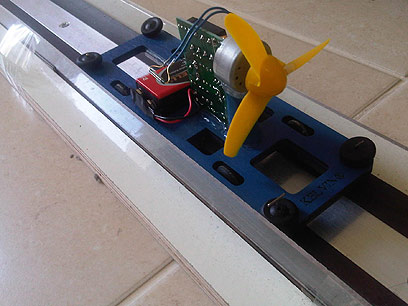
Erez Horev, a graduate student at the Faculty of Civil Engineering, Build Tools – vehicles moving on wheels but can also float in the air using sophisticated magnet. “Tool – based on motor vehicle and six magnets push, rejected the wheels up and allow the vehicle to float in the air travel,” said Horev.
Faster, more economical: magnetic car (Photo: Erez Horev)
Horev worked in the past on Highway 6 project matron (light rail Haifa) where the idea came to him Turnpike futuristic model that could compete with domestic flights and trains.
“It’s like working in Italy and live in Germany and do the distance in 50 minutes,” said Horev. “The car will go at 400 mph and the driver can go to sleep. It’s good long roads with no ports. “
Inventions and innovations
Students at the Technion have developed an elevator into space / Hayadan
Dragonfly flying unmanned aircraft Stealth lunar space elevator are just some outstanding projects created by students and will be presented this week at Jubilee to be held at the Technion Aerospace Sciences
Read more
Tool – ordinary vehicles, 99% of the energy used to overcome the friction wheels, so the selection tool – Vehicle compete only with negligible air friction will bring huge savings in fuel.
Other wins the contest, Dorothy light, built a model of the tool box follows the owner. Previously, he worked as a maintenance factory of Kibbutz Dan had to drag him the heavy toolbox. Model planned, could solve this problem by using electro-sensing system – enabling a mechanical trunk accompany its owner.
– 
1. What is special to you about studying at the Technion?
I was a student of Civil Engineering, which includes a lot of courses in modern physics. I have gained knowledge in physics, mathematics, the building blocks of the physical world such as quantum science,  physical organic chemistry. This has made me realize that with mind and will, I can learn and create anything.
2. What are your dreams / plans for the future?
Every day is a new day, and each year I look back, I’m again amazed again how my plans can differ from what happens. 
   
3. What was the inspiration behind the current project? 
My idea is to connect all the vehicles with magnetic wheels to reduce friction dramatically the use of energy.
Recently, I worked in two projects aimed at solving transportation problems in Israel, the first project is Highway 6 (Israel’s only toll road) and then I worked in the Haifa matron project (light rail) 
I think the combination Between these two projects brought me the idea of another form of mass transport. Looking 20-30 years ahead, it is a very realistic idea and it would only be a matter of time until the amount of roads would decrease significantly. 
Today, there is no research in the field of magnetic stability whip (Erez, do you have the English term for this?).
I asked to do my Technion thesis in magnetic stability, but was rejected on the grounds that the field too futuristic and did not represent the existential need of the market in Israel and abroad.
I recently got a lot of ideas in the whip(English?) and I hope to implement them privately in my spare time. This issue is close to my heart, and I’m going to go with it to the end.
4. Are you related to General Amos Horev? 🙂 
No, my grandfather changed his name from “Julio” and “multi” when he immigrated to Israel in the 40, I was not involved in the decision 🙂
5. Some biographical info – your parents, where you grew up … 
I am 29. I grew up in Netanya at 18 volunteer army performs Achachakcen intelligence, 
Today, I am a man of peace and my children very gwa not mobilize the army, Israel has a lot of self-involved companies in the military, I would never work in them, and I try my circle of friends will not be consists of people who work in these companies, the year I started a master’s degree in project management in construction while I’m looking for a job that I could combine my studies came also, dear wife (to win the long life) also is a graduate of Technion, electrical engineer and works at Intel (is successful among us)
6. Something more …
I want to address a huge demand for governments and companies to invest in research and development of new transportation methods and efficiency, since citizens are tired of spending more than two hours in endless traffic jams.

To enhance their research, the Technion established the Technion Autonomous Systems Program(TASP), the only one of its kind in Israel, and the scientific home for dozens of advanced researchers from many faculties.  Headed by Distinguished Professor Daniel Weihs, TASP has world-class facilities for application-oriented research and development of complete autonomous systems, including hardware, software, operations principles, and manufacturing and maintenance considerations. Developments in micro- and nanotechnology are also critical to the development and practical application of autonomous systems.

Technion Maglev

Technion Autonomous Systems Program (TASP)
Technion student ingenuity wins 1st prize for Maglev car.
A student at the Technion has developed a magnetic hovering air vehicle
Inventors are not always connected to the ground: They like to dream big. Erez Horev, a student at the Technion, he decided to take it a step further and invented a tool – a vehicle that can hover through the magnet
Shay Zamir
Released: 03:05:11, 11:12
Tools – Magnetic car floating in the air powered tool box keeps track of the owners are two of the projects presented by students in the competition conducted by the Technion Atonomiut modeling unmanned systems within the Faculty of Aerospace.
Erez Horev, a graduate student at the Faculty of Civil Engineering, Build Tools – vehicles moving on wheels but can also float in the air using sophisticated magnet. “Tool – based on motor vehicle and six magnets push, rejected the wheels up and allow the vehicle to float in the air travel,” said Horev.
Faster, more economical: magnetic car (Photo: Erez Horev)
Horev worked in the past on Highway 6 project matron (light rail Haifa) where the idea came to him Turnpike futuristic model that could compete with domestic flights and trains.
“It’s like working in Italy and live in Germany and do the distance in 50 minutes,” said Horev. “The car will go at 400 mph and the driver can go to sleep. It’s good long roads with no ports. “
Inventions and innovations
Students at the Technion have developed an elevator into space / Hayadan
Dragonfly flying unmanned aircraft Stealth lunar space elevator are just some outstanding projects created by students and will be presented this week at Jubilee to be held at the Technion Aerospace Sciences
Read more
Tool – ordinary vehicles, 99% of the energy used to overcome the friction wheels, so the selection tool – Vehicle compete only with negligible air friction will bring huge savings in fuel.
Other wins the contest, Dorothy light, built a model of the tool box follows the owner. Previously, he worked as a maintenance factory of Kibbutz Dan had to drag him the heavy toolbox. Model planned, could solve this problem by using electro-sensing system – enabling a mechanical trunk accompany its owner.
– 
1. What is special to you about studying at the Technion?
I was a student of Civil Engineering, which includes a lot of courses in modern physics. I have gained knowledge in physics, mathematics, the building blocks of the physical world such as quantum science,  physical organic chemistry. This has made me realize that with mind and will, I can learn and create anything.
2. What are your dreams / plans for the future?
Every day is a new day, and each year I look back, I’m again amazed again how my plans can differ from what happens. 
   
3. What was the inspiration behind the current project? 
My idea is to connect all the vehicles with magnetic wheels to reduce friction dramatically the use of energy.
Recently, I worked in two projects aimed at solving transportation problems in Israel, the first project is Highway 6 (Israel’s only toll road) and then I worked in the Haifa matron project (light rail) 
I think the combination Between these two projects brought me the idea of another form of mass transport. Looking 20-30 years ahead, it is a very realistic idea and it would only be a matter of time until the amount of roads would decrease significantly. 
Today, there is no research in the field of magnetic stability whip (Erez, do you have the English term for this?).
I asked to do my Technion thesis in magnetic stability, but was rejected on the grounds that the field too futuristic and did not represent the existential need of the market in Israel and abroad.
I recently got a lot of ideas in the whip(English?) and I hope to implement them privately in my spare time. This issue is close to my heart, and I’m going to go with it to the end.
4. Are you related to General Amos Horev? 🙂 
No, my grandfather changed his name from “Julio” and “multi” when he immigrated to Israel in the 40, I was not involved in the decision 🙂
5. Some biographical info – your parents, where you grew up … 
I am 29. I grew up in Netanya at 18 volunteer army performs Achachakcen intelligence, 
Today, I am a man of peace and my children very gwa not mobilize the army, Israel has a lot of self-involved companies in the military, I would never work in them, and I try my circle of friends will not be consists of people who work in these companies, the year I started a master’s degree in project management in construction while I’m looking for a job that I could combine my studies came also, dear wife (to win the long life) also is a graduate of Technion, electrical engineer and works at Intel (is successful among us)
6. Something more …
I want to address a huge demand for governments and companies to invest in research and development of new transportation methods and efficiency, since citizens are tired of spending more than two hours in endless traffic jams.

To enhance their research, the Technion established the Technion Autonomous Systems Program(TASP), the only one of its kind in Israel, and the scientific home for dozens of advanced researchers from many faculties.  Headed by Distinguished Professor Daniel Weihs, TASP has world-class facilities for application-oriented research and development of complete autonomous systems, including hardware, software, operations principles, and manufacturing and maintenance considerations. Developments in micro- and nanotechnology are also critical to the development and practical application of autonomous systems.

Russia, Israel, Technion and Space Research

Israel, Russia sign space cooperation agreement

The agreement covers observation, navigation, medicine and biology in space, advanced materials and launchings.

27 March 11 19:08, Globes’ correspondent
The Israel Space Agency and the Russian Federal Space Agency today signed a framework agreement in the Prime Minister’s Office in Jerusalem.

The agreement, which was signed in the presence of Prime Minister Benjamin Netanyahu, enhances cooperation between the Israeli and Russian space agencies in the fields of space research, observation, navigation, medicine and biology in space, and research in advanced materials and launchings.
Minister of Science and Technology Daniel Hershkovitz and Russian Ambassador to Israel Pyotr Stegny, the directors of the respective space agencies, and space experts from both countries also attended the signing.
Netanyahu said that the combination of Russia’s developed industry and Israel’s developed, focused and sophisticated industry would provide major benefits to both countries, and added that today’s agreement reflects the impressive development in bilateral relations.
Published by Globes, Israel business news – www.globes-online.com – on March 27, 2011