Tag Archives: technology

The future: knife-free non-invasive cancer surgery.

Insightec – voted a top innovator by TIME Magazine for its revolutionary ultrasound system for non-invasive surgery, is a powerhouse of Technion graduates. Here, Yoav Medan, who has taught at the department of electrical engineering at the Technion and who has graduated from there in aeronautical engineering, discusses how this patented Israeli system could soon be saving lives across the planet.

Imagine having a surgery with no knives involved. At TEDMED, surgeon Yoav Medan shares a technique that uses MRI to find trouble spots and focused ultrasound to treat such issues as brain lesions, uterine fibroids and several kinds of cancerous growths.

‘TIME’ honors InSightec’s Focused Ultrasound

By Viva Sarah Press
December 06, 2011
TIME magazine recently called InSightec’s MR Guided Focused Ultrasound (MRgFUS) one of the 50 best inventions of the year.

“Magnetic-resonance-imaging (MRI) and ultrasound technologies are each remarkable in their own right, but combine them and you get something life-changing,” the magazine wrote about InSightec’s technique.

Read full story at Israel 21C

Yoav Medan

Vice President and Chief Systems Architect, Insightec

Yoav Medan, Vice President and Chief Systems Architect, is responsible for developing new platforms for the Magnetic Resonance guided Focused Ultrasound technology.
Prior to joining InSightec in 1999, Dr. Medan spent 17 years in various senior research and management positions at the IBM Research Division and was elected to the IBM Academy of Technology.
In addition to technical and managerial experience, Dr. Medan has academic experience as well, teaching at the EE department at the Technion, Israel Institute of Technology, in addition to serving as a lecturer for Avionic Systems at the Aeronautical Engineering faculty. He is also a Senior Member of the Institute of Electrical and Electronics Engineers.
Dr. Medan has widely published and holds nine IBM as well as several other patents. He was awarded the IBM Outstanding Technical Achievement Award, the 3rd Invention Achievement Award and the Outstanding Research Division Award.
Dr. Medan received his D.Sc. and B.Sc.(Summa Cum Laude) in Aeronautical Engineering from the Technion, Israel Institute of Technology, and a M.B.A diploma from Bradford University, UK.

The focused ultrasound beam can be seen during the treatment to ensure taht the ultrasound travels through a safe pathway to the focus. This ensures that the correct region is targeted.  Sonication parameters can be adjusted to optimize the treatment and are monitored by the physician during the treatment.

The future: knife-free non-invasive cancer surgery.

Insightec – voted a top innovator by TIME Magazine for its revolutionary ultrasound system for non-invasive surgery, is a powerhouse of Technion graduates. Here, Yoav Medan, who has taught at the department of electrical engineering at the Technion and who has graduated from there in aeronautical engineering, discusses how this patented Israeli system could soon be saving lives across the planet.

Imagine having a surgery with no knives involved. At TEDMED, surgeon Yoav Medan shares a technique that uses MRI to find trouble spots and focused ultrasound to treat such issues as brain lesions, uterine fibroids and several kinds of cancerous growths.

‘TIME’ honors InSightec’s Focused Ultrasound

By Viva Sarah Press
December 06, 2011
TIME magazine recently called InSightec’s MR Guided Focused Ultrasound (MRgFUS) one of the 50 best inventions of the year.

“Magnetic-resonance-imaging (MRI) and ultrasound technologies are each remarkable in their own right, but combine them and you get something life-changing,” the magazine wrote about InSightec’s technique.

Read full story at Israel 21C

Yoav Medan

Vice President and Chief Systems Architect, Insightec

Yoav Medan, Vice President and Chief Systems Architect, is responsible for developing new platforms for the Magnetic Resonance guided Focused Ultrasound technology.
Prior to joining InSightec in 1999, Dr. Medan spent 17 years in various senior research and management positions at the IBM Research Division and was elected to the IBM Academy of Technology.
In addition to technical and managerial experience, Dr. Medan has academic experience as well, teaching at the EE department at the Technion, Israel Institute of Technology, in addition to serving as a lecturer for Avionic Systems at the Aeronautical Engineering faculty. He is also a Senior Member of the Institute of Electrical and Electronics Engineers.
Dr. Medan has widely published and holds nine IBM as well as several other patents. He was awarded the IBM Outstanding Technical Achievement Award, the 3rd Invention Achievement Award and the Outstanding Research Division Award.
Dr. Medan received his D.Sc. and B.Sc.(Summa Cum Laude) in Aeronautical Engineering from the Technion, Israel Institute of Technology, and a M.B.A diploma from Bradford University, UK.

The focused ultrasound beam can be seen during the treatment to ensure taht the ultrasound travels through a safe pathway to the focus. This ensures that the correct region is targeted.  Sonication parameters can be adjusted to optimize the treatment and are monitored by the physician during the treatment.

A Scientific and Technological Powerhouse

Q & A with Israel Minister of Science and Technology Professor Daniel Hershkowitz

December 9, 2011 by The American Technion Society

Israel is a Universal Scientific and Technological Powerhouse

Professor Daniel Hershkowitz, formerly of the Technion Faculty of Mathematics, is in Stockholm this week together with his wife Shimona, for the Nobel Prize Festivities. This is the first time that a governmental official has been invited to join in the Nobel ceremony. The following interview reflects his thoughts about the Nobel Prize and science and technology in Israel.
Q. What does the Nobel Prize mean to Israel?
A. This is another acknowledgement of the very special status of Israel as a universal scientific and technological powerhouse. It’s also an indication of the special status of the Technion. How many universities have three Nobel Laureates in seven years, and all of them grew up in the Technion, studied there and continued to conduct research and teach there. That is remarkable.
Q. What is the impact on the worldwide Jewish Community?
A. Most Jews around the world feel that the State of Israel is their homeland. The Nobel provides them with a great sense of pride. There is naturally excitement throughout the community as this is a great honor for Eretz Yisrael and the entire Jewish world.  I feel that when I represent the State of Israel at the Nobel ceremony, I will be representing Jews around the world as well.
Q. Before becoming a Minister, you were a Professor at the Technion. How important has the Technion been for the State of Israel?
A. In the high-tech sector, some 70% of the managers and founders of companies are Technion graduates. This is dramatic.  Israel is a very young country — only 63 years old — and is an economic miracle. The Technion played a big role in this. Not only in building buildings but in establishing the whole area of technology and also in the defense of our country. Technion graduates develop the cutting-edge technologies at the Israel Aircraft Industries and Rafael, Israel’s Armament Authority.
In addition the Technion has undertaken a new program to educate the ultraorthodox community. This is a great way to integrate this segment of the population so that they may contribute to the economy in a meaningful way.
Q. How can people become part of Israel’s great success in high-technology?
A. They should come to Israel, be involved, be part of what is happening or support it. Organizations that assist Israeli institutions help maintain its status. We need the brightest scientists and innovators but we also need to find a way to fund them. Those who contribute to these efforts are true partners. They should not view their support as a “donation” but rather as a way to express their deep understanding of what is important for our country, and where it needs investment. The people who help the Technion are in effect policy makers in science and technology — and that is the future.

A Scientific and Technological Powerhouse

Q & A with Israel Minister of Science and Technology Professor Daniel Hershkowitz

December 9, 2011 by The American Technion Society

Israel is a Universal Scientific and Technological Powerhouse

Professor Daniel Hershkowitz, formerly of the Technion Faculty of Mathematics, is in Stockholm this week together with his wife Shimona, for the Nobel Prize Festivities. This is the first time that a governmental official has been invited to join in the Nobel ceremony. The following interview reflects his thoughts about the Nobel Prize and science and technology in Israel.
Q. What does the Nobel Prize mean to Israel?
A. This is another acknowledgement of the very special status of Israel as a universal scientific and technological powerhouse. It’s also an indication of the special status of the Technion. How many universities have three Nobel Laureates in seven years, and all of them grew up in the Technion, studied there and continued to conduct research and teach there. That is remarkable.
Q. What is the impact on the worldwide Jewish Community?
A. Most Jews around the world feel that the State of Israel is their homeland. The Nobel provides them with a great sense of pride. There is naturally excitement throughout the community as this is a great honor for Eretz Yisrael and the entire Jewish world.  I feel that when I represent the State of Israel at the Nobel ceremony, I will be representing Jews around the world as well.
Q. Before becoming a Minister, you were a Professor at the Technion. How important has the Technion been for the State of Israel?
A. In the high-tech sector, some 70% of the managers and founders of companies are Technion graduates. This is dramatic.  Israel is a very young country — only 63 years old — and is an economic miracle. The Technion played a big role in this. Not only in building buildings but in establishing the whole area of technology and also in the defense of our country. Technion graduates develop the cutting-edge technologies at the Israel Aircraft Industries and Rafael, Israel’s Armament Authority.
In addition the Technion has undertaken a new program to educate the ultraorthodox community. This is a great way to integrate this segment of the population so that they may contribute to the economy in a meaningful way.
Q. How can people become part of Israel’s great success in high-technology?
A. They should come to Israel, be involved, be part of what is happening or support it. Organizations that assist Israeli institutions help maintain its status. We need the brightest scientists and innovators but we also need to find a way to fund them. Those who contribute to these efforts are true partners. They should not view their support as a “donation” but rather as a way to express their deep understanding of what is important for our country, and where it needs investment. The people who help the Technion are in effect policy makers in science and technology — and that is the future.

Nobel Prize lecture in Chemistry, Stockholm.

The Nobel Lecture in Chemistry, Stockholm University, December 8, 2011
Courtesy of the American Technion Society

At the official Nobel lecture, Professor Dan Shechtman spoke about his groundbreaking discovery of quasicrystals in 1982.  He first explained periodicity and four-fold symmetry and that it looks the same, even if it is rotated. From 1912-1982 all crystals were considered to be ordered and periodic. No one expected something new to be discovered.

Using electron diffraction patterns, Prof. Shechtman was able to observe five-fold symmetry.  On the screen he shared a page from his original laboratory log book dated April 8, 1982 that listed the experiments that he performed and his observations on that day. Several years later he was joined by Ilan Blech and other scientists and together their work, initially rejected, was published and finally accepted in the scientific community.

Professor Shechtman asked why this discovery did not happen before 1982 as some 100,000 crystals were studied for a period of 70 years.  He said that quasicrystals are abundant, not rare. Aluminum alone has hundreds. They are stable and very easy and inexpensive to make.

He shared the five factors that helped lead to the discovery and acceptance:

1. TEM – Transition Electron Microscope. The discovery could not be made with x-rays and required this powerful tool that enabled scientists to see things at the atomic level.

2. Professionalism

3. Tenacity

4. Belief in self as a scientist

5.Courage

Nobel Prize lecture in Chemistry, Stockholm.

The Nobel Lecture in Chemistry, Stockholm University, December 8, 2011
Courtesy of the American Technion Society

At the official Nobel lecture, Professor Dan Shechtman spoke about his groundbreaking discovery of quasicrystals in 1982.  He first explained periodicity and four-fold symmetry and that it looks the same, even if it is rotated. From 1912-1982 all crystals were considered to be ordered and periodic. No one expected something new to be discovered.

Using electron diffraction patterns, Prof. Shechtman was able to observe five-fold symmetry.  On the screen he shared a page from his original laboratory log book dated April 8, 1982 that listed the experiments that he performed and his observations on that day. Several years later he was joined by Ilan Blech and other scientists and together their work, initially rejected, was published and finally accepted in the scientific community.

Professor Shechtman asked why this discovery did not happen before 1982 as some 100,000 crystals were studied for a period of 70 years.  He said that quasicrystals are abundant, not rare. Aluminum alone has hundreds. They are stable and very easy and inexpensive to make.

He shared the five factors that helped lead to the discovery and acceptance:

1. TEM – Transition Electron Microscope. The discovery could not be made with x-rays and required this powerful tool that enabled scientists to see things at the atomic level.

2. Professionalism

3. Tenacity

4. Belief in self as a scientist

5.Courage

Israel Science Reaches for the Sun


GTEP ~ the Energy Core

Prof. Gideon Grader, director of the Grand Technion Energy Program (GTEP), was chosen to lead the Center of Excellence in Alternative Energies, as announced by the Council of Higher Education at the end of June 2011. This initiative, the fourth center to be named in the I-CORE (Israeli Centers of Research Excellence) framework, will incorporates 36 researchers at Technion, Weizmann Institute of Science, and Ben-Gurion University of the Negev (BGU).

GTEP together with Weizmann and BGU, combined efforts in a proposal for advanced research into solar fuels. This includes biomass generation; hydrogen production by water splitting; photo conversion of CO2 to CO; biomass conversion to ethanol and biodiesel; biomass gasification and catalytic fuel generation from H2, CO, CO2 and methanol.

The center, chosen by an international committee, is slated to enlist at least nine new researchers in the coming three years. Three new members, returning to Israel from Harvard and University of Michigan, will be recruited to Technion’s Faculty of Biology and Schulich Faculty of Chemistry this year.

Technion Harvey Prize, 2011

Technion’s 2010 Harvey Prize 

“The two brilliant men of science we honor today epitomize the same spirit which is honored by the Harvey Prize.  Each, in his own field, has made ground-breaking discoveries and has reached the peaks of scientific excellence.”
President Peretz Lavie

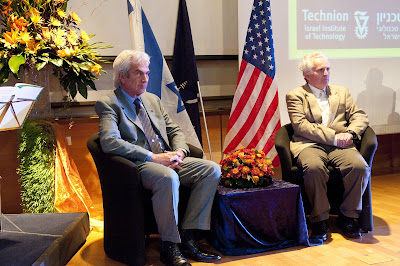
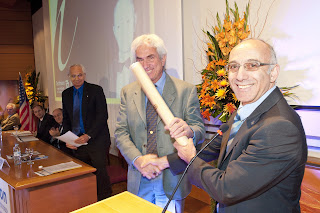
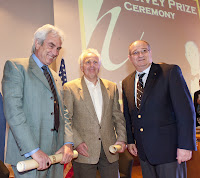
Prof. Michael Karin and Prof. Alexander Polyakov, Harvey Prize 2010 Laureates, with Technion President Prof. Peretz Lavie


Prof. Michael Karin and Prof. Alexander Polyakov are the winners of the Technion’s 2010 Harvey Prize. The festive ceremony took place on March 15th, 2011.


“The road to discovery is not an easy one,” said Technion President Prof. Peretz Lavie.  “It is time-consuming and at times can come at great personal and professional costs.  However, discovery is the engine which drives the human race.  Without it, we would not be able to survive.  Furthermore, it is the greatest and most wondrous feat of our nature.”  


Prof. Karin, from the University of California, San Diego, received the prize in the field of human health. He discovered the strong link between obesity, inflammation and cancer. The judges decided to award the prize to Prof. Karin for “his pioneering contribution that led to deciphering the molecular mechanism through which mammalian cells react to cytokines which cause inflammation, to adverse environmental conditions and also to various pathogens. His research laid the foundations for our understanding of the control mechanisms of transcription factor activities influenced by external stimulations, especially the transcription factors of the AP-1 family and NF-B. These discoveries led to the identification of new target protein cells that have recently been used to develop new medications for preventing and treating various malignant tumors.”


Prof. Polyakov, from Princeton University, received the prize in the field of science and technology. “He developed revolutionary theories that shaped our contemporary understanding of elementary particles in nature. In addition, he significantly contributed to condensed matter physics, statistical mechanics and mathematics. Among the ideas credited to him are topological structures (such as magnetic monopoles) in gauge field theories, which are important in understanding the confinement of quarks in the nucleus. Polyakov also contributed to the foundations of string theory, the unification of quantum mechanics and gravity, and to the idea of duality between string theory and gauge field theory.”


The Technion’s prestigious Harvey Prize foresaw the winning of the Nobel Prize for two of the latest Nobel laureates – Elizabeth Blackburn (Medicine) and Ada Yonath of the Weizmann Institute of Science (Chemistry). To date, 13 Harvey Prize winners have gone on to win the Nobel Prize.


The Harvey Prize was first awarded in 1972 from a fund established by the late Leo M. Harvey of Los Angeles in order to recognize those who have made great contributions to advancing humanity in science and technology and in human health, as well as advancing peace in the Middle East. Every year, prizes totaling $75,000 per winner are awarded from the fund’s income.


Among the winners of the prestigious Harvey Prize are scientists from the US, Great Britain, Russia, Sweden, France and Israel. These include Nobel Prize laureate Mikhail Gorbachev, former leader of the USSR, who was awarded the prize for his activities aimed at reducing regional tensions; Prof. Bert Sakmann who won the Nobel Prize in Medicine; Prof. Pierre-Gilles de Gennes who won the Nobel Prize in Physics; Prof. Edward Teller for his discoveries in solid state physics, atomic physics and nuclear physics; and Prof. William J. Kolff for his invention of the artificial kidney.


Proposals for candidates for the Harvey Prize are received from leading scientists and personalities in Israel and the world. The prize laureates are chosen by the Harvey Prize committee in a stringent process at the Technion.

Prof. Karin (left) and Prof. Polyakov (right)


Description: Description: Description: TechnionLive - Technion’s e-newsletter Description: Description: Description: Technion Live on FaceBook Description: Description: Description: Technion’s YouTube Channel Description: Description: Description: Subscribe to RSS News Feeds
   

F.I.R.S.T. Robotics Competition ~ Technion


FIRST 2011 competition

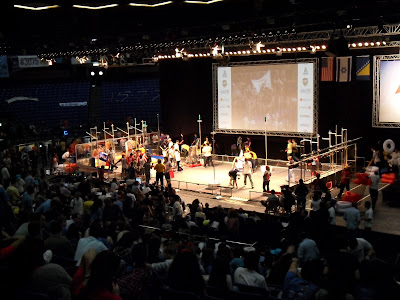
The Nokia Arena, Tel aviv, 15-16th March 2011: 48 groups of students from Israel, a group from California and a group from Bosnia and Herzegovina participated in the finals of the seventh season of FIRST competitions – titled Logo Motion.

The FIRST competition has been active in Israel since 2005, integrating about 3000 children and youth from across the country. This unique competition combines the excitement from the world of sports with the challenge for science and technology. The competition challenges participants to demonstrate excellence in design, team spirit, professionalism, maturity and problem-solving.

Technion has been involved with the competitions since they began in Israel ~ transferring funds through Technion Societies and the National Center for Robotics Center at the Faculty of Mechanical Engineering.

Beyond inspiring and motivating generations of future scientists and engineers,  FIRST creates interaction and dialog between participants from all walks of Israeli life.


To read about the kind of things these kids get up to when they’re older, check Israel21C’s Surgery? Border patrol? Israeli robots can do that.


Technion Entrepreneur in Residence Program (EIR)

Reposted from T3 – the Technion Technology Transfer office


The Technion Entrepreneur in Residence (EIR) program introduces entrepreneurs into the Technion research environment, identifying promising technologies in order to launch start-up companies. By engaging experienced entrepreneurs to transfer technology to the global marketplace, the Technion enables researchers to concentrate on their academic endeavors, while ensuring commercialization of new technologies.

As a part of the program, each entrepreneur has up to six months to discover a business opportunity and launch a startup. While entrepreneurs are not paid for their participation in the EIR program, they receive equity in the newly formed startups. Preference is given to entrepreneurs that are willing to establish their operations in the Haifa area, near the Technion, thus facilitating close dialogue with faculty members, Technion laboratories, and the business unit.

The EIR’s Board of Directors guides entrepreneurs through the commercialization process. During an up-to-three-month ‘opportunity discovery’ period, the entrepreneurs work within a designated Technion department. They have access to other departments to identify and stimulate multi-disciplinary opportunities. While entrepreneurs are expected to point out several opportunities, they ultimately focus on a single option.

Having identified their startup opportunity, entrepreneurs work with the Technion Entrepreneurship and Innovation Center for an additional three months to develop a detailed business strategy. These plans are then submitted to the EIR Board of Directors, for final acceptance or rejection.

Upon a ‘thumbs up’ decision by the Board, a newly minted startup company is formed. Entrepreneurs are responsible for implementing the business plan, raising capital, achieving milestones, and reporting progress to the EIR Board on a quarterly basis. The startup receives broad Technion support, which includes access to Institute laboratories for ongoing research, as well as administrative and legal services.

For further information contact: t3info@technion.ac.il