Tag Archives: technology

Christine Quinn at Technion City

Technion President Prof. Peretz Lavie with Christine Quinn of New York at Technion City, Feb. 2012.

“The Technion-Cornell Initiative will make our City the Global High-Tech Capital”

“The residents of New York City and its government are very excited about the planned applied science and engineering campus which Cornell and the Technion are partnering to establish”, said Christine Quinn, New York City council speaker, in her visit today to the Technion. “We have no doubt that this important venture, which will make our city the global high-tech capital, will inject new blood into it and improve all municipal aspects – from affordable housing to cafés and restaurants”.

Quinn, who in 2007 was ranked by the New York Post third in the list of the most influential women in New York, is a member of the Democratic Party, and is considered a leading candidate in the mayoral election that will end next year. She invests substantial resources in improving health care and in promoting affordable housing in New York. “We, as a municipality, cannot create entrepreneurial ventures, but we can and are committed to creating a suitable envelope for them: an efficient transportation system, personal security, housing, quality education and employment – without these, entrepreneurs and high-tech companies cannot be attracted to the city”.

 “Whenever I hear the slogan ‘Intel Inside’ I say: Haifa Inside.”

Technion President Professor Peretz Lavie said to the guest that the future is in the interdisciplinary realm, and that this is the rational behind the new campus that will be set-up  on Roosevelt Island in New York. “It may be that Prof. Shechtman is the last scientist to be awarded the Nobel Prize for research conducted by one person working alone in one laboratory,” said Prof. Lavie. “Nowadays, achieving significant scientific and engineering breakthroughs requires tremendous knowledge that the single scientist does not possess. In light of this, the new campus will be structured as interdisciplinary centers that will intercommunicate and overlap, rather than in the well-known university model of programs and faculties. With time this center will be surrounded by startup companies and extensions of large high-tech companies, just as such companies and extensions historically developed near the Technion. Intel is an example of a giant company that chose to establish here its first research center outside the US, and so whenever I hear the slogan ‘Intel Inside’ I say: Haifa Inside. Our innovative venture will build a bridge of friendship and cooperation between New York and Haifa”.

1912-2012: Technion Timeline of a Century.

Landmark behind Time


The Technion’s historic building was designed by the renowned Jewish German architect, Alexander Baerwald. His design includes both oriental and European motives. It is built from sandstone quarried in Tantura and Atlit. The building was part of Baerwald’s plan of an open corridor leading directly to the bay. He also designed buildings that would line the road, of which some were built, indeed (e.g. the Hebrew Reali School). 

The building’s cornerstone was laid in 1912. The building’s construction was delayed during the First World War. The partially completed building was used, then, as a military hospital. In 1925 it became the home of Israel’s first institute of higher education – The Technion, Israel Institute of Technology. Until 1953, all the Technion Faculties were located there. By 1965, most of them have moved to the Technion new campus in Haifa’s Nave Shaanan. The Faculty of Architecture and Town Planning stayed in the historic Technion building until 1985. 


Timeline of the Century

2012: Technion partners with Cornell University to found the Technion Cornell Institute of Innovation (TCII), an international ‘School of Genius’ in the heart of New York City.


2011: Technion Prof. Dan Shechtman receives the Nobel Prize in Chemistry for his discovery of quasicrystals.


2007: Technion pools its brainpower in a unique multidisciplinary center for research into energy science, technology and engineering: The Grand Technion Energy Program.


2006: Technion is Israel’s 1st university to receive the Nobel Prize for Science. Prof. Aaron Ciechanover and Prof. Avram Hershko jointly receive the Nobel Prize in Chemistry for their discovery, together with Irwin Rose, of the ubiquitin system within living cells.


2005: Technion opens the Russell Berrie Nanotechnology Institute (RBNI) to further empower and concentrate the plethora of excellent scientists, researchers and students pioneering science in the nano dimension.


2001: Technion scientists reveal they have long been quietly researching solutions to meet the threat of 3rd millennium terrorism as revealed by the horrific events in the US of September 11th


1998: Combining microbiology and microelectronics, scientists show how to make a transistor 1/100,000th the size of a human hair


1993: Technion students design and launch their own satellite: Gurwin Tech Sat. The satellite is still in orbit.


1991: Gulf War – Technion shows that the integration of expertise of Israel’s top institute of technology with its dynamic medical school makes Technion first responders in responding to missile attack on the home-front.


1989: Optoelectronics: A new center of excellence pioneering the technological promise of an expert understanding of light.


1982: The Rappaport Family Institute for Research in the Medical Sciences is established. During more than two decades of activity, the Institute has established itself as an internationally recognized research center and counts among its members several world-renowned scientists.
1981: Fiberoptics is pioneered by Technion


1978: Camp David accords with Egypt: the scientific challenges of peace and nation-planning means that in addition to its many projects in water management and environmental engineering, the Technion sets up the Samuel Neaman Institute.


1973: Yom Kippur War


1971: The Faculty of Biology is set up.


1969: The faculty of medicine is born. The first class consists of 43 students who had their preclinical education abroad. They were admitted to the fourth year and finished the requirements for the degree of Medical Doctor (M.D.), after two years of clinical training in the hospitals. The same year also sees the birth of the Department of Biomedical Engineering and the Faculty of Computer Science. 


1967: Six-Day War, Faculty of Materials Engineering is set up.


1966: Agricultural engineering degrees awarded to students from Africa and Asia


1965: Department of Education in Technology and Science


1962: Faculty of Food Engineering and Biotechnology 


1961: Technion offers a  flourishing graduate school and R&D foundation


1960: The Faculty of Mathematics and the Faculty of Physics are formed.

1958:  The opening of the Faculty of Chemistry, the Faculty of Industrial Engineering and Management, and The  Department of Humanities and Arts

1956: Students take part in the Sinai War


1954: Technion founding father Prof. Albert Einstein is awarded a Technion honorary doctorate. The Faculty of Chemical Engineering is opened.


1953:The Department of Aeronautical Engineering and the  Faculty of Agricultural Engineering are set up in the new campus.


1952: Rapid growth and expansion and increasing demand for Technion graduates and engineers nation-wide means the Technion leaves its first home in the historic building in down-town Haifa. Prime-Minister David Ben Gurion selects the new site for Technion City further up the slopes of Mount Carmel.


1948: With 680 students, Technion celebrates the declaration of independence. Studies are disrupted for most of the year as faculty and students fight for independence. The Faculty of Electrical Engineering and the Faculty of Mechanical Engineering are opened.


1944: Survival tasks – Technion develops early warning systems against air attacks as well as weapons for the Hagannah, the Israeli underground army that are preparing for the War of Independence.


1943: 1000 skilled Technion graduates join the war effort against Nazi Germany


1938: The Faculties of civil engineering, architecture, industrial engineering and opened, together with 11 new labs and a nautical school


1935: The Polish government recognizes Technion
1934: The Faculty of Industrial Technology is established covering broad fields. 


1931: Technion staff vote to work for nothing to ensure their institute survives.
1928: First class of 17 Technion engineers and architects graduates


1926: Zeev Jabotinsky addresses Technion Haganah members


1924: Technion officially enrolls 1st class of engineering students


1923: Einstein’s first visit in which he becomes president of the first Technion society, the German Technion Society


In 1923, Albert Einstein visited the empty building of the Technikum, where there was a plan to give courses for word workers, electricians and telephone and telegraph workers. Although the derelict buildings were being used as a hostel for immigrants from Europe, Albert Einstein did not think the dream of founding a technical university in the Middle East to be fantasy. As a great scientist, Einstein knew that what makes the impossible possible is the courage to follow an inspiration. 


1920: The building is legally acquired and recruitment for staff begins


1914: 1918 German, Turkish and then British troops occupy the building


1913: A battle continues over the language of Technion instruction: German or revitalized Hebrew?   Hebrew wins.


1912: The cornerstone is laid for Technion’s building


1908: Wissotzky, Schiff and the Jewish National Fund invest in the new “Technikum” 


1903: Hebrew teachers association of Palestine calls for a polytechnic university


1902 Herzl publishes the novel Altneuland  (The Old New Land), which takes place in Palestine, creating the vision for a Jewish state and Zionism.


1901: 5th Zionist congress calls for a Jewish technological university, as a first necessary step to realize the dream of a Jewish state.


File:Herzl.jpg


We began with a thought…
           
“Our technical inventors, who are the true benefactors of humanity… will discover things as marvelous as those we have already seen, or indeed more wonderful than these…”
Theordor Herzl, 1896, The Jewish State

In 1902, Theodor Herzl envisioned Haifa as “a great park….with an overhead electrical train…. a city of magnificent homes and public institutions all made possible by applied science, engineering and technology.” (Altneuland)
At that time, even an automobile was an exceptional extravagance of engineering. Electricity was still an expensive luxury for the elite few.
Haifa was a small, remote, coastal town most easily accessed by boat.
The advance of science and technology; the creation of the State of Israel; the emergence of the global village connected by the information superhighway; discoveries in basic science that have fundamentally changed the way scientists think about the material world, and the tremendous applied advances taking place in every corner of Technion City are just some of the miracles witnessed in the past century.

It all began with an inspirational thought in the mind of one man, Binyamin Ze’ev Herzl. Prof. Albert Einstein later added his mind to the vision. Thousands of great thinkers have since added to the blaze of light which is Technion, creating an institute of technology that in the 3rd millennium is truly a light to the nations.

1912-2012: Technion Timeline of a Century.

Landmark behind Time


The Technion’s historic building was designed by the renowned Jewish German architect, Alexander Baerwald. His design includes both oriental and European motives. It is built from sandstone quarried in Tantura and Atlit. The building was part of Baerwald’s plan of an open corridor leading directly to the bay. He also designed buildings that would line the road, of which some were built, indeed (e.g. the Hebrew Reali School). 

The building’s cornerstone was laid in 1912. The building’s construction was delayed during the First World War. The partially completed building was used, then, as a military hospital. In 1925 it became the home of Israel’s first institute of higher education – The Technion, Israel Institute of Technology. Until 1953, all the Technion Faculties were located there. By 1965, most of them have moved to the Technion new campus in Haifa’s Nave Shaanan. The Faculty of Architecture and Town Planning stayed in the historic Technion building until 1985. 


Timeline of the Century

2012: Technion partners with Cornell University to found the Technion Cornell Institute of Innovation (TCII), an international ‘School of Genius’ in the heart of New York City.


2011: Technion Prof. Dan Shechtman receives the Nobel Prize in Chemistry for his discovery of quasicrystals.


2007: Technion pools its brainpower in a unique multidisciplinary center for research into energy science, technology and engineering: The Grand Technion Energy Program.


2006: Technion is Israel’s 1st university to receive the Nobel Prize for Science. Prof. Aaron Ciechanover and Prof. Avram Hershko jointly receive the Nobel Prize in Chemistry for their discovery, together with Irwin Rose, of the ubiquitin system within living cells.


2005: Technion opens the Russell Berrie Nanotechnology Institute (RBNI) to further empower and concentrate the plethora of excellent scientists, researchers and students pioneering science in the nano dimension.


2001: Technion scientists reveal they have long been quietly researching solutions to meet the threat of 3rd millennium terrorism as revealed by the horrific events in the US of September 11th


1998: Combining microbiology and microelectronics, scientists show how to make a transistor 1/100,000th the size of a human hair


1993: Technion students design and launch their own satellite: Gurwin Tech Sat. The satellite is still in orbit.


1991: Gulf War – Technion shows that the integration of expertise of Israel’s top institute of technology with its dynamic medical school makes Technion first responders in responding to missile attack on the home-front.


1989: Optoelectronics: A new center of excellence pioneering the technological promise of an expert understanding of light.


1982: The Rappaport Family Institute for Research in the Medical Sciences is established. During more than two decades of activity, the Institute has established itself as an internationally recognized research center and counts among its members several world-renowned scientists.
1981: Fiberoptics is pioneered by Technion


1978: Camp David accords with Egypt: the scientific challenges of peace and nation-planning means that in addition to its many projects in water management and environmental engineering, the Technion sets up the Samuel Neaman Institute.


1973: Yom Kippur War


1971: The Faculty of Biology is set up.


1969: The faculty of medicine is born. The first class consists of 43 students who had their preclinical education abroad. They were admitted to the fourth year and finished the requirements for the degree of Medical Doctor (M.D.), after two years of clinical training in the hospitals. The same year also sees the birth of the Department of Biomedical Engineering and the Faculty of Computer Science. 


1967: Six-Day War, Faculty of Materials Engineering is set up.


1966: Agricultural engineering degrees awarded to students from Africa and Asia


1965: Department of Education in Technology and Science


1962: Faculty of Food Engineering and Biotechnology 


1961: Technion offers a  flourishing graduate school and R&D foundation


1960: The Faculty of Mathematics and the Faculty of Physics are formed.

1958:  The opening of the Faculty of Chemistry, the Faculty of Industrial Engineering and Management, and The  Department of Humanities and Arts

1956: Students take part in the Sinai War


1954: Technion founding father Prof. Albert Einstein is awarded a Technion honorary doctorate. The Faculty of Chemical Engineering is opened.


1953:The Department of Aeronautical Engineering and the  Faculty of Agricultural Engineering are set up in the new campus.


1952: Rapid growth and expansion and increasing demand for Technion graduates and engineers nation-wide means the Technion leaves its first home in the historic building in down-town Haifa. Prime-Minister David Ben Gurion selects the new site for Technion City further up the slopes of Mount Carmel.


1948: With 680 students, Technion celebrates the declaration of independence. Studies are disrupted for most of the year as faculty and students fight for independence. The Faculty of Electrical Engineering and the Faculty of Mechanical Engineering are opened.


1944: Survival tasks – Technion develops early warning systems against air attacks as well as weapons for the Hagannah, the Israeli underground army that are preparing for the War of Independence.


1943: 1000 skilled Technion graduates join the war effort against Nazi Germany


1938: The Faculties of civil engineering, architecture, industrial engineering and opened, together with 11 new labs and a nautical school


1935: The Polish government recognizes Technion
1934: The Faculty of Industrial Technology is established covering broad fields. 


1931: Technion staff vote to work for nothing to ensure their institute survives.
1928: First class of 17 Technion engineers and architects graduates


1926: Zeev Jabotinsky addresses Technion Haganah members


1924: Technion officially enrolls 1st class of engineering students


1923: Einstein’s first visit in which he becomes president of the first Technion society, the German Technion Society


In 1923, Albert Einstein visited the empty building of the Technikum, where there was a plan to give courses for word workers, electricians and telephone and telegraph workers. Although the derelict buildings were being used as a hostel for immigrants from Europe, Albert Einstein did not think the dream of founding a technical university in the Middle East to be fantasy. As a great scientist, Einstein knew that what makes the impossible possible is the courage to follow an inspiration. 


1920: The building is legally acquired and recruitment for staff begins


1914: 1918 German, Turkish and then British troops occupy the building


1913: A battle continues over the language of Technion instruction: German or revitalized Hebrew?   Hebrew wins.


1912: The cornerstone is laid for Technion’s building


1908: Wissotzky, Schiff and the Jewish National Fund invest in the new “Technikum” 


1903: Hebrew teachers association of Palestine calls for a polytechnic university


1902 Herzl publishes the novel Altneuland  (The Old New Land), which takes place in Palestine, creating the vision for a Jewish state and Zionism.


1901: 5th Zionist congress calls for a Jewish technological university, as a first necessary step to realize the dream of a Jewish state.


File:Herzl.jpg


We began with a thought…
           
“Our technical inventors, who are the true benefactors of humanity… will discover things as marvelous as those we have already seen, or indeed more wonderful than these…”
Theordor Herzl, 1896, The Jewish State

In 1902, Theodor Herzl envisioned Haifa as “a great park….with an overhead electrical train…. a city of magnificent homes and public institutions all made possible by applied science, engineering and technology.” (Altneuland)
At that time, even an automobile was an exceptional extravagance of engineering. Electricity was still an expensive luxury for the elite few.
Haifa was a small, remote, coastal town most easily accessed by boat.
The advance of science and technology; the creation of the State of Israel; the emergence of the global village connected by the information superhighway; discoveries in basic science that have fundamentally changed the way scientists think about the material world, and the tremendous applied advances taking place in every corner of Technion City are just some of the miracles witnessed in the past century.

It all began with an inspirational thought in the mind of one man, Binyamin Ze’ev Herzl. Prof. Albert Einstein later added his mind to the vision. Thousands of great thinkers have since added to the blaze of light which is Technion, creating an institute of technology that in the 3rd millennium is truly a light to the nations.

Keep it PURE – Nano filters for cleantech & desalination.

Handing you the Future ~
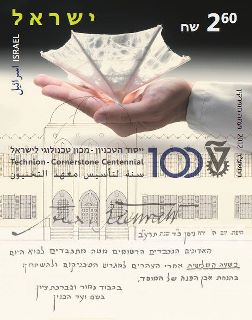
1912-2012: the Technion Centennial Stamp features
one application of the innovative nano fibers
Featured on the Technion 2012 Cornerstone Centennial Stamp, the nanofibers behind the dynamic new start-up NanoSpun signify many of the secrets of Technion’s success in conceptualizing, shaping and nurturing Israel as the high-tech global success of the third millennium.
 
Why would Cornell University and New York City invite Technion to set up a new campus on Roosevelt Island, in order to boost economic growth through innovation and entrepreneurship? Throughout the world, news headlines have cited Technion’s unique ability to produce dynamic and profitable start ups using advanced technology and skills. In 2012, one company that exemplifies the secrets of this success is the prize-winning start up NanoSpun.

How start-ups get started. Israel, NYC & TCII

Silicon Island: a NYC hub for technology transfer

“We are glad to have the opportunity to join forces with Cornell University, to tap into the already rich innovative New York based eco-system and share our tech-transfer practices, insights and methodologies”

One of the most significant global academic milestones of this century must be the decision announced on December 19th 2011 by New York Mayor Bloomberg of Cornell University and Technion-Israel Institute of Technology as winners in a $2 billion competition to build a science and engineering campus on Roosevelt Island. The planned campus aims to serve 2,500 students and 280 faculty by 2043. It also intends to boost the number of graduate engineering students in the area by 70 percent. For the first time in history, the new academic venture will be called an institute of “Innovation”.

For Technion scientists patenting new technologies and looking at commercialization, TCII represents a foothold in New York City which is vital for global commercialization and networking. US investors will also have a domestic gateway to emerging technologies from Israel’s top powerhouse of innovation.

Included in plans for TCII (the Technion Cornell Institute of Innovation), is a $150 million fund to spawn New York area startups. The move comes on the heels of plans from IBM, Intel and others to participate in a $4.4 billion New York state effort to develop semiconductor technology for 450mm wafers.

“The message we are sending with this announcement is: look out Silicon Valley, look out Boston, New York will be second to none,” stated U.S. Senator Charles E. Schumer.

The campus will be organized around three interdisciplinary hubs: Connective Media, Healthier Life, and the Built Environment. Cornell will immediately offer Master and Doctoral degrees in areas such as Computer Science, Electrical and Computer Engineering, and Information Science and Engineering. In addition, after receiving the required accreditation, the campus will also offer innovative Technion-Cornell dual Master of Applied Sciences degrees. The concept of organizing TCII into multidiciplinary ‘hubs’ was introduced by the Technion, based on its successful multidisciplinary research centers, such as the Grand Technion Energy Program, says Technion President Peretz Lavie.

The TCII Campus will host entrepreneurs-in-residence, organize business competitions, provide legal support for startups, reach out to existing companies to form research partnerships and sponsor research, and establish a pre-seed financing program to support promising research. In addition, the campus will structure its tech transfer office, which will be on-site, to facilitate startup formation and technology licensing. The TCII Campus will also establish a $150 million revolving financing fund that will be solely devoted to start-up businesses in new York City.

“Starting today, we are going to put our plan to work, tapping into our extensive connections throughout the city and build a truly 21st Century campus to fuel the creation of new businesses and new industries throughout the city for decades to come.

“Technology Transfer activity takes place at the Technion in many shapes and forms resulting in significant economic development both locally and nationally,” says manager of the Technion Technology Transfer Office ( T3 ) Benjamin Soffer. “We are glad to have the opportunity to join forces with Cornell University, tap into the already rich innovative New York based eco-system and share our tech-transfer practices, insights  and methodologies to the benefit of the state of New York and the US at large.” 

IP (intellectual property) coming out of the TCII will be held jointly by Cornell University and Technion.

According to Israel’s Ministry of Foreign Affairs, Technion has a world-class track-record in research, development and entrepreneurship. The Technion’s departments of Electrical Engineering and Computer Science are considered among the best in the world. It  boasts top ranking faculty members including Nobel laureates. The Technion has long been considered a driving force behind Israel’s emergence as one of the world’s great centers of technology.

“Israel’s heros used to be the generals; now, the heros are the entrepreneurs.”

Technion  T3 Manager Benjamin Soffer,

Israel today has one of the highest concentrations of high-tech start-up companies globally. In partnership with a strong community of incubators, private investors, venture capitalists, angel groups and entrepreneurs, the Technion’s tech transfer arm, Technion Technology Transfer ( T3 ), has filed an average of 300 new patents each year and annually nurtures innovative startups in sectors such as clean-tech, cell therapy, drug delivery, nanotechnology and others. Companies including Intel, Google, Microsoft, IBM, Qualcomm, Broadcom, Yahoo! and Hewlett-Packard have established major operations near or on the Technion campus. Only this month, Apple announced that it will be joining the others to set up a ground-breaking R&D Center near Technion City – to be headed by Technion graduate Aharon Aharon.

Technion graduates currently head nearly half of the 121 Israeli companies on the NASDAQ, which have a combined market value of over $28 billion. More than 70 percent of the Technion graduates are employed in the high technology sectors that drive Israel’s economic growth.  Presently, Israeli companies headed by the Technion graduates employ 85 percent of Israel’s technical workforce.  According to a recent article in the Israeli newspaper Haaretz, there are approximately 4,000 start-up companies located around the Technion’s home campus.

President Lavie addresses press. NYC, 19th December, 2011

With the selection of Cornell/Technion now complete, the project is scheduled to move into the environmental and land use review process, expected to be completed by the fall of 2013. Groundbreaking on the first phase of the Roosevelt Island campus is expected by the beginning of 2015. A temporary off-site campus will be open in 2012.

NYC – Technion-Cornell Cornerstone of the Future

NYC Tech Campus:
“Our greatest strength is our diversity. This is the day we really do usher in the high tech economy.”


Technion President Peretz Lavie

“No more faculties but HUBS that are flexible, overlapping and interact with industry: an open very flexible system built around themes rather than traditional fields of science.
…We found a partner, and what a partner. A program of innovation. We are not going to have an extension of the Technion or Cornell but something new that will really energize this city. 
…The links between Technion and New York go back to the 1910s, with a donation from US philanthropist Jacob Schiff….
…The Technion was founded in 1912…100 years later we come to New York to close the historic circle. We are building the bridge between Israel and the US, Technion and Cornell, New York and Haifa.” 

...from Jaffa oranges to semiconductors

…I just came from Stockholm… this is as exciting as a Nobel”

Cornell President David J. Skorton:
“A story of connectivity, between people and their ideas, between teachers and their students…
…Success needs technology,innovation, entrepreneurial ecosystem…
…We need to extend the talent pool… and retain them in NYC – as many as possible for as long as possible.”
New campius: “An environmental standard bearer.”
Mayor Bloomberg:

 “Today will be remembered as a defining moment.”

“A dynamic joint submission from two world class institutions”

“The economic impact will be greater than we thought. A game changer.”

“Transformative, cutting edge campus, pioneering green elements…”

The bid- “The most students, faculty, building space, environmentally sustainable”

“The element includes elements to integrate the campus with the city… “

“Unprecedented fund for start ups with high dividends”

“Technion sits at the center of an ecosystem of startups + hightech giants”

3/4 nobel scientists in Israel came from Technion – “

 Technion – Cornell: “A tantalizing groundbreaking partnership.”

“Cornell Tech campus will spin out more than 600 new companies over 30 yrs”

“The courage to expand… their success will be our success”
They are calling the Technion Israel’s version of MIT. This is very flattering, but there is a difference. Technion was founded in 1912 – decades before the birth of the State of Israel. It was the inculcation of expert skills, creativity and pioneering ingenuity among young people that facilitated the birth of a nation. You can check the Technion’s unique history on Wikipedia, or view it rapidly in the video below! If you want it in a different language, go to Technion Channel and take your pick!
100 years ago, the first cornerstone was laid for Israel’s 1st university. So much was embodied in that cornerstone, including the realization of the hopes, dreams and genius of a people who had been disenfranchised for centuries. The original charter of the Technion was not only Zionist. It was to bring skills, education and training to people denied access to higher education in the service of all humanity.
In 2012, in the year of the Technion’s cornestone centenary, a third millennium cornerstone is to be laid, on that realized the vision to be of service to all humankind. United with Cornell University – an institution unrivaled in its creativity, standards of excellence and flair for innovation, Technion will be working to establish the foundations of the global village of tomorrow – a center of higher education that will transform the New York of the coming 100 years – bringing innovation, employment and creativity, introducing tomorrows generation of medicine, life sciences, nanotechnology, software, electronics and  global entrepreneurship.
At Technion, tomorrow begins today.
The path of progress. Technion & Cornell link up
to announce the bid for NYC ‘genius’ tech campus

Unconstrained by geography… the Technion – Cornell link-up
to generate innovation at the heart of the global village.

Green, clean and aesthetic… artists impression of the new
campus on Roosevelt Island.

A coalition to lay the scientific and technological foundations
of tomorrow’s world.

Cornell President Skorton in a video conference with
Technion President Peretz Lavie.

NYC – Technion-Cornell Cornerstone of the Future

NYC Tech Campus:
“Our greatest strength is our diversity. This is the day we really do usher in the high tech economy.”


Technion President Peretz Lavie

“No more faculties but HUBS that are flexible, overlapping and interact with industry: an open very flexible system built around themes rather than traditional fields of science.
…We found a partner, and what a partner. A program of innovation. We are not going to have an extension of the Technion or Cornell but something new that will really energize this city. 
…The links between Technion and New York go back to the 1910s, with a donation from US philanthropist Jacob Schiff….
…The Technion was founded in 1912…100 years later we come to New York to close the historic circle. We are building the bridge between Israel and the US, Technion and Cornell, New York and Haifa.” 

...from Jaffa oranges to semiconductors

…I just came from Stockholm… this is as exciting as a Nobel”

Cornell President David J. Skorton:
“A story of connectivity, between people and their ideas, between teachers and their students…
…Success needs technology,innovation, entrepreneurial ecosystem…
…We need to extend the talent pool… and retain them in NYC – as many as possible for as long as possible.”
New campius: “An environmental standard bearer.”
Mayor Bloomberg:

 “Today will be remembered as a defining moment.”

“A dynamic joint submission from two world class institutions”

“The economic impact will be greater than we thought. A game changer.”

“Transformative, cutting edge campus, pioneering green elements…”

The bid- “The most students, faculty, building space, environmentally sustainable”

“The element includes elements to integrate the campus with the city… “

“Unprecedented fund for start ups with high dividends”

“Technion sits at the center of an ecosystem of startups + hightech giants”

3/4 nobel scientists in Israel came from Technion – “

 Technion – Cornell: “A tantalizing groundbreaking partnership.”

“Cornell Tech campus will spin out more than 600 new companies over 30 yrs”

“The courage to expand… their success will be our success”
They are calling the Technion Israel’s version of MIT. This is very flattering, but there is a difference. Technion was founded in 1912 – decades before the birth of the State of Israel. It was the inculcation of expert skills, creativity and pioneering ingenuity among young people that facilitated the birth of a nation. You can check the Technion’s unique history on Wikipedia, or view it rapidly in the video below! If you want it in a different language, go to Technion Channel and take your pick!
100 years ago, the first cornerstone was laid for Israel’s 1st university. So much was embodied in that cornerstone, including the realization of the hopes, dreams and genius of a people who had been disenfranchised for centuries. The original charter of the Technion was not only Zionist. It was to bring skills, education and training to people denied access to higher education in the service of all humanity.
In 2012, in the year of the Technion’s cornestone centenary, a third millennium cornerstone is to be laid, on that realized the vision to be of service to all humankind. United with Cornell University – an institution unrivaled in its creativity, standards of excellence and flair for innovation, Technion will be working to establish the foundations of the global village of tomorrow – a center of higher education that will transform the New York of the coming 100 years – bringing innovation, employment and creativity, introducing tomorrows generation of medicine, life sciences, nanotechnology, software, electronics and  global entrepreneurship.
At Technion, tomorrow begins today.
The path of progress. Technion & Cornell link up
to announce the bid for NYC ‘genius’ tech campus

Unconstrained by geography… the Technion – Cornell link-up
to generate innovation at the heart of the global village.

Green, clean and aesthetic… artists impression of the new
campus on Roosevelt Island.

A coalition to lay the scientific and technological foundations
of tomorrow’s world.

Cornell President Skorton in a video conference with
Technion President Peretz Lavie.

Israel: Land of the Little Apple


High-tech Giant Apple to set up Israel development center

With Technion graduates heading R&D centers for Microsoft, Yahoo, Google and Intel to name a view, Apple has until now been noticeable by it absence. Now, news is surfacing that Technion graduate (first and second degrees) Aharon Aharon will head Apple’s first ever development center outside of its California headquarters.

 
Apple Inc. has decided to open a development center in Israel focusing on semiconductors, the first R&D venture for the company outside the United States, the Israeli Business news service Globes Wednesday. The decision was apparently made even before the company entered into talks to acquire Herzliya-based flash storage solutions provider Anobit Ltd.

Apple has hired Aharon Aharon, Technion graduate and a veteran player in Israel’s high tech industry, to lead the new development center. The planned Israel center will be the company’s first such center outside of its California headquarters.

Aharon Aharon comes to Apple with a rich background. His most high-tech venture was Camero Tech Ltd., which develops Radio Frequency (RF) based imaging systems, and which he founded in 2004 with Amir Beeri. Before that, he was chairman of embedded security solutions developer Discretix Inc. and managed their Israel development center. He was also VP operations at Zoran Corp.(Nasdaq: ZRAN), having begun his career at IBM’s Haifa development center where he reached the post of deputy director.

Apple is cultivating it;s new orchard for future growth fast. Aharon will be spending some months at Apple HQ in Cupertino before launching the Israel enterprise and harvesting the local skills and ingenuity. It is one ground breaking decision that is sure to support Apple in maintaining its competitive edge in the next, even smarter generation.

The Birth of Super Resolution – Technion Startup in HD!


A clear-cut example of the dynamic process of technology transfer at the Technion – the startup BETTERview is slated to revolutionize the quality of HD imaging – by taking and applying new research from the Technion department of electrical engineering all the way to your the screen of your TV, PC or smart phone. Have something old and cloudy? BETTERvIew also offers a conversion service to produce images as crisp as if they were filmed with the cutting-edge cameras of tomorrow.


BETTERView offers SD to true HD (High Definition) conversion and video enrichment. Check the following video to see the quality advantage.


The patented breakthrough in the super resolution promises to breaks the “glass ceiling” of existing technology, says the company, whose team includes world-experts from Technion’s Faculty of Computer Science, which is ranked #15 in the world. While conventional methods use conversion techniques to “blow up” or stretch the SD video onto an HD display, BetterVirw increases optical resolution of a video stream, generating an HD stream that looks as authentic as it gets.


BETTERview technology is based on a novel family of SR algorithms, proposed by a world-leader in this field, Prof. Michael Elad (Technion – Israel Institute of Technology). Elad and his collaborator, Dr. Matan Protter devised the first method that overcomes the requirement for very accurate and explicit motion estimation in previous SR technologies. The new family of SR techniques avoids the exact motion estimation and replaces it by a probabilistic estimate. This enables handling successfully general content scenes containing extremely complex motion patterns. 


The results are impressive, with no visual artifacts, and the process is completely robust. Based on this core technology, BETTERview developed the first cutting-edge industrial-grade robust system that perform SD to True HD resolution conversion. Its solution strengthens the above-mentioned core technology by handling various video artifacts, interlaced content, synchronization issues and run-time efficiency.


The innovative research of Prof. Michael Elad was listed in 2010 by Thomson Reuters Science Watch. You can read their interview with him here.


It has been known for the past 20 years that, in principle, one could take several low-quality images and fuse them into a single, higher-resolution outcome. This has been demonstrated by scientists, adopting various techniques and algorithms. The process is known as Super-Resolution (SR), which  became a hot field in image processing, with thousands of academic papers published during the past two decades on the problem and ways to handle it. The classical approach to fuse the low-quality images requires finding an exact correspondence between their pixels, a process known as “motion estimation”. Several years ago this field experienced a revolution, due to a breakthrough in the way to handle (or better yet, bypass altogether) the motion estimation. 

The Birth of Super Resolution – Technion Startup in HD!


A clear-cut example of the dynamic process of technology transfer at the Technion – the startup BETTERview is slated to revolutionize the quality of HD imaging – by taking and applying new research from the Technion department of electrical engineering all the way to your the screen of your TV, PC or smart phone. Have something old and cloudy? BETTERvIew also offers a conversion service to produce images as crisp as if they were filmed with the cutting-edge cameras of tomorrow.


BETTERView offers SD to true HD (High Definition) conversion and video enrichment. Check the following video to see the quality advantage.


The patented breakthrough in the super resolution promises to breaks the “glass ceiling” of existing technology, says the company, whose team includes world-experts from Technion’s Faculty of Computer Science, which is ranked #15 in the world. While conventional methods use conversion techniques to “blow up” or stretch the SD video onto an HD display, BetterVirw increases optical resolution of a video stream, generating an HD stream that looks as authentic as it gets.


BETTERview technology is based on a novel family of SR algorithms, proposed by a world-leader in this field, Prof. Michael Elad (Technion – Israel Institute of Technology). Elad and his collaborator, Dr. Matan Protter devised the first method that overcomes the requirement for very accurate and explicit motion estimation in previous SR technologies. The new family of SR techniques avoids the exact motion estimation and replaces it by a probabilistic estimate. This enables handling successfully general content scenes containing extremely complex motion patterns. 


The results are impressive, with no visual artifacts, and the process is completely robust. Based on this core technology, BETTERview developed the first cutting-edge industrial-grade robust system that perform SD to True HD resolution conversion. Its solution strengthens the above-mentioned core technology by handling various video artifacts, interlaced content, synchronization issues and run-time efficiency.


The innovative research of Prof. Michael Elad was listed in 2010 by Thomson Reuters Science Watch. You can read their interview with him here.


It has been known for the past 20 years that, in principle, one could take several low-quality images and fuse them into a single, higher-resolution outcome. This has been demonstrated by scientists, adopting various techniques and algorithms. The process is known as Super-Resolution (SR), which  became a hot field in image processing, with thousands of academic papers published during the past two decades on the problem and ways to handle it. The classical approach to fuse the low-quality images requires finding an exact correspondence between their pixels, a process known as “motion estimation”. Several years ago this field experienced a revolution, due to a breakthrough in the way to handle (or better yet, bypass altogether) the motion estimation.