All posts by admin

1912-2012: Technion Timeline of a Century.

Landmark behind Time


The Technion’s historic building was designed by the renowned Jewish German architect, Alexander Baerwald. His design includes both oriental and European motives. It is built from sandstone quarried in Tantura and Atlit. The building was part of Baerwald’s plan of an open corridor leading directly to the bay. He also designed buildings that would line the road, of which some were built, indeed (e.g. the Hebrew Reali School). 

The building’s cornerstone was laid in 1912. The building’s construction was delayed during the First World War. The partially completed building was used, then, as a military hospital. In 1925 it became the home of Israel’s first institute of higher education – The Technion, Israel Institute of Technology. Until 1953, all the Technion Faculties were located there. By 1965, most of them have moved to the Technion new campus in Haifa’s Nave Shaanan. The Faculty of Architecture and Town Planning stayed in the historic Technion building until 1985. 


Timeline of the Century

2012: Technion partners with Cornell University to found the Technion Cornell Institute of Innovation (TCII), an international ‘School of Genius’ in the heart of New York City.


2011: Technion Prof. Dan Shechtman receives the Nobel Prize in Chemistry for his discovery of quasicrystals.


2007: Technion pools its brainpower in a unique multidisciplinary center for research into energy science, technology and engineering: The Grand Technion Energy Program.


2006: Technion is Israel’s 1st university to receive the Nobel Prize for Science. Prof. Aaron Ciechanover and Prof. Avram Hershko jointly receive the Nobel Prize in Chemistry for their discovery, together with Irwin Rose, of the ubiquitin system within living cells.


2005: Technion opens the Russell Berrie Nanotechnology Institute (RBNI) to further empower and concentrate the plethora of excellent scientists, researchers and students pioneering science in the nano dimension.


2001: Technion scientists reveal they have long been quietly researching solutions to meet the threat of 3rd millennium terrorism as revealed by the horrific events in the US of September 11th


1998: Combining microbiology and microelectronics, scientists show how to make a transistor 1/100,000th the size of a human hair


1993: Technion students design and launch their own satellite: Gurwin Tech Sat. The satellite is still in orbit.


1991: Gulf War – Technion shows that the integration of expertise of Israel’s top institute of technology with its dynamic medical school makes Technion first responders in responding to missile attack on the home-front.


1989: Optoelectronics: A new center of excellence pioneering the technological promise of an expert understanding of light.


1982: The Rappaport Family Institute for Research in the Medical Sciences is established. During more than two decades of activity, the Institute has established itself as an internationally recognized research center and counts among its members several world-renowned scientists.
1981: Fiberoptics is pioneered by Technion


1978: Camp David accords with Egypt: the scientific challenges of peace and nation-planning means that in addition to its many projects in water management and environmental engineering, the Technion sets up the Samuel Neaman Institute.


1973: Yom Kippur War


1971: The Faculty of Biology is set up.


1969: The faculty of medicine is born. The first class consists of 43 students who had their preclinical education abroad. They were admitted to the fourth year and finished the requirements for the degree of Medical Doctor (M.D.), after two years of clinical training in the hospitals. The same year also sees the birth of the Department of Biomedical Engineering and the Faculty of Computer Science. 


1967: Six-Day War, Faculty of Materials Engineering is set up.


1966: Agricultural engineering degrees awarded to students from Africa and Asia


1965: Department of Education in Technology and Science


1962: Faculty of Food Engineering and Biotechnology 


1961: Technion offers a  flourishing graduate school and R&D foundation


1960: The Faculty of Mathematics and the Faculty of Physics are formed.

1958:  The opening of the Faculty of Chemistry, the Faculty of Industrial Engineering and Management, and The  Department of Humanities and Arts

1956: Students take part in the Sinai War


1954: Technion founding father Prof. Albert Einstein is awarded a Technion honorary doctorate. The Faculty of Chemical Engineering is opened.


1953:The Department of Aeronautical Engineering and the  Faculty of Agricultural Engineering are set up in the new campus.


1952: Rapid growth and expansion and increasing demand for Technion graduates and engineers nation-wide means the Technion leaves its first home in the historic building in down-town Haifa. Prime-Minister David Ben Gurion selects the new site for Technion City further up the slopes of Mount Carmel.


1948: With 680 students, Technion celebrates the declaration of independence. Studies are disrupted for most of the year as faculty and students fight for independence. The Faculty of Electrical Engineering and the Faculty of Mechanical Engineering are opened.


1944: Survival tasks – Technion develops early warning systems against air attacks as well as weapons for the Hagannah, the Israeli underground army that are preparing for the War of Independence.


1943: 1000 skilled Technion graduates join the war effort against Nazi Germany


1938: The Faculties of civil engineering, architecture, industrial engineering and opened, together with 11 new labs and a nautical school


1935: The Polish government recognizes Technion
1934: The Faculty of Industrial Technology is established covering broad fields. 


1931: Technion staff vote to work for nothing to ensure their institute survives.
1928: First class of 17 Technion engineers and architects graduates


1926: Zeev Jabotinsky addresses Technion Haganah members


1924: Technion officially enrolls 1st class of engineering students


1923: Einstein’s first visit in which he becomes president of the first Technion society, the German Technion Society


In 1923, Albert Einstein visited the empty building of the Technikum, where there was a plan to give courses for word workers, electricians and telephone and telegraph workers. Although the derelict buildings were being used as a hostel for immigrants from Europe, Albert Einstein did not think the dream of founding a technical university in the Middle East to be fantasy. As a great scientist, Einstein knew that what makes the impossible possible is the courage to follow an inspiration. 


1920: The building is legally acquired and recruitment for staff begins


1914: 1918 German, Turkish and then British troops occupy the building


1913: A battle continues over the language of Technion instruction: German or revitalized Hebrew?   Hebrew wins.


1912: The cornerstone is laid for Technion’s building


1908: Wissotzky, Schiff and the Jewish National Fund invest in the new “Technikum” 


1903: Hebrew teachers association of Palestine calls for a polytechnic university


1902 Herzl publishes the novel Altneuland  (The Old New Land), which takes place in Palestine, creating the vision for a Jewish state and Zionism.


1901: 5th Zionist congress calls for a Jewish technological university, as a first necessary step to realize the dream of a Jewish state.


File:Herzl.jpg


We began with a thought…
           
“Our technical inventors, who are the true benefactors of humanity… will discover things as marvelous as those we have already seen, or indeed more wonderful than these…”
Theordor Herzl, 1896, The Jewish State

In 1902, Theodor Herzl envisioned Haifa as “a great park….with an overhead electrical train…. a city of magnificent homes and public institutions all made possible by applied science, engineering and technology.” (Altneuland)
At that time, even an automobile was an exceptional extravagance of engineering. Electricity was still an expensive luxury for the elite few.
Haifa was a small, remote, coastal town most easily accessed by boat.
The advance of science and technology; the creation of the State of Israel; the emergence of the global village connected by the information superhighway; discoveries in basic science that have fundamentally changed the way scientists think about the material world, and the tremendous applied advances taking place in every corner of Technion City are just some of the miracles witnessed in the past century.

It all began with an inspirational thought in the mind of one man, Binyamin Ze’ev Herzl. Prof. Albert Einstein later added his mind to the vision. Thousands of great thinkers have since added to the blaze of light which is Technion, creating an institute of technology that in the 3rd millennium is truly a light to the nations.
Keep it PURE – Nano filters for cleantech & desalination.

Handing you the Future ~
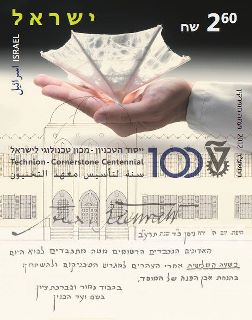
1912-2012: the Technion Centennial Stamp features
one application of the innovative nano fibers
Featured on the Technion 2012 Cornerstone Centennial Stamp, the nanofibers behind the dynamic new start-up NanoSpun signify many of the secrets of Technion’s success in conceptualizing, shaping and nurturing Israel as the high-tech global success of the third millennium.
 
Why would Cornell University and New York City invite Technion to set up a new campus on Roosevelt Island, in order to boost economic growth through innovation and entrepreneurship? Throughout the world, news headlines have cited Technion’s unique ability to produce dynamic and profitable start ups using advanced technology and skills. In 2012, one company that exemplifies the secrets of this success is the prize-winning start up NanoSpun.

Biological Computer – 1 Billion Programs Ahead

Technion Scientists Develop Biological Computer on Chip

Prof. Keinan in the lab at the Schulich Faculty of Chemistry.

Technion scientists have developed a biological computer, composed entirely of DNA molecules and enzymes constructed on a gold-coated chip. This new computer represents a significant improvement over the original computer reported three years ago in a joint paper by Prof. Ehud Keinan of the Technion and a group from the Weizmann Institute of Science, which included Yaakov Benenson, Prof. Ehud Shapiro and Prof. Zvi Livneh.

The Technion researchers succeeded in increasing the level of complexity of their computer. Whereas the original computer could accept up to 765 different programs, the new computer can accept as many as 1 billion programs. This increase represents a dramatic advance in terms of the potential mathematical operations and complexity of problems that may be solved using a biological computer. The results are published this week in the Journal of the American Chemical Society.

“Such computers could have a variety of practical applications, including encryption of information.”

“An equally significant breakthrough is the incorporation of chips as an integral part of the computer”, explains Prof. Ehud Keinan, who carried out this research together with graduate students Michal Soreni, Sivan Yogev, Elizaveta Kossoy, and Prof. Yuval Shoham, Director of the Technion’s  Lokey Center for Life Science and Engineering. “The chip allows for automatic, real-time readout of the computation results, with no need to employ elaborate techniques of molecular biology, such as gel electrophoresis and the use of radioactively labeled materials. Computation on a chip allows efficient parallel computation with many, geographically labeled input molecules. Such computers could have a variety of practical applications, including encryption of information. For example, it would be possible to encrypt images on a chip, whereby deciphering the images would be possible only by a person with access to a secret key comprised of several short DNA molecules and several enzymes.”

Prof. Keinan explains that a computer is, by definition, a machine made of four components: hardware, software, input and output. All of the currently known computers are electronic computers, namely, machines in which both input and output are electronic signals, the hardware is a complex composition of metallic and plastic components, wires, transistors, etc., and the software is a sequence of instructions given to the machine in the form of electronic signals. “In contrast to electronic computers, there are computing machines in which all four components are nothing but molecules,” says Prof. Keinan. “For example, all biological systems, and even entire living organisms, are such computers. Every one of us is a bio-molecular computer, that is, a machine in which all four components are molecules “talking” to one another in a logical manner. The hardware and software are complex biological molecules that activate one another to carry out some predetermined chemical work. The input is a molecule that undergoes specific, predetermined changes, following a specific set of rules (software) and the outcome of this chemical computation process, the output, is another well defined molecule.”

Over the past decade, bio-molecular computers have aroused much interest in the scientific community due to of their ability to carry out an enormous number of operations in parallel. A tiny drop of solution containing a large number of input molecules contains enormous computational power.

CAMILA – Rocket Engine Ingenuity

Across the Universe – Rocket Engine Innovation

It takes energy to keep a satellite positioned in space, or to move a spacecraft to it’s destination. It also takes ASRI brainpower from Technion – Israel Institute of Technology.

Testing the Camila at ASRI’s Rocket Propulsion Lab.

When the iron curtain came down, a scientific opportunity emerged. World-class scientists were among the millions of Russians that were free to find America. Empowered by cultural diversity and open to newcomers, Technion’s Asher Space Research Institute (ASRI) seized the moment and recruited Prof. Alexander Kapulkin. Today, he is the mastermind of the world’s most efficient, fast and effective rocket engine, the CAMILA.

Downstairs at ASRI, the future of earth and space science is being born. In the new Rocket Propulsion Lab, suspended within a huge stainless steel vacuum cylinder, the hand-sized electric-propulsion hall thruster CAMILLA is undergoing tests. The lab took form through the combined skills of three immigrants from the former USSR. Kapulkin, his student from the University of Dnipropetrovsk in Ukraine Maxim Rubinovitch, and mechanical designer Dr. Vladimir Balabanov, who came to Israel 20 years ago from Omsk.

CAMILA includes a revolutionary fuel-delivery design and an innovative magnetic field configuration that propels the engine faster. This innovation consumes less fuel, thus increasing engine efficiency. The impact will be less size, weight, and cost of small satellites. The new lab is set to be the only plasma process monitoring facility in Israel. CAMILA? The three scientists hope to experience her Sputnik moment within the next two years, when she will take her maiden voyage to propel her first microsatellite through space.

Patent Details: patents@tx.technion.ac.il 

Highly efficient spacecraft thruster – CAMILA
Ref. MAE-0877

Background:
Hall Thrusters (HTs) are used in spacecraft to generate thrust by emitting particles at high velocities. Their low propellant consumption per unit of force allows them to be used for much longer times than rocket thrusters, which are short-lived. HTs work by ionizing gas particles in an anode cavity. The newly created ions exit the cavity and are drawn towards the opposite end of an acceleration channel by a strong electric field. When particles exit the channel at high speed into space, net thrust is induced on the channel. But, HTs suffer from relatively high power requirements. This is mainly due to the fact that some ‘slow’ ions collide with the anode walls, and do not exit the anode cavity into the acceleration channel.
Method:
Our technology increases Hall Thruster efficiency by significantly reducing the number of ‘slow ions’. Two major modifications contribute to the effect – unique geometry and an additional magnetic field. The acceleration channel is shaped like a cylinder, which has a low surface-to-volume ratio. This way, ions have higher chances of escaping the channel without colliding with the anode surface. The second modification is the addition of a longitudinal magnetic field inside the anode. This field lowers the electrical potential on the central cylindrical surface in respect to that of the anode, practically drawing ions away from the anode. As a result, the phenomenon of ‘slow ion waste’ is nearly eliminated. The added magnetic field can be generated by permanent magnets, which do not require additional power to operate.
Advantages:
• More than 100% increase in thrust without increase in propellant consumption
• Minute design and manufacturing modifications required 
• No additional power requirements in permanent magnet implementation
Applications:
Satellite and other spacecraft propulsion
  
Technological Keywords: Plasma, ion, thruster, hall, effect, electrons, electric, magnetic, field, xenon, gas, anode, cathode, accelerator, coil, pole, impulse
Market Keywords: space, satellite, rocket


CAMILA – Rocket Engine Ingenuity

Across the Universe – Rocket Engine Innovation

It takes energy to keep a satellite positioned in space, or to move a spacecraft to it’s destination. It also takes ASRI brainpower from Technion – Israel Institute of Technology.

Testing the Camila at ASRI’s Rocket Propulsion Lab.

When the iron curtain came down, a scientific opportunity emerged. World-class scientists were among the millions of Russians that were free to find America. Empowered by cultural diversity and open to newcomers, Technion’s Asher Space Research Institute (ASRI) seized the moment and recruited Prof. Alexander Kapulkin. Today, he is the mastermind of the world’s most efficient, fast and effective rocket engine, the CAMILA.

Downstairs at ASRI, the future of earth and space science is being born. In the new Rocket Propulsion Lab, suspended within a huge stainless steel vacuum cylinder, the hand-sized electric-propulsion hall thruster CAMILLA is undergoing tests. The lab took form through the combined skills of three immigrants from the former USSR. Kapulkin, his student from the University of Dnipropetrovsk in Ukraine Maxim Rubinovitch, and mechanical designer Dr. Vladimir Balabanov, who came to Israel 20 years ago from Omsk.

CAMILA includes a revolutionary fuel-delivery design and an innovative magnetic field configuration that propels the engine faster. This innovation consumes less fuel, thus increasing engine efficiency. The impact will be less size, weight, and cost of small satellites. The new lab is set to be the only plasma process monitoring facility in Israel. CAMILA? The three scientists hope to experience her Sputnik moment within the next two years, when she will take her maiden voyage to propel her first microsatellite through space.

Patent Details: patents@tx.technion.ac.il 

Highly efficient spacecraft thruster – CAMILA
Ref. MAE-0877

Background:
Hall Thrusters (HTs) are used in spacecraft to generate thrust by emitting particles at high velocities. Their low propellant consumption per unit of force allows them to be used for much longer times than rocket thrusters, which are short-lived. HTs work by ionizing gas particles in an anode cavity. The newly created ions exit the cavity and are drawn towards the opposite end of an acceleration channel by a strong electric field. When particles exit the channel at high speed into space, net thrust is induced on the channel. But, HTs suffer from relatively high power requirements. This is mainly due to the fact that some ‘slow’ ions collide with the anode walls, and do not exit the anode cavity into the acceleration channel.
Method:
Our technology increases Hall Thruster efficiency by significantly reducing the number of ‘slow ions’. Two major modifications contribute to the effect – unique geometry and an additional magnetic field. The acceleration channel is shaped like a cylinder, which has a low surface-to-volume ratio. This way, ions have higher chances of escaping the channel without colliding with the anode surface. The second modification is the addition of a longitudinal magnetic field inside the anode. This field lowers the electrical potential on the central cylindrical surface in respect to that of the anode, practically drawing ions away from the anode. As a result, the phenomenon of ‘slow ion waste’ is nearly eliminated. The added magnetic field can be generated by permanent magnets, which do not require additional power to operate.
Advantages:
• More than 100% increase in thrust without increase in propellant consumption
• Minute design and manufacturing modifications required 
• No additional power requirements in permanent magnet implementation
Applications:
Satellite and other spacecraft propulsion
  
Technological Keywords: Plasma, ion, thruster, hall, effect, electrons, electric, magnetic, field, xenon, gas, anode, cathode, accelerator, coil, pole, impulse
Market Keywords: space, satellite, rocket


2012 New Appointments at Technion

100 Years of Technion – It starts here.

1912-2012: a musical celebration of 100 years of creativity.

Timeline of a Century

1912-2012 – Technion opens festivities of a 100 years since the first cornerstone with a festive concert of the Technion choir and orchestra, and the launching of a national centennial stamp.

Three Nobel Laureates in Chemistry – Distinguished Professors Avram Hershko, Aaron Ciechanover and Dan Shechtman – received yesterday the special stamp that was issued by Israel Postal Company to commemorate 100 Years to the laying of the cornerstone for the Technion. The stamp was launched in frame of a festive concert commemorating the Technion’s cornerstone centennial, in the presence of Technion President Prof. Peretz Lavie, Mayor of Haifa Adv. Yona Yahav, Chairman of the Board of Israel Postal Company Sasi Shilo, and Director of Philatelic Services Yaron Ratzon.
The Chairman of the Board of Israel Postal Company Sasi Shilo said that “the stamp we are launching today salutes the first academic educational institute established in Israel, and one of the most prominent institutes in its field worldwide”. He added that the Technion’s praiseworthy activity has had substantial contribution to the development of the State of Israel’s economy.
Technion President Prof. Peretz Lavie said that he is as excited on this evening as he was on December 10th, 2004 and on December 10th, 2011 in Stockholm, when the three professors received the Nobel Prize in Chemistry. He also emphasized the exciting event held in New York on December 19, 2011, when Mayor Michael Bloomberg announced that the Technion and Cornell University have won the tender to establish an applied science and engineering campus in his city.
Mayor of Haifa Adv. Yona Yahav said that his city is identified with the distinguished institute that it is honored to have had residing in it for over one hundred years now.
The Shalom Zielony Technion Choir and Orchestra, conducted by Menahem Nebenhaus and Leonti Wolf, performed an especially festive concert. Sasi Shilo and Yaron Ratzon unveiled the stamp and granted it to the Nobel laureates, to the designer of the stamp Naama Tumarkin (Director of the Israel Technion Society), and to Distinguished Prof. Danny Weihs and Prof. Eyal Zussman, whose research subject is displayed on the stamp. 

Description of the stamp and the First Day Cover
The stamp enfolds within it the past, present and future not only of the Technion, but also of the State of Israel, that has become a science and technology pioneer.
The stamp features a rendering of the building façade, designed by the Jewish-German architect Alexander Baerwald, one of the pioneers of modern Israeli architecture.
Out of the building grows an element developed in the Technion by three scientists: Distinguished Prof. Daniel Weihs, Prof. Alexander Yarin and Prof. Eyal Zussman. It is the prototype of a nano-parachute, whose structure and movement are based on the structure of the dandelion seed and its movement in the air. The nano-parachute is made of nano-fibers, and is in fact a sophisticated detector of airborne toxins. Thousands of nano-parachutes that are dispersed at a site suspected of being contaminated change their color in the presence of toxins, thus allowing to determine the type of toxins and to prevent or mitigate loss of life. The scientific patents behind the image have recently been applied in a prize winning start up NanoSpun at the Gutwirth Science Park in Technion City.
In recent years, the Technion has engaged in nano-technology research in a number of areas: nano-electronics, nano-optics, nano-materials, and their interface with life sciences. This field brings about collaborations between scientists in a variety of disciplines and from different faculties. The element displayed in the stamp is an excellent example of this.
The stamp tab features the invitation to “the cornerstone laying ceremony, on Thursday, 24 Nissan 5672 (April 11, 1912), at 3 pm at the Technikum plot”.
The First Day Cover shows a photo of the Technion building after its completion, along with a rendering of the building. Above them float icosahedrons, bodies taken from the research of Prof. Dan Shechtman of the Technion, the Nobel Laureate in Chemistry in 2011 for his discovery of quasiperiodic crystals.  
The photo seen in the stamp is that of a nano-parachute on the palm of a hand – courtesy of Miki Koren.
The stamp was designed by Naama Tumarkin, Director of the Israel Technion Society.
Denomination: NIS 2.60.
The unveiling of the Technion Centennial National Postal Stamp.
(L-R) Nobel Laureate 2011 Dan Shechtman, Nobel Laureate 2004 Avram Hershko,
Nobel Laureate 2004 Aaron Ciechanover, Technion President Peretz Lavie.

Who’s Who at Technion: Prof. Raphael Semiat

Meet Prof. Raphael Semiat, global water pioneer and new Dean of the Wolfson Faculty of Chemical Engineering. 

Prof. Semiat’s pioneering water research has covered the following areas:

Image Detail
Prof. Raphael Semiat, new Dean of the Wolfson Faculty of Cheimcal Engineering.
  • Water Technology
  • Desalination using evaporation and membrane processes. Problems of membranes fouling, pre and post treatment. Uses of membranes for water quality problems and waste treatment. Enhanced recovery with concentrate treatment.
  • Separation Processes
  • Membrane processes. Crystallization. Nano crystallization. Use of nano crystals for removal of organic matter from water. Modeling of liquid-liquid settlers. Improvement of extraction columns. Mechanisms of heat transfer enhancement.
  • Optical measurements techniques
  • Use of Laser Doppler Velocimetry for two phase-flow. Development of Laser Grating Velocimetry technique for relatively large particles. Study of drops motion in printing heads. Shear induced migration in concentrated slurries.
  • Industrial Project
  • Desalination. Concentrate treatment. Water treatments. Double falling film evaporator for solution concentration. Crystallization of aluminum chloride.

Who’s Who at Technion: Prof. Noah Galil

 “Technion is now ahead of the game in terms of reuse. Ours is not just the green approach but one that also addresses the demands of industry.” Meet Prof. Noah Galil: new Dean at the Faculty of Civil and Environmental Engineering.

Image Detail
Prof. Noah Galil, Dean at the 
Faculty of Civil and Environmental Engineering
Sometimes coined “Noah’s Ark”, Prof. Galil’s vision of a sustainable future for Israel and the planet has influenced the development of history.

  • Galil’s long research history includes: Industrial wastewater, treatment and reuse.
  • Biomass characteristics and process Mechanisms in biological treatment.
  • Fate of contaminants in soil subsurfaces.
  • Sludge characterization, treatment, reuse and/or disposal.
  • Cost modeling for wastewater treatment Technologies and process combinations.
  • Energy balances in wastewater treatment.

Who’s Who at Technion: Prof. Noah Galil

 “Technion is now ahead of the game in terms of reuse. Ours is not just the green approach but one that also addresses the demands of industry.” Meet Prof. Noah Galil: new Dean at the Faculty of Civil and Environmental Engineering.

Image Detail
Prof. Noah Galil, Dean at the 
Faculty of Civil and Environmental Engineering
Sometimes coined “Noah’s Ark”, Prof. Galil’s vision of a sustainable future for Israel and the planet has influenced the development of history.

  • Galil’s long research history includes: Industrial wastewater, treatment and reuse.
  • Biomass characteristics and process Mechanisms in biological treatment.
  • Fate of contaminants in soil subsurfaces.
  • Sludge characterization, treatment, reuse and/or disposal.
  • Cost modeling for wastewater treatment Technologies and process combinations.
  • Energy balances in wastewater treatment.