Category Archives: News

Technion Life Science in Action

Prof. Venkatraman Ramakrishnan, Nobel Laureate 2009 (Chemistry), Cambridge University, UK. delivered this years lecture at Technion. Entitled: The Structural Basis of Decoding by the Ribosome.
Held as part of The Lokey Center Distinguished Lecture Series, opening Remarks from Technion Nobel Laureate 2004 (Chemistry), Distinguished Prof. Aaron Ciechanover, who spoke of the lowering barriers between basic sciences.
The Nobel Laureates planted a tree to celebrate the occasion, in accordance with the tradition of Prof. Albert Einstein, founder of the 1st Technion Society.


Prof. Venkatraman Ramakrishnan, Prof. Aaron Ciechanover. Prof. Yuval Shoham.

Technion guest Nobel Laureate Venkatramen Ramakrishnan joins a list of Nobel Laureates who planted trees to celebrate their visit to Technion. The tradition was begun by Prof. Albert Einstein – Chairman of the first Technion Society, who planted two palm trees in 1921 in front of the Technion’s majestic first building in Hadar, Haifa.

1921: Albert Einstein initiates the Technion Nobel tradition.


Click here to ZOOM2Click here to ZOOM3Click here to ZOOM4Click here to ZOOM5Click here to ZOOM7Click here to ZOOM4


Nobel Laureate Trees planted at Lokey Park and on Technion soil.

  • Prof. Venkatraman Ramakrishnan, UK; Nobel Laureate in Chemistry, 2009
  • Professor Ada Yonath, Israel; Nobel Laureate in Chemistry, 2009
  • Professor Linda B. Buck, USA; Nobel Laureate in Physiology/Medicine 2004
  • Prof. Avram Hershko, Israel; Nobel Laureate in Chemistry 2004
  • Prof. Aaron Ciechanover, Israel; Nobel Laureate in Chemistry 2004
  • Prof. Tim Hunt. U.K; Nobel Laureate in Medicine, 2001
  • Prof. Kurt Wüthrich, Switzerland; Nobel Laureate in Chemistry, 2002
  • Prof. Günter Blobel, USA; Nobel Laureate in Medicine, 1999
  • Prof. Ferid Murad, USA; Nobel Laureate in Medicine, 1998
  • Prof. Jean-Marie Lehn, France; Nobel Laureate in Chemistry, 1987
  • Prof. David Gross, USA; Nobel Laureate in Physics, 2004
  • Prof. Elie Wiesel, USA; Nobel Laureate in Peace, 1986
  • Rita Levi-Montalcini, Italy; Nobel Prize in Physiology or Medicine, 1986
  • Albert Einstein, Germany/USA at old site; Nobel Prize in Physics, 1921

Prof. Venkatramen Ramakrishnan talks here of his Nobel Prize:


Lokey Life Science in Action


“The Illumina HiSeq 2000 is the first of its kind to be installed in Israel and it will enable Technion researchers to perform human genotyping for personalized medicine.”

A report from director of the Larry I. Lokey Interdisciplinary Center for Life Science and Engineering, Prof. Yuval Shoham.


This month, the first researchers will be moving into their new laboratories in the Emerson Family Life Sciences Building.  This will include the infrastructure units.  The move was somewhat delayed because of the very special specifications of each lab.


Inside the Emerson Family Life Science Building at Technion

We recently obtained the most advanced DNA sequencing instrument called the Illumina HiSeq 2000.  As you are probably aware, DNA sequencing technology was revolutionized in the last five years, bringing down time and cost by several orders of magnitude.   For the first time, this revolutionary technology allows scientists to decipher entire human, animal and plant genomes in just a few days, a feat that had required years and billions of dollars beforehand. The Illumina HiSeq 2000 is the first of its kind to be installed in Israel and it will enable Technion researchers to perform human genotyping for personalized medicine.  If nanomedicine is to solve complex human diseases, it must first seek to understand them at the molecular level. Sequencing has become invaluable in understanding diseases by identifying the genetic variation between diseased and normal states. Identifying the causal genes and variants would represent a significant step towards improved diagnosis, prevention and treatment of disease.

The HiSeq 2000 – decoding genes in days. 

Google Sponsors Technion Research

“The Technion views this collaboration as a highly important component in its efforts to establish a fruitful academia-industry cooperation in information technologies, an area in which the Technion is highly ranked internationally.”


Google

The multinational internet giant Google announced this month that it would be sponsoring some 20 research projects in Israel’s Universities to address the opportunities of the Internet economy, with a particular focus on the fundamentals of online auctions.

For example, unlike in TV advertising, where the advertiser buys a fixed number of commercials, online systems like Google’s AdWords use a computerized auction where advertisers determine how much they are willing to pay and other relevance signals then contribute to an algorithm determining the online selection and rank of a particular ad. These auction systems involve complex computation, and result with overall more relevant and effective ads.

To date, these auctions have been developed mainly by the Internet industry. Academic research in such disciplines, as algorithmic game theory and algorithmic mechanism design, could greatly benefit from insights learned from the practice of the new industry, and may be able to provide future insights to improve online advertising auctions and create more opportunity for advertisers, users, and the online economy at large.

Google will support a cluster of research projects which will explore the basic questions which lie at the heart of this new economy. Such questions include the economic effects of viral networking, the dynamics of electronic markets, and new formats of selling advertisements, which could be beneficial to the user and the advertisers.

The research projects will be conducted by experts in many fields, ranging from computer science, statistics and game theory, through artificial intelligence and optimization to economy and social sciences. This interdisciplinary and large scale approach is necessary to tackle these challenges. 

Prof. Shie Mannor

At the Technion, the projects will be led by Prof. Seffi Naor from the faculty of Computer Science; Dr Ron Lavi from the faculty of Industrial Engineering; and Professors Shie Mannor and Ariel Orda from the faculty of Electrical Engineering.

Prof. Ariel Orda
Dr. Ran Levi
Prof. Seffi Naor
Prof. Yossi Matias, Managing Director, Israel R&D Center, Google, said: “The field of Electronic Aucions and Markets has grown tremendously over the past decade, and has become a significant factor in the Internet industry and economy. Google is proud to support open academic research which will advance the fundamental research in this evolving discipline. Israel boasts unusual academic excellence in the inter-disciplinary foundations of electronic auctions and markets. I am personally delighted at this unique opportunity to strengthen the collaboration between Google and Israeli academia.”

Prof. Oded Shmueli, Executive Vice President for Research at the Technion, said: “The Technion views this collaboration as a highly important component in its efforts to establish a fruitful academia-industry cooperation in information technologies, an area in which the Technion is highly ranked internationally.”

About T3 &  the TRDF – Technion Research and Development Foundation Ltd. – Business Unit

T3 is the commercial arm of the Technion – Israel Institute of Technology. T3, operating within TRDF, initiates and promotes the transfer of research findings and innovative technologies developed by Technion scientists to the global marketplace. T3 has vast expertise in IP protection and licensing inventions and forming win-win business agreements in a wide variety of fields, including Nanotechnology, Biology, Medical Devices, Cleantech, Computer science and IT, Pharmaceuticals, Homeland Security etc. T3`s responsibilities include : Analysis of new inventions and concepts; Protecting and maintenance of IP; IP licensing; Negotiation the IP and business aspects of agreements with industry; Incorporation of spin-off companies based on Technion IP; and Participation in the board of directors of Technion affiliated companies.


Is Smart being Greedy? Read more about how Technion is shaping the Internet of tomorrow.


Technion, Europe & Greenhouse Gases

Returning greenhouse gases to the ground
Technion is part of the “MUSTANG” research project, funded by the EU and overseen by Upsala University of Sweden. The project includes a field trial of carbon dioxide injection into abandoned oil wells at Heletz
By Avi Belizovsky
Everyone senses global warming, which is a result of the increase in the concentration of greenhouse gases, at the top of which is carbon dioxide, methane and other gases. In many places in the world, following international agreements such as the Kyoto Protocol from about a decade ago, governments are limiting and setting caps on carbon dioxide emissions.
In general, the limiting system works like this: Any company that wishes to increase in any way whatsoever the amount of carbon it release to the atmosphere is required to pay a fine. These fines are earmarked for bodies developing clean energy. On the other hand, companies that produce petroleum or burn it to produce electricity can offset these taxes if they reduce their carbon emissions in other ways.
One way that companies such as the Norwegian company Statoil has been doing this for 16 years is by capturing carbon dioxide in the chimney, before it is emitted into the atmosphere, cooling it, turning it into a liquid and finally – injecting it back through wells into a depleted oil or gas reservoirs, so that the harmful gas can remain there forever and not contribute to global warming.
Nevertheless, the question arises as to who guarantees that the gas will not leak back into the atmosphere and consequently, nothing will have been gained. To answer this, a scientific and technological study by geologists who specialize in underground reservoirs and hydraulics (in our case, we are actually talking about liquid gas and not water, but some features are the same) was required. “MUSTANG” is an integrative project that began June 1, 2009 and is planned to run for four years with funding by the Seventh Framework Program of the European Commission (FP7).
“We expect to see how the carbon dioxide gas behaves in Israel’s geology.”
The “MUSTANG” consortium comprises 19 institutions among which are universities, research institutes and large companies from Sweden, England, Scotland, Spain, Romania, Germany, and Israel. The Israeli partners are the Technion, the Geophysics Institutes, Lapidot Ltd., and EWRE Ltd. The strategic objectives of the consortium are to develop guidelines, methods and tools to characterize deep brine-containing aquifers in which to store carbon dioxide for  long periods of time. This new knowhow is to be based on firm scientific knowledge about the critical processes involved in such opertations.
The project aims to improve and develop design, monitoring and verification technologies so that they especially suit the sequestration of CO2 below ground, in order to reliably verify the physical and chemical properties of such sites, and facilitate short reaction times in revealing and monitoring CO2 plumes in subterranean reservoirs that were previously contained petroleum and gas or in reservoirs containing saline water. The research includes development of technologies that enable identification of leaks, should there be any, during the process of CO2injection and sequestration in the underground reservoir.
The second aim is to improve understanding of the relevant processes of CO2sequestration using theoretical research, lab experiments, research in nature and research using field trials such as the example of the gas injection to be done at Heletz. This project is being conducted in parallel to a similar project at Ketzin near Berlin.
Prof. Jacob Bear of the Faculty of Civil and Environmental Engineering at the Technion is the head of the research team charged with developing models that will facilitate design of the project for injecting the CO2 into deep geological saline layers. “These models will enable the design of injection projects under different condition, prediction of the dispersion of the CO2 in geological layers, geochemical processes and also the possibility that the gas will leak back up to above ground. This information is necessary for risk assessment, if any, and for decision making bodies. Also in Israel there is a need to get rid of the CO2 emissions from power stations and cement factories, which are the big producers of CO2. It is important that the knowledge created by this research, funded by the European Community, also interests bodies in Israel such as the Ministry of Environmental Protection, the Ministry of National Infrastructures, the Electric Company and others. In Europe and the U.S., there is a large volume of activities on the subject – research and applied. This is a huge industry that is going to grow and Israel must be a part of it.”
Sandip Sharma, a petroleum reservoir engineer, is the director of the CO2injection project in Hawaii as part of the CO2CRC organization (Australia): “The trial in Australia was a breakthrough in that through it we were able to understand legislative issues. It turned out that there were overlaps and contradictions between two laws and we needed to draw up new legislation focused on CO2 injection. In addition, in executing the actual project we had to negotiate with community members worried about, for example, leaks. Our project was in an agricultural area that produces milk and there was concern that a CO2 leak from the mine might in some way damage the milk or cheese being produced there. However, cooperation with the community is important because it is difficult to get anything without support.
“We also learned about technical problems and what happens to a gas plume that spreads through the reservoir. Because this field is still in its infancy, it is important to develop theoretical models and carry out measurements in real time in order to verify and calibrate them. Models are meant to provide a way for us to predict what will happen in another 100 and 200 years, and therefore, it is important that there be consistency between the monitoring results and the model – something that will provide assurance that the model accurately predicts the future.”
The company that is actually doing this in a number of petroleum and/or natural gas wells is Statoil of Norway. Tor Anders Thorpe is a senior engineer and has been in charge of CO2injection activities for about 16 years in the company’s well in the North Sea. He speaks of his experiences: “The more we operate the project, the more it approximates the normal operation of a petroleum and gas reservoir. Underground is always different than what you expect, but with our experience and the different ways, it can always be done safely. You must remember that we are injecting CO2beneath the surface and it is different than natural gas; however, it has many features that are similar to natural gas or water, for example, when it becomes a plume dispersing underground. In effect, we are talking about the same physical laws that operate when pumping petroleum but just in the opposite direction.
“We already have three sites to compare with each other – Sleipner, in the heart of the North Sea near the water border between Norway and Britain, In Salah, in the heart of the Sahara Desert in Algeria (together with BP and the Algerian oil company Sunatark), and in Snohvit, on the border with the Barnets Sea on the northwest shore of Norway. Whereas in Sleipner the petroleum well is shallow – just 800 m below the sea’s bottom and it has a swift current, in In Salah we are talking about a dry well, at a depth of 2,100 m, and because of this depth and the fact that the ground rose up from a deeper area because there was once a mountain here, the flow is very slow, and in Snohvit, at a depth of 2,600 m, of which 350 m is below the sea bottom, we can learn about three different geologic environments.
“We inject gas that is mostly (96%-98%) carbon dioxide, while the rest is methane. The gas is generated from natural gas that we pump and sell. Since this is a commercial well, we conduct the research alongside the commercial operations, something that is not always possible given that the production has first priority
“We have always been helped by international research partners, even before the MUSTANG project, for two reasons: first, it brings together experts from different backgrounds and when several experts from different disciplines are involved in solving the same problem, the chances are that the reliability of the results will increase. The second reason is to improve our reliability, and as is well known, the credibility of petroleum and gas companies when talking about environmental subjects is not of the best, and therefore, it is preferable to rely on outside experts and reach a consensus about the scientific interpretation of findings.
“The technology may be similar but the geology varies from place to place and consequently it is important for us to learn about more and more environments and this is the reason we joined this research in Ketzin in Germany and we are partners in the research in Heltz and expect to see how the carbon dioxide gas behaves in Israel’s geology.”
The 2010 Horton Medal, a prize awarded by the American Geophysical Union (AGU), was awarded to Prof. Jacob Bear of the Faculty of Civil and Environmental Engineering at the Technion, at a recent ceremony held in San Francisco, California. Prof. Bear was given the prestigious award for his achievements in the field of hydrology.
Prof. Bear was surprised by a cake and good wishes for his award during the opening event of the meeting of researchers participating in the MUSTANG project. The medal is awarded by the American Geophysical Union to one person at most per year for their extraordinary contribution to hydrology.

Technion Students & A Better Place

In December 2010, Technion International School of Engineering students made a visit to the Better Place Visitor’s Center in Israel to test drive the electric car and learn more about this exciting global venture. Technion alumnus Shai Agassi is the founder and chief executive of Better Place, the leading electric vehicle services provider. Agassi is focused on one of this century’s biggest challenges, moving the world from oil-based to sustainable transportation. Better Place is building the infrastructure and intelligent network to deliver a range of services to drivers, enable widespread adoption of electric vehicles, and optimize energy use.


You can watch Technion graduate Shai Agassi – founder of Better Place – talking at Technion’s 2010 Board of Governors in the inspiring video below. Enjoy!


Marseilles to Technion.

Mayor of Marseilles Jean Claude Gaudin with Technion’s Gurwin TechSat (a student designed and launched satellite)


Jean Claude Gaudin, Mayor of Marseilles (3rd largest city in France) visited the Technion on March 14, accompanied by a delegation of 80 senior representatives from the municipal/regional councils, Chamber of Commerce France-Israel, industry,  and academia. The large delegation was escorted through Technion by the Mayor of Haifa.


Technion’s Nobel Laureates in Chemistry – Collect the Stamp!

Israel Post – International Year of Chemistry 2011

Technion Prof. Ehud Keinan, President of the Israel Chemical Society, had the vision to celebrate the international year of chemistry in a manner suited to the world-class position of Israel’s three Nobel Laureates in science. With determination and application, he engineered the release of official stamps celebrating the Year of Chemistry, and Israel’s Nobel Laureates.
Ubiquitin
Why our proteins must die so that we may live
Proteins are the machines that drive our bodies. They are responsible for all our activities, from the beating of our hearts, to walking, seeing, hearing, digestion, respiration and even the secretion of waste materials. Unlike useful items that surround us, like furniture and clothing, our bodies’ proteins are dynamic. They are constantly being destroyed and rebuilt, again and again. Our bodies destroy on a daily basis up to 10% of our proteins and generate new ones instead. This phenomenon raises interesting questions: why does this process occur at all, and how does it occur? Which diseases would happen if this mechanism was to fail? How can we cure such diseases? As part of the body’s quality control mechanism, proteins are destroyed after fulfilling their specific function in case they have been damaged by heat, by pollutants, by genetic mutation, or simply because they are no longer needed. Professors Aaron Ciechanover and Avram Hershko of the Technion – Israel Institute of Technology, and Irwin Rose of the University of California, Irvine, USA, were jointly awarded the 2004 Nobel Prize in Chemistry for discovering the mechanism that removes damaged or unnecessary proteins. These proteins are labeled for destruction by another small protein called ubiquitin, whose general structure is shown on the stamp. The structure was adopted from W. J. Cook and his coworkers, the Journal of Molecular Biology, 1987. Once tagged by this “kiss of death” the labeled proteins are removed by a biological shredding machine called the proteasome, while sparing healthy, untagged proteins. Aberrations in this protein destruction process may result in numerous sicknesses, including certain types of cancers and brain diseases. Many pharmaceutical companies are working to develop drugs to combat such diseases. One such drug to treat multiple myeloma, which is a form of blood cancer, is already used clinically.
Ribosome
Ribosome translates DNA code into life
Ribosome is the biological machine in every living cell that makes proteins from amino acids. Genetic information, which is stored in our DNA, is copied into RNA, which is then read by the ribosome and used to create proteins. This process is known as translation, meaning that the ribosome translates the genetic information from RNA into proteins, which in turn control the structure and function of all living organisms. The ribosome is a huge machine, consisting of three RNA chains and more than 50 different proteins. Understanding the ribosomal structure and its operating mechanism is critical for the scientific understanding of all kinds of life. In particular, this insight into the life of pathogenic bacteria opened the door to the use of ribosomes as an important target for new antibiotics. Many of today’s antibiotics cure various diseases by blocking the function of bacterial ribosomes. The 2009 Nobel Prize in Chemistry was awarded jointly to professors Ada E. Yonath of the Weizmann Institute of Science, Venkatraman Ramakrishnan of the Medical Research Council, Cambridge, UK, and Thomas A. Steitz of Yale University, USA. They showed what the ribosome looks like and how it functions at the atomic level. All three used a method called X-ray crystallography to map the position for each and every one of the hundreds of thousands of atoms that make up the ribosome. The image on the stamp, which is adopted from a paper published by Ada Yonath and her coworkers in 2001 in Nature magazine, shows a view into the tunnel of the large ribosomal subunit from which the newly constructed chain of amino acids exits. This huge structure shows the ribosomal proteins (shown in orange), the ribosomal RNA (blue and pink) together with the antibiotic erythromycin (red).
Ehud Keinan
Professor of Chemistry
Technion – Israel Institute of Technology,
President of the Israel Chemical Society,
Editor in Chief, Israel Journal of Chemistry,
Chairman of the Chemistry Committee,
Ministry of Education
 
Dr. Joerg Harms of the University of Hamburg is
acknowledged for the ribosome graphics.
Technical Details:
Issue: January 2011
Design: Haimi Kivkovitch
Stamp Size: 30 mm x 40 mm
Plate nos: 823 (two phosphor bars)
824 (two phosphor bars)
Sheet of 15 stamps, Tabs: 5
Printers: Joh. Enschede, The Netherlands
Method of printing: Offset

F.I.R.S.T. Robotics Competition ~ Technion


FIRST 2011 competition

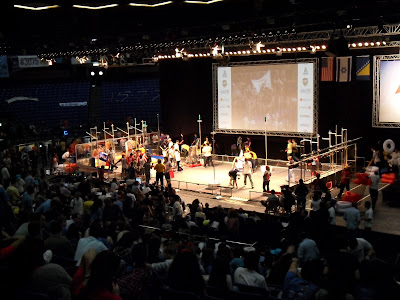
The Nokia Arena, Tel aviv, 15-16th March 2011: 48 groups of students from Israel, a group from California and a group from Bosnia and Herzegovina participated in the finals of the seventh season of FIRST competitions – titled Logo Motion.

The FIRST competition has been active in Israel since 2005, integrating about 3000 children and youth from across the country. This unique competition combines the excitement from the world of sports with the challenge for science and technology. The competition challenges participants to demonstrate excellence in design, team spirit, professionalism, maturity and problem-solving.

Technion has been involved with the competitions since they began in Israel ~ transferring funds through Technion Societies and the National Center for Robotics Center at the Faculty of Mechanical Engineering.

Beyond inspiring and motivating generations of future scientists and engineers,  FIRST creates interaction and dialog between participants from all walks of Israeli life.


To read about the kind of things these kids get up to when they’re older, check Israel21C’s Surgery? Border patrol? Israeli robots can do that.


Graduate students, partners, children, come home to Technion.

Moving into the Zielony Graduate Student village at Technion City.

“In order to remain vibrant and productive, we aim to increase the number of first-rate graduate students that are so critical to 
our future.” 


Technion President Prof. Peretz Lavie.


The Zielony Graduate Student Village – opening its doors to Technion’s graduate students and their families.


Graduate families are now moving in to the Zielony Graduate Student Village at Technion City. The village is on a sloping, tree-covered hillside, and covers an area of approximately four acres. All of the 216 the apartments are connected to the high-speed, campus-wide computer network, which is connected to the Internet. 

“The Technion has made great strides over the past few years in recruiting more top graduate students worldwide,” said Prof. Moshe Shpitalni, Dean of Graduate Studies. “Graduate students currently constitute one-third of the Technion’s student body. The long-term goal of the university is to raise that proportion to one-half.” 


 Being Part of a Community


The close-knit nature of the Graduate Student Village encourages graduate student families to foster close friendships. The families can get to know one another, help each other out, (especially with the kids!).
This concentration of graduate students in similar circumstances with similar concerns and responsibilities creates a supportive social framework where each person or family can contribute to the welfare of the community. 


Benefits of the Graduate Student Village

  • Safe and supportive environment
  • Affordable rent
  • Free utilities
  • Fully-furnished apartments (furniture and electrical appliances)
  • Connections to campus-wide computer network in each apartment
  • Easy and convenient access to diverse campus facilities: central and departmental libraries, computer centers, sports facilities (gym, swimming pool, fitness room, tennis courts), mini-markets
  • On-campus day care facilities
  • Quiet, peaceful environment

The Community Center of Tomorrow

The coming addition to the village – The Community Center – will support and enhance community life. Professional childcare will be provided in four kindergarten classrooms for different ages of children (aged 0 to 1-1/2 years, 1-1/2 to 2 years, 2-3 years, 3-4 years), enabling parents to immerse themselves in work, confident that their children are well looked after. A multipurpose room on the lower level will serve as a possible fifth kindergarten classroom as well as provide venues for a variety of other activities.


Post-doctoral Scholarship in Space Research


The Asher Space Research Institute (ASRI) at Technion invites candidates to apply for the Ilan Ramon Scholarship: 

~Research in Earth observations from space to the development of methods and devices of electronic and electro-optic micro with potential application in space~

Scholarship conditions, required documents and forms can be found at Israel’s Ministry of Science.

Please note that candidates can not be graduates of the Technion.

Deadline for applications: 15/5/11.

For further questions please contact Ayelet Raz – Catalan, coordinator of academic guests: Phone: 972 4 829 2560

Technion Graduate from Japan Talks of “Nightmare”

Technion graduate of Physics Shumon Mori spent five “wonderful” years at Technion before returning to Japan. “I was 18 when I decided to study at Technion,” says Mori. “I learned about Technion for the first time over Internet and I noticed that Technion is one of the best institutes of technology in the world. Of course, I had fears of leaving my home country but my strong will to living in Israel enabled me to overcome these fears.”

In the aftermath of the terrible earthquake, tsunami and nuclear crisis unfolding in Japan this month, Technion reached out to find out how Mori, one of many graduates from Japan is doing.

“Thanks for your care,” said Mori, “Your consideration from Technion keeps us strong. Myself, my family and colleagues are fine. But the damage to the North of Japan is like a nightmare. It is unbelievable. We, and all Japanese are trying to be strong to overcome this crisis.”

“In Japan, nature has shown us how truly powerful it is, unfortunately, with devastating effects,” said Technion President Prof. Peretz Lavie, at the Technion’s Harvey Prize Ceremony. “I send my sincere hopes that recovery will come swiftly and as painlessly as possible.”

“When I studied at Technion, everyone asked me “Shumon, B’seder? Tzarich Ezra? (Are you O.K? Do you need help?) They constantly encouraged me. Without this kind of help, I wouldn’t have succeeded in graduating from Technion. I know that the Israeli people want to help somebody who is having difficulty.


A poem from Dr. Ada Aharoni, a retired Senior Lecturer from the Technion, and the Founder – President of IFLAC.

CHERRY BLOSSOMS WILL BLOOM AGAIN IN JAPAN

By Ada Aharoni (20 March 2010)

My dear Japanese friends
Cherry Blossoms will soon
Bloom again
In Japan
After the cruel horrific earthquake
Followed by the overwhelmingly
Savage tsunami
Pouncing on you with its deathly claws
In the midst of your lives –
Now comes the nightmare of
Creeping radiation
And horrendous deathly plutonium leaks
May it indeed only be a passing nightmare –
May the ultimate radiation red-light danger
Only be a fleeting dark nightmare –
May you wake up my friends to a bright
And healthy new day
Full of energy to rebuild
Your beautiful world again
Poor wounded Japan
I want to bandage your wounds
With Cherry Blossoms.