Landmark behind Time
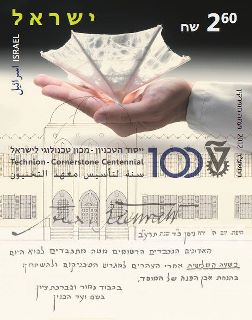
The Technion’s historic building was designed by the renowned Jewish German architect, Alexander Baerwald. His design includes both oriental and European motives. It is built from sandstone quarried in Tantura and Atlit. The building was part of Baerwald’s plan of an open corridor leading directly to the bay. He also designed buildings that would line the road, of which some were built, indeed (e.g. the Hebrew Reali School).
The building’s cornerstone was laid in 1912. The building’s construction was delayed during the First World War. The partially completed building was used, then, as a military hospital. In 1925 it became the home of Israel’s first institute of higher education – The Technion, Israel Institute of Technology. Until 1953, all the Technion Faculties were located there. By 1965, most of them have moved to the Technion new campus in Haifa’s Nave Shaanan. The Faculty of Architecture and Town Planning stayed in the historic Technion building until 1985.
Timeline of the Century
2012: Technion partners with Cornell University to found the Technion Cornell Institute of Innovation (TCII), an international ‘School of Genius’ in the heart of New York City.
2011: Technion Prof. Dan Shechtman receives the Nobel Prize in Chemistry for his discovery of quasicrystals.
2007: Technion pools its brainpower in a unique multidisciplinary center for research into energy science, technology and engineering: The Grand Technion Energy Program.
2006: Technion is Israel’s 1st university to receive the Nobel Prize for Science. Prof. Aaron Ciechanover and Prof. Avram Hershko jointly receive the Nobel Prize in Chemistry for their discovery, together with Irwin Rose, of the ubiquitin system within living cells.
2005: Technion opens the Russell Berrie Nanotechnology Institute (RBNI) to further empower and concentrate the plethora of excellent scientists, researchers and students pioneering science in the nano dimension.
2001: Technion scientists reveal they have long been quietly researching solutions to meet the threat of 3rd millennium terrorism as revealed by the horrific events in the US of September 11th
1998: Combining microbiology and microelectronics, scientists show how to make a transistor 1/100,000th the size of a human hair
1993: Technion students design and launch their own satellite: Gurwin Tech Sat. The satellite is still in orbit.
1991: Gulf War – Technion shows that the integration of expertise of Israel’s top institute of technology with its dynamic medical school makes Technion first responders in responding to missile attack on the home-front.
1989: Optoelectronics: A new center of excellence pioneering the technological promise of an expert understanding of light.
1982: The Rappaport Family Institute for Research in the Medical Sciences is established. During more than two decades of activity, the Institute has established itself as an internationally recognized research center and counts among its members several world-renowned scientists.
1981: Fiberoptics is pioneered by Technion
1978: Camp David accords with Egypt: the scientific challenges of peace and nation-planning means that in addition to its many projects in water management and environmental engineering, the Technion sets up the Samuel Neaman Institute.
1973: Yom Kippur War
1971: The Faculty of Biology is set up.
1969: The faculty of medicine is born. The first class consists of 43 students who had their preclinical education abroad. They were admitted to the fourth year and finished the requirements for the degree of Medical Doctor (M.D.), after two years of clinical training in the hospitals. The same year also sees the birth of the Department of Biomedical Engineering and the Faculty of Computer Science.
1967: Six-Day War, Faculty of Materials Engineering is set up.
1966: Agricultural engineering degrees awarded to students from Africa and Asia
1965: Department of Education in Technology and Science
1962: Faculty of Food Engineering and Biotechnology
1961: Technion offers a flourishing graduate school and R&D foundation
1960: The Faculty of Mathematics and the Faculty of Physics are formed.
1958: The opening of the Faculty of Chemistry, the Faculty of Industrial Engineering and Management, and The Department of Humanities and Arts
1956: Students take part in the Sinai War
1954: Technion founding father Prof. Albert Einstein is awarded a Technion honorary doctorate. The Faculty of Chemical Engineering is opened.
1953:The Department of Aeronautical Engineering and the Faculty of Agricultural Engineering are set up in the new campus.
1952: Rapid growth and expansion and increasing demand for Technion graduates and engineers nation-wide means the Technion leaves its first home in the historic building in down-town Haifa. Prime-Minister David Ben Gurion selects the new site for Technion City further up the slopes of Mount Carmel.
1948: With 680 students, Technion celebrates the declaration of independence. Studies are disrupted for most of the year as faculty and students fight for independence. The Faculty of Electrical Engineering and the Faculty of Mechanical Engineering are opened.
1944: Survival tasks – Technion develops early warning systems against air attacks as well as weapons for the Hagannah, the Israeli underground army that are preparing for the War of Independence.
1943: 1000 skilled Technion graduates join the war effort against Nazi Germany
1938: The Faculties of civil engineering, architecture, industrial engineering and opened, together with 11 new labs and a nautical school
1935: The Polish government recognizes Technion
1934: The Faculty of Industrial Technology is established covering broad fields.
1931: Technion staff vote to work for nothing to ensure their institute survives.
1928: First class of 17 Technion engineers and architects graduates
1926: Zeev Jabotinsky addresses Technion Haganah members
1924: Technion officially enrolls 1st class of engineering students
1923: Einstein’s first visit in which he becomes president of the first Technion society, the German Technion Society
In 1923, Albert Einstein visited the empty building of the Technikum, where there was a plan to give courses for word workers, electricians and telephone and telegraph workers. Although the derelict buildings were being used as a hostel for immigrants from Europe, Albert Einstein did not think the dream of founding a technical university in the Middle East to be fantasy. As a great scientist, Einstein knew that what makes the impossible possible is the courage to follow an inspiration.
1920: The building is legally acquired and recruitment for staff begins
1914: 1918 German, Turkish and then British troops occupy the building
1913: A battle continues over the language of Technion instruction: German or revitalized Hebrew? Hebrew wins.
1912: The cornerstone is laid for Technion’s building
1908: Wissotzky, Schiff and the Jewish National Fund invest in the new “Technikum”
1903: Hebrew teachers association of Palestine calls for a polytechnic university
1902: Herzl publishes the novel Altneuland (The Old New Land), which takes place in Palestine, creating the vision for a Jewish state and Zionism.
1901: 5th Zionist congress calls for a Jewish technological university, as a first necessary step to realize the dream of a Jewish state.
We began with a thought…
“Our technical inventors, who are the true benefactors of humanity… will discover things as marvelous as those we have already seen, or indeed more wonderful than these…”
Theordor Herzl, 1896, The Jewish State
In 1902, Theodor Herzl envisioned Haifa as “a great park….with an overhead electrical train…. a city of magnificent homes and public institutions all made possible by applied science, engineering and technology.” (Altneuland)
At that time, even an automobile was an exceptional extravagance of engineering. Electricity was still an expensive luxury for the elite few.
Haifa was a small, remote, coastal town most easily accessed by boat.
The advance of science and technology; the creation of the State of Israel; the emergence of the global village connected by the information superhighway; discoveries in basic science that have fundamentally changed the way scientists think about the material world, and the tremendous applied advances taking place in every corner of Technion City are just some of the miracles witnessed in the past century.
It all began with an inspirational thought in the mind of one man, Binyamin Ze’ev Herzl. Prof. Albert Einstein later added his mind to the vision. Thousands of great thinkers have since added to the blaze of light which is Technion, creating an institute of technology that in the 3rd millennium is truly a light to the nations.

 PRESIDENT’S REPORT 2015